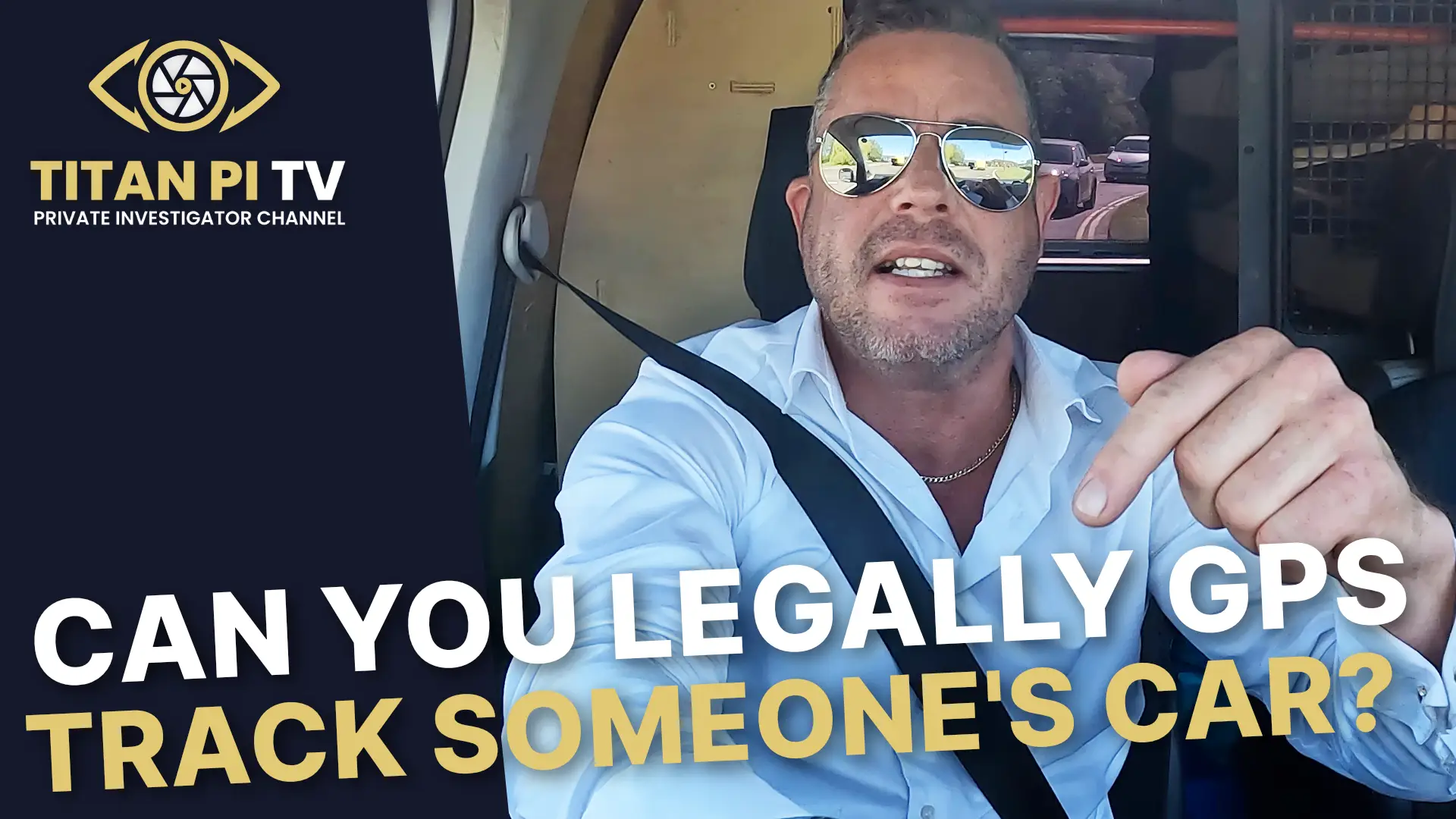
Can You Legally GPS Track Someone’s Car? Titan Investigations Reveals All
Is It Legal to Use GPS Car Trackers? Titan PI TV Explores the Facts
n the latest episode of Titan PI TV, host and Managing Director Simon Henson tackles one of the most frequently asked questions in the world of private investigation: when is it actually legal to place a GPS tracking device on someone else’s vehicle? The answer, as Simon explains, is more nuanced than many people might expect — but the good news is that, under the right circumstances, it is entirely lawful.
For those new to the channel, Titan PI TV offers a rare and fascinating glimpse behind the curtain of a live, operational investigation agency. Titan Private Investigation Limited is headquartered in Derby but operates across England with ten offices spanning from Truro in the far southwest all the way up to Manchester in the northwest — providing comprehensive national coverage for clients across the country.
Your host, Simon Henson, is the Managing Director of Titan Private Investigation Limited and brings over 13 years of hands-on experience in the industry. Whether you prefer to watch on YouTube or listen on the go, the Titan PI TV podcast is available on all major podcast platforms, so you can stay informed wherever life takes you.
The Big Question: When Is GPS Vehicle Tracking Legal?
GPS car trackers have long been associated with surveillance, espionage, and — in the wrong hands — stalking. It is little wonder, then, that many people are uncertain about the legality of deploying such devices. Simon cuts straight to the heart of the matter in this episode, offering a clear and authoritative breakdown of the legal framework that governs the use of tracking devices in the United Kingdom.
The short answer? Tracking devices are legal — provided three key conditions are met:
- There is no intention to harass, alarm, or distress the subject — in other words, the device must not be used as a tool for stalking.
- There is a clear and defined objective behind the deployment of the tracker.
- The tracking device is used as a surveillance aid, rather than as a standalone means of gathering information.
Meet those three criteria, and the use of a GPS tracker on another person’s vehicle is entirely within the bounds of the law.
Real-World Scenarios: Why Clients Come to Titan
Simon outlines two of the most common scenarios in which clients approach Titan Private Investigation seeking the deployment of a tracking device.
The first is the deeply personal situation of suspected infidelity. If you believe your partner may be cheating, a GPS tracker can help establish patterns of movement that inform a broader surveillance operation. The second is a corporate scenario: a business owner or manager who suspects that an employee is falsifying expenses or misusing a company vehicle. In both cases, there is a clear, legitimate objective — and that objective is the cornerstone of lawful tracker deployment.
The Legitimate Interest Assessment (LIA)
Before any tracking device is deployed, Titan must conduct what is known as a Legitimate Interest Assessment, or LIA. This is a formal process in which the agency documents the objectives of the operation and evaluates whether the use of a tracker is proportionate and necessary.
Crucially, the LIA also requires consideration of whether there is a less intrusive method of achieving the same outcome. If a less invasive approach would suffice, that must be explored first. This ensures that the deployment of a tracking device is always a measured, justified decision — not a reflexive one.
Location Data vs. Personal Data: An Important Distinction
One of the most illuminating points Simon raises in this episode concerns the nature of the data that a GPS tracker actually collects. Without active surveillance running alongside the tracker, all the device provides is location data — where a vehicle started, where it stopped, what speed it was travelling, and the route it took.
Critically, this data does not, in and of itself, confirm who was driving the vehicle. Even if you are confident that only your partner drives a particular car, that assumption is not evidentially sound in a legal context. Without visual confirmation — such as footage from a surveillance operative — the tracking data remains intelligence only, not evidence.
This distinction has an important implication under data protection law. Because the data collected is purely locational and contains no personal identifiers, it does not fall under the remit of GDPR or the Data Protection Act. There is no personal information being processed — merely the movements of a vehicle.
This is precisely why the tracker must be used as a surveillance aid. At some point during the operation, a surveillance team must be deployed to gather the visual, evidential confirmation that the tracker alone cannot provide. The tracker informs when and where to deploy that team — making the overall operation more efficient and cost-effective for the client.
Knowing When to Remove the Device
Simon is equally clear on the matter of when a tracking device should be removed. Once the objective of the operation has been fulfilled — once the necessary intelligence has been gathered and surveillance has been conducted — the tracker must come off the vehicle. Leaving it in place beyond that point risks infringing upon the subject’s right to privacy, which is both ethically and legally unacceptable.
If a new objective arises, a fresh assessment must be conducted. The process is not open-ended; it is always tied to a specific, time-limited purpose.
What Happens If the Police Get Involved?
It is a question that understandably concerns many clients: what if the subject discovers the tracker and reports it to the police? Simon addresses this directly and reassuringly.
For the police to become involved, they first need a formal allegation — typically that the subject is being stalked, harassed, alarmed, or distressed. Once such an allegation is made, the police are duty-bound to investigate. This may involve visiting the client, or in some cases, interviewing them under caution or even making an arrest pending interview.
However, Simon is emphatic: as long as the Legitimate Interest Assessment has been properly completed, there is no crime. Titan would become a witness in any such investigation, and the LIA — along with all relevant documentation — can be submitted to the police to demonstrate that the operation was conducted lawfully and professionally.
In over 13 years of operation, Simon notes that police involvement has occurred only a handful of times, and in every instance, it has been the result of what he diplomatically describes as “loose lips” on the client side — not any failing on Titan’s part. Common causes have included a subject gaining access to a shared email account and discovering correspondence with Titan, or — in one notable case — a solicitor accidentally forwarding tracking data to the opposing solicitor during a cohabitation dispute in a divorce case. Subjects have also been known to have their vehicles professionally swept for bugs, or to place them on ramps at a garage in search of a device.
How Titan Deploys a Tracking Device
For those curious about the operational side of things, Simon offers a fascinating insight into how Titan actually goes about fitting a tracker. The process begins with the client providing the make, model, and registration number of the target vehicle. Titan will then examine a donor vehicle of the same type and year — if they have not previously fitted a tracker to that model — to identify the optimal placement: somewhere discreet enough that it will not be discovered even during an MOT, accident repair, or routine garage inspection.
The physical deployment typically takes place in the early hours of the morning — usually between 1am and 2am — when foot traffic is at its lowest. Prior to fitting, the team conducts reconnaissance to identify any CCTV cameras or security lighting in the area. The device itself takes no more than 30 to 60 seconds to fit, and the team is then away without incident.
The following day, at a more reasonable hour, the client is granted access to the tracking platform. From there, they can monitor the vehicle’s movements in real time or review historical data at their leisure — a particularly useful feature for busy clients who simply want to check where the vehicle has been at the end of the day.
GPS Car Trackers: The Bottom Line
GPS car trackers are a powerful and entirely legal tool in the right hands and under the right circumstances. The key takeaways from this episode of Titan PI TV are straightforward: there must be a clear objective, there must be no intention to stalk or cause distress, and the device must be used as part of a broader surveillance operation rather than as a standalone solution.
If you are considering whether a tracking device might be appropriate for your situation — whether personal or professional — Titan Private Investigation Limited has the expertise, the experience, and the legal framework to handle it correctly from start to finish.
What’s Next on Titan PI TV?
Titan PI TV continues to grow steadily, with over 3,500 subscribers and counting—a testament to the appetite for straight-talking guidance in a complex field. If you found Simon’s insights useful, subscribe to the channel to catch future episodes. New content drops every Friday at 3:00 pm, offering grounded advice for investigators, agency owners, and professionals who work with them.
Thank you for reading, watching, or listening to this week’s blog post on Titan PI TV. For more expert advice and behind-the-scenes insights, subscribe to Titan PI TV on YouTube or download the Titan PI TV podcast wherever you get your podcasts. If you found this information helpful, please give us a thumbs up and subscribe to our channel. Stay tuned for more insights into the world of private investigations. Until next time, stay safe and keep learning!
Titan PI TV: Uncovering the Truth, One Investigation at a Time.