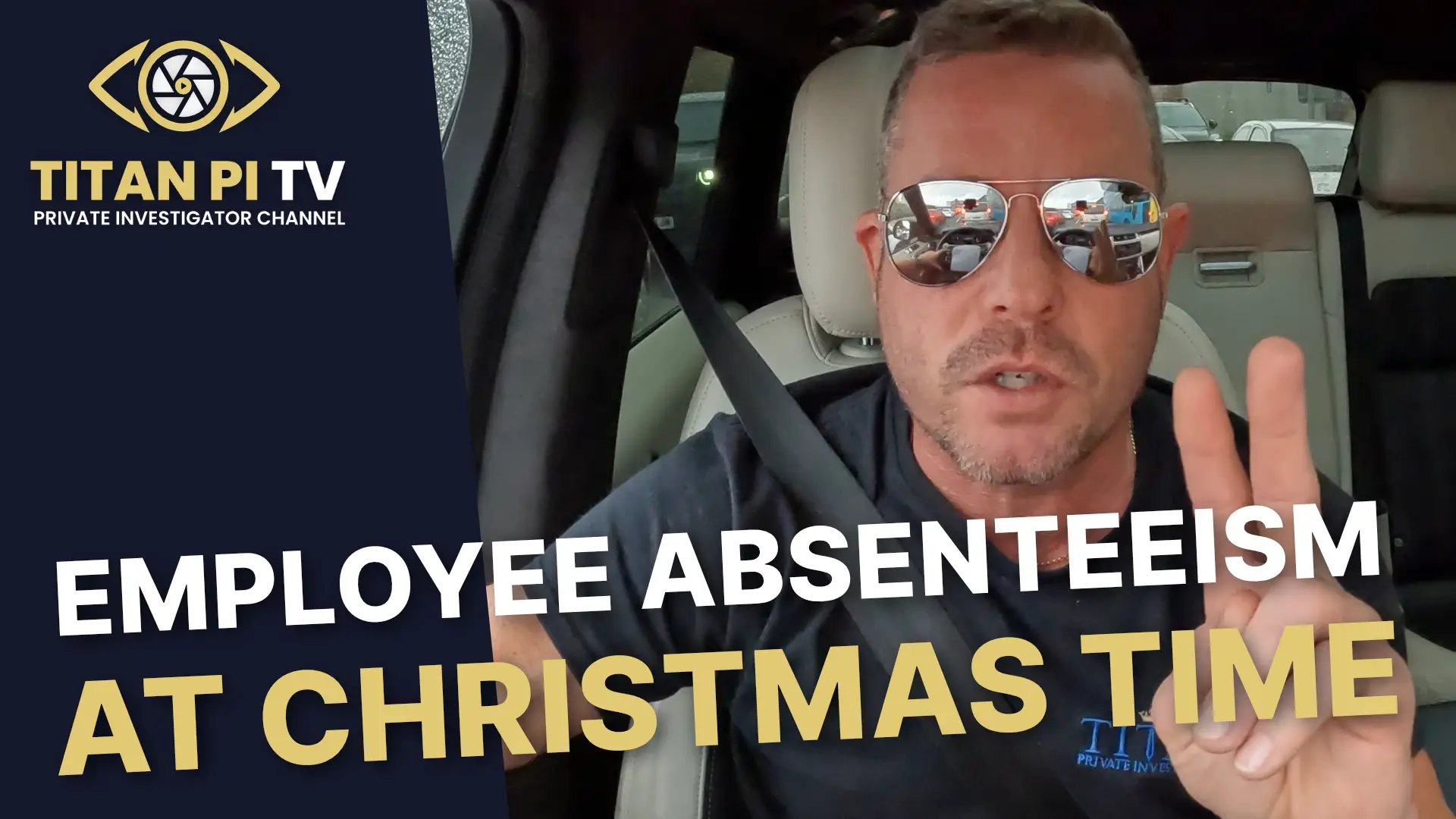
Employee Absenteeism at Christmas Time
Titan PI TV Investigates: Employee sickness during the Chritmas period
In the latest episode of Titan PI TV, host and Managing Director of Titan Private Investigation Ltd, Simon Henson, lifts the lid on how employers can lawfully and effectively investigate suspected bogus sickness and unauthorised absence over the Christmas period – and why getting it right matters so much.
Broadcast from Titan’s Derby office on what Simon describes as a “miserable, wet Friday” in the UK, the episode offers a rare insight into the operational reality of a modern investigation agency, and the support it provides to employers across England.
As the festive season approaches, most employers are preparing for a predictable mix of increased demand, reduced staffing and a flurry of annual leave requests. For many businesses, particularly those in retail, hospitality, logistics and manufacturing, Christmas is the busiest and most operationally sensitive time of the year. It is also, increasingly, the time when patterns of suspicious or fraudulent employee absenteeism come sharply into focus.
National Coverage, Local Insight
Titan Private Investigation Ltd, headquartered in Derby, operates as a live, full-service private investigation agency. As Simon explains, Titan now has 10 offices across England, from Truro in the South West to Manchester in the North West, providing extensive national coverage for corporate and legal clients.
That footprint is crucial at Christmas, when absenteeism issues can arise suddenly and in locations scattered across the country. Titan’s structure allows it to respond quickly, deploying experienced surveillance teams wherever they are needed, often at short notice.
The Christmas Absenteeism Problem
This festive-focused episode follows on from last week’s Titan PI TV discussion on “cheating partners and office Christmas parties”. This time, the emphasis shifts from personal relationships to the workplace – specifically, employees who may be planning to take unauthorised time off over Christmas.
Simon poses a question that will resonate with many business owners and HR professionals:
Do you own a business and are you expecting absenteeism from one individual or several employees this Christmas?
From Titan’s casework, there are several common scenarios that raise red flags for employers:
- Refused holiday followed by “sickness”
An employee submits a leave request for the Christmas period, openly mentioning they are going on holiday. Operational pressures mean the request is legitimately refused. Despite this, management suspects – or fears – that the employee may take the time off regardless, potentially calling in sick. - A history of festive absence
The employee has a track record of conveniently timed sickness or non-attendance during Christmas in previous years. The pattern itself becomes grounds for concern, especially when it causes disruption or places extra strain on colleagues. - Boasting or confiding they will “go sick”
In some cases, employees confide in colleagues that they plan to call in sick over Christmas, perhaps to travel, attend events or simply take extra time off without using holiday entitlement. That information is then reported back to senior management or HR.
In all of these examples, employers are left in a difficult position. Genuine illness must be handled sensitively and lawfully. However, where there is evidence or strong suspicion of dishonesty, organisations are entitled to protect themselves, their clients and their staff from the consequences of fraudulent absenteeism.
From Suspicion to Evidence: How Titan Investigates
Simon explains that Titan’s role is not to speculate, but to obtain clear, lawful evidence that can support internal disciplinary processes, tribunals or court proceedings if needed.
Scenario 1: Refused Holiday, Suspected Secret Trip
In the situation where an employee’s leave request has been refused, but the employer has reason to believe they will travel anyway, Titan will often begin planning well in advance.
If the employer knows the likely destination and intended travel dates, Titan’s team can conduct preparatory work, such as identifying all feasible flights or routes. Surveillance is then structured around the employee’s home address, rather than trying to guess which airport or departure point they will use.
On the day of suspected travel, Titan typically deploys a surveillance team to covertly monitor the subject from their residence. The investigators will seek to obtain imagery and video of:
- The employee loading luggage or holiday bags into a vehicle
- Their departure from the home address
- Their journey to the airport
- Their arrival, parking and check-in activity at the terminal
While investigators cannot follow subjects airside beyond security, the combination of imagery and detailed observation notes is usually sufficient to demonstrate that the individual has travelled for leisure at a time they claimed to be unavailable for work due to illness or other reasons.
Simon emphasises that the resulting evidence is fully admissible in tribunal proceedings, provided it has been gathered lawfully and proportionately – a standard Titan adheres to rigorously.
Scenarios 2 & 3: Historic Patterns and Advance Boasts
Where the suspicion is rooted in previous Christmas absence or comments made to colleagues about “going sick” this year, Titan usually advises a slightly different approach.
In these cases, there is little operational value in deploying surveillance every day in anticipation. Instead, Titan waits until the employee actually fails to attend work or calls in sick. At that point, surveillance operatives are deployed to monitor the employee’s activities during the period they are claiming to be unfit for work.
This might uncover, for example:
- Attendance at social events, pubs or parties
- Undertaking physical activities incompatible with the stated illness
- Travel away from home for leisure
- Working elsewhere while on sick leave from the main employer
Again, the goal is not entrapment, but objective, time-stamped evidence of what the employee is genuinely doing while absent.
Why Two Operatives Are Essential
A key operational detail highlighted by Simon is the use of two surveillance operatives as standard.
“You can’t follow someone covertly with one surveillance operative,” he explains. “It’s one person or one vehicle following a subject and, even if they’re not surveillance aware, before long they will realise they are being followed.”
Using only a single operative substantially increases the risk of the subject detecting the surveillance, which can compromise the operation, place staff at risk and undermine the evidential value of any footage obtained.
With two operatives – and two separate vehicles – Titan can rotate positions, manage traffic situations and maintain distance while still keeping the subject under constant observation. This is essential for maintaining covert status, avoiding confrontations and preserving the integrity of the investigation.
Costs, Timeframes and What Employers Receive
Titan’s surveillance deployments for absenteeism cases are conducted on a structured and transparent basis.
- Minimum deployment:
Two operatives for a minimum of five consecutive hours.
This cannot be split across different days or separate time slots. For instance, a deployment starting at 6:00am will run through to 11:00am as a continuous five-hour block. - Hourly rate:
Each operative is charged at £60 per hour plus VAT. - Indicative cost:
A five-hour deployment for one operative would be £300 plus VAT, but because two operatives are mandatory, the real minimum is £600 plus VAT, totalling £720.
Once the initial five-hour threshold is reached, employers can authorise extensions hour by hour at the same rate, depending on what is unfolding on the ground. Some operations may run for 8, 10 or even 12 hours if the circumstances justify it.
During the deployment, Titan provides live updates to the client. Where operationally safe and appropriate, imagery can be shared in near real-time. However, the operatives’ primary focus is always on retaining control of the subject and preserving covert status, rather than constantly transmitting media.
The Final Product: A Court-Ready Narrative
After the surveillance concludes, Titan supplies a comprehensive written report, accompanied by still images taken from the recorded footage. This document is structured to tell a clear, chronological story of the subject’s movements and activities.
“It is effectively a story being told,” says Simon Henson, “and everything we see is backed up with imagery.”
Crucially, that report is prepared to evidential standards. It can be used as:
- An internal exhibit for HR and disciplinary hearings
- Evidence in employment tribunals
- Evidence in civil, family or criminal courts, where relevant
Titan’s investigators draw on their policing background, which means they are highly familiar with evidential continuity, exhibit handling, data protection and disclosure duties. All material is gathered legally, retained appropriately and documented in a way that supports scrutiny in formal proceedings.
This careful approach ensures that, if challenged, the investigation and its findings can stand up to legal and procedural examination.
Legal, Ethical and Practical Considerations
The episode makes clear that surveillance is never a step to be taken lightly. Employers must ensure they have:
- A legitimate reason to suspect misconduct or fraudulent absence
- Considered less intrusive options first, where appropriate
- A clear understanding of the legal framework, including privacy and data protection obligations
By working with an experienced investigation agency, businesses can ensure any monitoring is proportionate, justified and lawful, reducing the risk of claims of harassment, victimisation or breach of privacy.
At the same time, there is a practical, business-critical dimension. Absenteeism at Christmas is not just inconvenient; it can damage service delivery, client relationships, staff morale and bottom-line performance. Having robust, admissible evidence allows employers to make informed decisions about disciplinary action, dismissal, or policy changes, rather than relying on suspicion or hearsay.
Free, Confidential Consultation for Concerned Employers
For organisations worried about potential absenteeism this Christmas, Simon emphasises that the first step is simply to start a conversation.
Titan offers a completely free, confidential consultation, during which the team will:
- Discuss the specific concerns about one or more employees
- Review any existing evidence or patterns of behaviour
- Advise on whether surveillance or another investigative approach is appropriate
- Draw up a tailored investigation plan for the employer to consider
Employers are then encouraged to take that plan back to their directors or senior management team to decide what, if any, course of action should be taken. There is no obligation to proceed.
Titan can be contacted by phone, e-mail or via a confidential contact form on the company’s website, ensuring discretion at every stage.
A Final Word for the Festive Season
As the year draws to a close, Simon signs off with a seasonal message. While much of the episode focuses on tackling dishonest behaviour, the underlying theme is one of fairness, integrity and protection – for employers, honest staff and clients alike.
For businesses expecting a challenging Christmas in terms of staffing and attendance, the message from Titan is clear: you do not have to rely on rumours or gut feeling. With professional support, it is possible to obtain clear, lawful evidence – and to act on it with confidence.
Until the next episode of Titan PI TV, Simon wishes viewers a fantastic weekend and, most importantly, urges everyone to stay safe.
What’s Next on Titan PI TV?
Titan PI TV continues to grow steadily, with over 3,000 subscribers and counting—a testament to the appetite for straight-talking guidance in a complex field. If you found Simon Henson’s insights useful, subscribe to the channel to catch future episodes. New content drops every Friday at 3:00 pm, offering grounded advice for investigators, agency owners, and professionals who work with them.
Thank you for reading, watching, or listening to this week’s blog post on Titan PI TV. For more expert advice and behind-the-scenes insights, subscribe to Titan PI TV on YouTube or download the Titan PI TV podcast wherever you get your podcasts. If you found this information helpful, please give us a thumbs up and subscribe to our channel. Stay tuned for more insights into the world of private investigations. Until next time, stay safe and keep learning!
Titan PI TV: Uncovering the Truth, One Investigation at a Time.