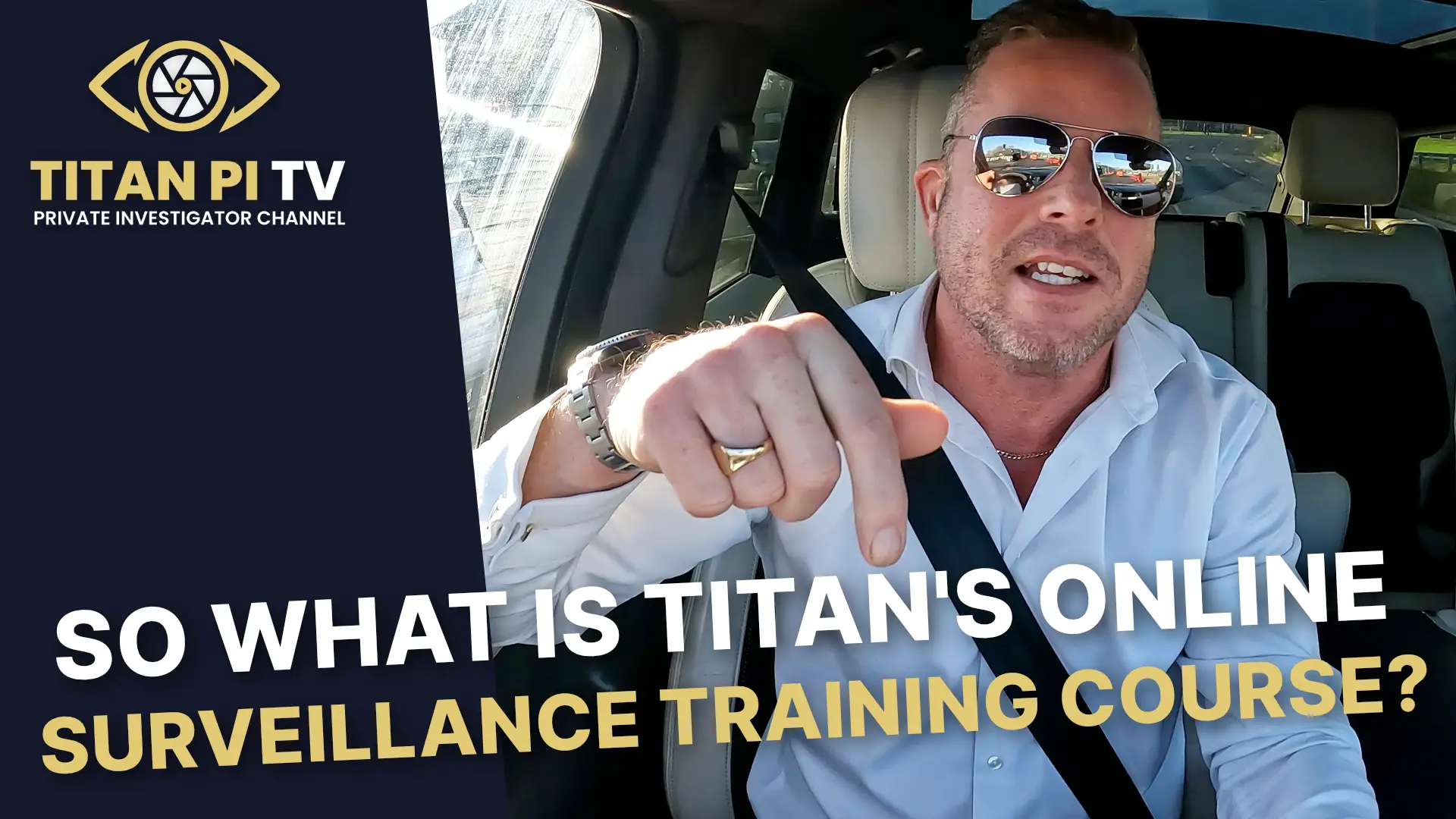
So what is Titan’s online surveillance training course?
Titan PI TV lifts the lid on Titan’s online surveillance training course
In the latest episode of the YouTube channel, host and Managing Director of Titan Private Investigation Ltd, Simon Henson, breaks down exactly what the course is, who it is for, and how it fits alongside Titan’s renowned five and ten‑day practical surveillance programmes.
Broadcast from Titan’s Derby headquarters – one of ten offices the agency now operates across England, from Truro in the south‑west to Manchester in the north‑west – the episode sets out to answer a simple question: “So what is Titan’s online surveillance training course?”
From COVID workaround to permanent training option
Simon begins by addressing a criticism often levelled at online training.
“There are some people that say you cannot learn surveillance online,” he acknowledges, before adding, “I agree, to a degree.”
The course was originally born out of necessity during the COVID‑19 pandemic, when Titan was unable to deliver its popular five and ten‑day in‑person surveillance courses. Rather than bring training to a complete halt, the team developed a structured online programme to allow learners to continue their professional development from home.
That emergency solution has now become a permanent part of Titan’s training portfolio. While Simon is clear that nothing replaces the value of a physical, practical course with constant assessment and real‑time feedback, the online option offers a flexible, more accessible way to grasp the fundamentals of professional surveillance.
Who is the online surveillance course for?
Throughout the episode, Simon is careful not to oversell the course as a complete substitute for practical training. Instead, he positions it as a powerful entry point and a flexible alternative for specific types of learners.
He highlights several groups who may particularly benefit:
- Those testing the waters
Individuals curious about the private investigation or surveillance industry who want to “dip their toes in” before committing to the time and cost of a full five or ten‑day in‑person course. - Learners on a tighter budget
Those unable to afford to take time off work or pay for a longer, residential course, but who still want to begin building knowledge and understanding of surveillance techniques. - International students
Learners based overseas who may find it impractical or too costly to travel to the UK to attend a Titan course in person. - Existing professionals seeking a theoretical refresher
People already working in security, investigations or related sectors who want to consolidate their understanding of surveillance principles, law and procedure.
At £399 plus VAT, the online course offers what Simon describes as “a flavour of surveillance” – a comprehensive overview of the theory and methodology that underpins what Titan delivers in its intensive in‑person programmes.
Experience behind the screen: 77 years of combined service
One of Titan’s selling points has always been the calibre of its instructors, and the online course is no exception.
Simon explains that the course is delivered through 17 video‑based modules taught by three Titan instructors who together bring 77 years of combined police service and surveillance experience.
This experience feeds directly into the course content. The modules are not abstract or academic; they are grounded in methods and procedures used daily on live operations, both in law enforcement and in the private sector.
Seventeen modules covering the core skills of surveillance
The heart of the episode is Simon’s systematic walk‑through of the 17 modules that make up the online course. Together, they mirror the theoretical backbone of Titan’s classroom‑based training.
1. Principles of surveillance
The opening module sets the foundation: how professional surveillance is conducted in practice.
Learners are introduced to:
- The core aims and principles of surveillance
- How operatives manage their appearance and profile
- The theory behind remaining covert while gathering intelligence
Simon notes that this is a “quite long module”, reflecting its importance as the framework for everything that follows.
2. Subject identification
Next, the course explores how to correctly and reliably identify a subject.
“There are three official ways to identify subjects,” Simon says, and the module explains each in detail. Accurate subject identification is critical to avoid mistakes which could compromise an operation or lead to surveillance on the wrong person.
3. Radio and mobile communications
For many newcomers, using a professional radio system is unfamiliar territory. This module covers:
- The basic components and functions of a radio
- How to communicate clearly and concisely over the air
- What to do if radio communications fail
- How and when to fall back to mobile phones or other methods
The emphasis is on ensuring that all team members can communicate effectively under pressure.
4. Legends (cover stories)
In the world of surveillance, being present without attracting suspicion is essential.
Simon explains that operatives must always have a credible “legend” – a cover story that explains why they are where they are. The module teaches learners how to:
- Build convincing cover stories tailored to different environments
- Maintain consistency if challenged by members of the public
- Respond if approached by a third party or, more seriously, by the subject themselves
The goal is to ensure that, if questioned, the operative can give a plausible, confident explanation for their presence.
5. Static observations
Static surveillance focuses on monitoring from a fixed position, rather than physically following a subject.
This module covers:
- Selecting appropriate observation points
- Monitoring premises, such as an address, discreetly
- Recording everyone who enters and exits
- Maintaining logs and evidential continuity
Static work is often less glamorous than mobile pursuits but is crucial for building patterns of life and corroborating intelligence.
6. Evidential footage
Simon describes evidential footage as “the most important area of surveillance”.
“You can be the best surveillance team in the world,” he says, “but if you’ve got no product, you’ve got no imagery of what’s happened during that day, then you’re effectively going to be the worst surveillance team there is.”
This module focuses on:
- Capturing clear, usable video and photographs
- Ensuring that events critical to a case are properly recorded
- Understanding what courts and clients expect from surveillance evidence
Without high‑quality evidential footage, clients are left taking the operative’s word for what occurred – something professional investigators strive to avoid.
7. Anti‑surveillance and 8. Counter‑surveillance
Two closely related modules examine both sides of the surveillance coin.
- Anti‑surveillance looks at how a subject might behave if they suspect they are being followed. Learners are taught to recognise manoeuvres and checks that indicate a subject is trying to detect surveillance.
- Counter‑surveillance covers the use of a separate surveillance team to identify whether you are being followed. This might be used to protect a principal, a client, or even an investigator who suspects they are under observation.
Both modules sharpen situational awareness and help learners understand how professional operatives think – on both sides of the operation.
9. Foot surveillance
Here, the course moves into practical formations and movement on foot, including:
- The classic ABC formation
- Techniques for clearing corners and maintaining sight of the subject
- Managing distance and angles to remain covert in busy or quiet environments
Although the online course cannot physically coach movement, it explains the drills and principles that underpin effective team foot surveillance.
10. Mobile surveillance
This module addresses following a subject in a vehicle from another vehicle:
- Maintaining appropriate following distances
- Using multiple vehicles where possible
- Minimising the risk of compromise at junctions and lights
- Coordinating the team over radio
Mobile work is one of the most challenging aspects of surveillance, and the module outlines the theory behind safe, effective following.
11. Public transport surveillance
Not all subjects travel by car. Learners are introduced to techniques for following individuals who use buses, trains, trams or underground systems, including:
- Boarding and alighting tactically
- Positioning inside carriages or buses
- Managing ticket barriers and platform changes without losing the subject
12. Stop and plot
“Stop and plot” refers to the creation of a sterile area around a subject when they stop – for example when they park a vehicle or enter a shop.
This module explains:
- How to position team members around the near side and off side
- How to maintain coverage of possible exits
- The mnemonics Titan uses, such as “VINO”, to help operatives remember their responsibilities
13. Loss procedures
Losses, Simon points out, are inevitable in surveillance. Even the best teams will occasionally lose a subject.
The course teaches:
- Standard procedures when a subject is lost on foot
- Recovery strategies during mobile and vehicle‑based operations
- How to use last known locations, patterns of behaviour and local knowledge to re‑establish contact
The emphasis is on systematic, disciplined attempts to recover the subject rather than panicked, ad‑hoc reactions.
14. Car park procedures
Multi‑storey and complex car parks present particular risks for surveillance teams. This module sets out a structured way of dealing with them, including:
- Entering and exiting without drawing attention
- Positioning vehicles to maintain visibility while minimising exposure
- Managing tight spaces, ramps and multiple levels
15. Motorcycle surveillance
Motorcycle surveillance is a specialist discipline, but Simon stresses that all operatives should at least understand how it works.
The module gives an overview of:
- The advantages and limitations of motorcycles in surveillance
- How bikes integrate into a wider team
- Safety and legal considerations
16. Motorway surveillance
Motorway work is significantly different from town and city surveillance.
On high‑speed roads:
- Traditional “landmarks” such as bins or post boxes do not exist
- Reference points change – junctions, gantries and services become key
- Communication and anticipation are critical at higher speeds
The module explains the distinct glossary and triggers used in motorway operations and how teams adapt their tactics.
17. The law and evidential logs
The final area is split between legal frameworks and documentation.
Law and compliance
Simon emphasises that surveillance operatives must work “within the parameters of the law”. The course therefore covers key areas such as:
- RIPA (the Regulation of Investigatory Powers Act) and related legislation
- GDPR and data protection obligations
- How surveillance activity intersects with privacy and human rights
He describes this as a “quite heavy” and lengthy module, but stresses its importance. Understanding the law is essential to staying on the right side of it.
Evidential logs
The course also teaches how to produce contemporaneous notes and surveillance logs suitable for matters that may go to court, including:
- Recording events accurately as they happen
- Debriefing the surveillance team
- Signing off logs correctly to preserve evidential integrity
Simon calls evidential logs “another really important area” and reminds viewers that many surveillance cases ultimately stand or fall on the quality of the written and visual record.
Online vs in‑person: what’s the difference?
Throughout the episode, Simon returns to a central point: the online course mirrors the theory delivered on Titan’s five and ten‑day surveillance courses, but it does not replace the experience of being trained in person.
On a physical course, learners benefit from:
- Constant assessment
- One‑to‑one instruction and immediate correction
- Ongoing development as the course progresses
- Practical exercises in real‑world environments
On the online course, learners watch the 17 video modules, absorb the information and interpret it in their own way. There is no built‑in assessment or personalised feedback.
For many, however, that is precisely the appeal. The online course allows people to study at their own pace, on their own schedule, from anywhere in the world, while still being taught by seasoned professionals.
How to access Titan’s online surveillance course
The online surveillance course is priced at £399 plus VAT and can be purchased directly via Titan’s website.
Once enrolled, learners gain access to the full suite of 17 modules, providing a structured introduction to the theory, language and legal framework of professional surveillance as practised by Titan across its live operations.
As Simon sums up, the course:
- Gives “a flavour of surveillance”
- Sets out the theory that underpins Titan’s five and ten‑day courses
- Helps learners decide whether to progress to more intensive, practical training
Titan PI TV: more insight from a live investigations agency
Simon closes the episode with a reminder that viewers can also access Titan PI TV in podcast format, available across major podcast platforms for those who prefer to listen on the go.
He encourages anyone interested in surveillance, private investigation or Titan’s wider work to:
- Give the episode a thumbs up
- Subscribe to the Titan PI TV YouTube channel to avoid missing future content
“Till next time,” he signs off, “stay safe, see you later.”
With its latest episode, Titan PI TV continues to deliver rare insight into the methods and training behind a live private investigation agency – and, in this case, offers a clear route for those considering their first steps into the world of professional surveillance.
What’s Next on Titan PI TV?
Titan PI TV continues to grow steadily, with over 3,200 subscribers and counting—a testament to the appetite for straight-talking guidance in a complex field. If you found Simon Simon’s insights useful, subscribe to the channel to catch future episodes. New content drops every Friday at 3:00 pm, offering grounded advice for investigators, agency owners, and professionals who work with them.
Thank you for reading, watching, or listening to this week’s blog post on Titan PI TV. For more expert advice and behind-the-scenes insights, subscribe to Titan PI TV on YouTube or download the Titan PI TV podcast wherever you get your podcasts. If you found this information helpful, please give us a thumbs up and subscribe to our channel. Stay tuned for more insights into the world of private investigations. Until next time, stay safe and keep learning!
Titan PI TV: Uncovering the Truth, One Investigation at a Time.