The Art of Deception: A Comprehensive Guide to Spotting the Truth
The ten proven tell-tale signs to spot a liar
In the complex world of private investigation, the ability to discern truth from fabrication is perhaps the most critical skill a professional can possess. At Titan Private Investigation Ltd, our operatives are trained to look beyond the surface, understanding that deception rarely looks like a movie-style confession. More often, it hides in small, unconscious changes: the way someone talks, where they look, or how much they choose to say. Recognising these signals doesn’t give absolute proof, but spotting a cluster of them makes dishonesty much more likely.
Whether you are a business owner vetting a potential partner, an employer conducting an internal disciplinary, or an individual seeking clarity in a personal matter, understanding the mechanics of a lie is invaluable. Below, we explore ten reliable signs to watch for, followed by practical tips and a quick look at modern lie-detection tools used in the industry today.

The 10 Proven Signs of a Liar
1. Change in Speech Patterns
People who are lying often shift their usual manner of speaking. This is known as a deviation from the “linguistic baseline.” When the brain is under the cognitive load of inventing a story, it often defaults to different vocabulary, unusual phrasing, or a tone that doesn’t match the individual’s normal style. You might notice a person who usually uses contractions (like “don’t” or “can’t”) suddenly using formal language (“I did not do that”) to sound more emphatic and convincing.
2. Non-Congruent Gestures
The human body often betrays the mind. Body language that contradicts words—such as shaking the head slightly while saying “yes” or nodding while saying “no”—is a classic unconscious giveaway. This physical “leakage” occurs because the subconscious mind knows the truth, even while the conscious mind is attempting to project a falsehood. At Titan, we pay close attention to these micro-expressions and physical contradictions during interviews.
3. Saying Too Little (Information Frugality)
To avoid tripping themselves up, liars sometimes offer minimal detail and stick rigidly to a short, rehearsed story. This is a defensive mechanism; the less they say, the fewer opportunities there are for a private investigator or an employer to find a hole in the narrative. If a person who is usually talkative suddenly becomes monosyllabic when a specific topic is raised, it is a significant red flag.
4. Saying Too Much
Conversely, some people overcompensate and flood the conversation with unnecessary detail. Excessive, irrelevant information can be a cover for fabrication. The logic behind this is that a “detailed” story must be a true one. However, these details often feel “tacked on” and don’t relate to the core of the question being asked. They are designed to distract the listener and lead them away from the uncomfortable truth.
5. Unusual Rise or Fall in Voice Tone
A sudden change in pitch or volume when answering a question often marks discomfort or the cognitive load of inventing an answer. When we are stressed or anxious—common states when lying—the vocal cords can tighten, causing the voice to go higher. Alternatively, a person might lower their voice to a whisper to avoid being overheard or to appear more intimate and “honest.”
6. Direction of the Eyes
While the old adage that “liars can’t look you in the eye” is largely a myth (many liars actually overcompensate with intense eye contact), the direction of the eyes remains relevant. Many people look left or right when constructing responses. A noticeable change in where someone looks while answering can indicate they are moving into a deceptive story. It is important to note that left or right alone isn’t proof—different people process information differently—so look for it alongside other signs.
7. Covering the Mouth or Eyes
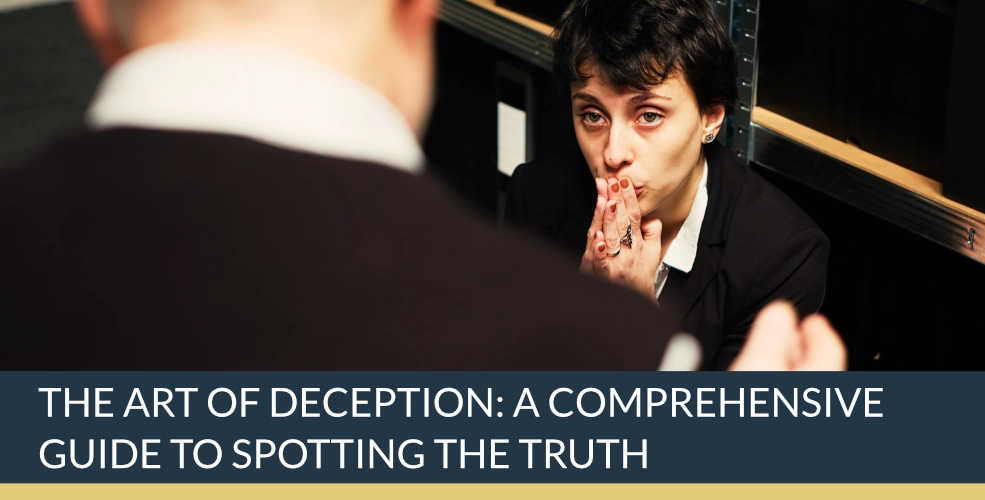
Shielding the face is a common nonverbal attempt to remove attention from what’s being said. It is almost as if the liar is subconsciously trying to “block” the lie from coming out or “hide” from the person they are deceiving. This can manifest as rubbing the nose, covering the mouth with a hand, or shielding the eyes. It signals deep discomfort or a psychological want to hide the truth.
8. Excessive Fidgeting
Increased fidgeting—playing with a pen, tapping a foot, frequent shifting in a chair—can be an unconscious attempt to calm the anxiety associated with lying. This is known as “displacement behaviour.” The nervous energy generated by the fear of being caught needs an outlet, and it often manifests in these repetitive, restless movements.
9. Finger-Pointing and Blame Shifting
A liar may deflect attention by accusing others or exaggerating blame to move the conversational spotlight away from themselves. This is an aggressive form of deception. By becoming the “accuser,” the liar hopes to put the other person on the defensive, thereby ending the line of questioning that was making them uncomfortable.
10. Claiming to be a Great Liar
Bragging about one’s ability to deceive is itself suspicious. If someone self-identifies as a good liar or frequently tells “funny” stories about how they tricked someone else, treat their current claims with extra caution. This bravado often masks a habitual relationship with the truth.
Common Traits of Convincing Lies
Beyond nonverbal cues, certain qualities make lies more believable. A fabricated account that includes these traits is harder to detect, even for seasoned professionals. Understanding these traits helps us at Titan Investigations to look deeper into a subject’s testimony:
- Expressiveness: A story delivered with emotional detail appears authentic. If a liar can simulate the appropriate emotion—sadness, anger, or surprise—the listener is more likely to empathise rather than scrutinise.
- Confidence: Confident delivery lowers suspicion. We are conditioned to believe those who seem sure of themselves.
- Eloquence: Well-phrased, articulate answers sound credible. A smooth talker can often bypass the “logic centres” of a listener’s brain.
- Information Frugality: As mentioned, saying as little as possible reduces opportunities to be caught in a contradiction. The “less is more” approach is a hallmark of a sophisticated liar.
- Rapid Thinking: Quick, plausible responses avoid the hesitation that might betray fabrication. This requires a high level of cognitive agility.
- Attractiveness: Research consistently shows that people often (unfairly) find attractive individuals more trustworthy. This “halo effect” is something investigators must consciously work to ignore.
Practical Tips for Assessing Honesty
If you suspect you are being lied to, there are several techniques you can employ to test your theory. These are the same principles we apply in our professional surveillance and interview work:
Establish a Baseline
Before diving into the difficult questions, note how the person normally speaks and behaves when relaxed. What is their normal blink rate? How do they use their hands? Deviations from that baseline are far more telling than absolute behaviours. A person who always fidgets isn’t necessarily lying when they tap their pen; a person who is usually still but starts tapping when asked about a specific event is a different story.
Ask Unexpected Follow-Ups
Liars usually rehearse their main story, but they rarely prepare for the “side” details. Surprising questions force the brain to work harder, making fabricated answers more likely to show slips or inconsistent detail. If someone claims they were at a specific restaurant, don’t just ask what they ate; ask what the lighting was like or where the toilets were located.
Look for Clusters of Signs
This is the golden rule of lie detection. One cue alone is weak; it could just be a sign of general nervousness. However, multiple simultaneous signals—such as a change in pitch combined with mouth-covering and a shift in eye direction—are far more meaningful.
Pay Attention to Timing
The “latency” of a response is crucial. Hesitation before a response suggests the brain is “loading” a fabricated story. Conversely, an immediate, over-rehearsed answer that comes out too fast can also be revealing.
Mind Context and Culture
Nervousness doesn’t equal lying. A person might be nervous simply because they are being interviewed by a private investigator. Furthermore, cross-cultural differences can change how gestures and eye contact are expressed. In some cultures, looking away is a sign of respect, not deception.
Use Silence as a Tool
Pausing after a person has finished speaking often creates psychological pressure. Most people feel a need to fill the silence. A liar may overcompensate during this pause, adding too much detail or exhibiting awkward body language as they wonder if you’ve seen through their story.
Modern Lie Detection: What to Know
Technology has advanced significantly beyond the traditional polygraph, which measures heart rate, blood pressure, and perspiration. While the polygraph is still a useful tool, modern systems that analyse eye movement, pupil response, and other physiological signals can be faster and more practical.
At Titan Private Investigation Ltd, we stay at the forefront of these developments. Typical commercial systems, such as EyeDetect, report accuracy in the low to mid 80s percent range for correctly identifying deceptive responses. These tools are particularly useful in corporate environments for pre-employment screening or large-scale internal investigations.
Key Distinctions in Modern Testing:
- Speed: Some modern tests can be completed in around 30 minutes, whereas formal polygraph exams often take well over an hour and a half.
- Questions: Many tests are structured to handle a small set of carefully worded questions; adding more questions may require an additional session to maintain accuracy.
- Limitations: No method is infallible. Results should be treated as one piece of evidence and interpreted by trained professionals alongside behavioural observations and corroborating facts.
Final Thoughts – How to spot a liar
Detecting deception is a skill built on observation, context, and pattern recognition rather than a single “tell.” It is a discipline that combines psychology, technology, and old-fashioned intuition. Watch for clusters of the ten signs, establish how someone normally behaves, and use careful, strategic questioning.
When higher certainty is needed—whether for legal proceedings, corporate integrity, or personal peace of mind—professional testing and corroborating evidence will make assessments far more reliable. Honesty is rarely perfect, but with attention to these cues, you can significantly improve your ability to spot when something doesn’t add up.
If you require professional assistance in uncovering the truth, Titan Private Investigation Ltd offers a range of services, from surveillance to advanced lie detection, across the UK. Our team is dedicated to providing the clarity and evidence you need to move forward with confidence.
About Titan Private Investigation Ltd
Titan Private Investigation Ltd is a leading provider of corporate and private investigation services in the UK. Based in Derby, the company serves clients nationwide, offering a full range of investigative solutions including surveillance, fraud investigation, digital forensics, and more. We are a private investigation agency with a reputation for professionalism, discretion, and delivering results. Titan is the trusted partner of choice for businesses seeking to protect their interests and ensure compliance.
London Private Investigator Training – Call the Titan Investigations London Office 020 39046622
Birmingham Private Investigator Training – Call the Titan Investigations Birmingham Office 0121 7162442
Cambridge Private Investigator Training – Call the Titan Investigations Cambridge Office 01223 662022
Derby Private Investigator Training – Call the Titan Investigations Derby (Head Office) 01332 504256
Leeds Private Investigator Training – Call the Titan Investigations Leeds Office 0113 4574066
Leicester Private Investigator Training – Call the Titan Investigations Leicester Office 0116 2436520
Nottingham Private Investigator Training – Call the Titan Investigations Nottingham Office 0115 9646950
Manchester Private Investigator Training – Call the Titan Investigations Manchester Office 0161 3023008
Sheffield Private Investigator Training – Call the Titan Investigations Sheffield Office 0114 3499400
Truro Private Investigator Training – Call the Titan Investigations Truro Office 01872 888706
Alternatively, you can contact us directly using our fully confidential contact form at enquiries@titaninvestigations.co.uk or chat directly using our Live Chat facility, and one of our UK Private Investigators will get right back to you.