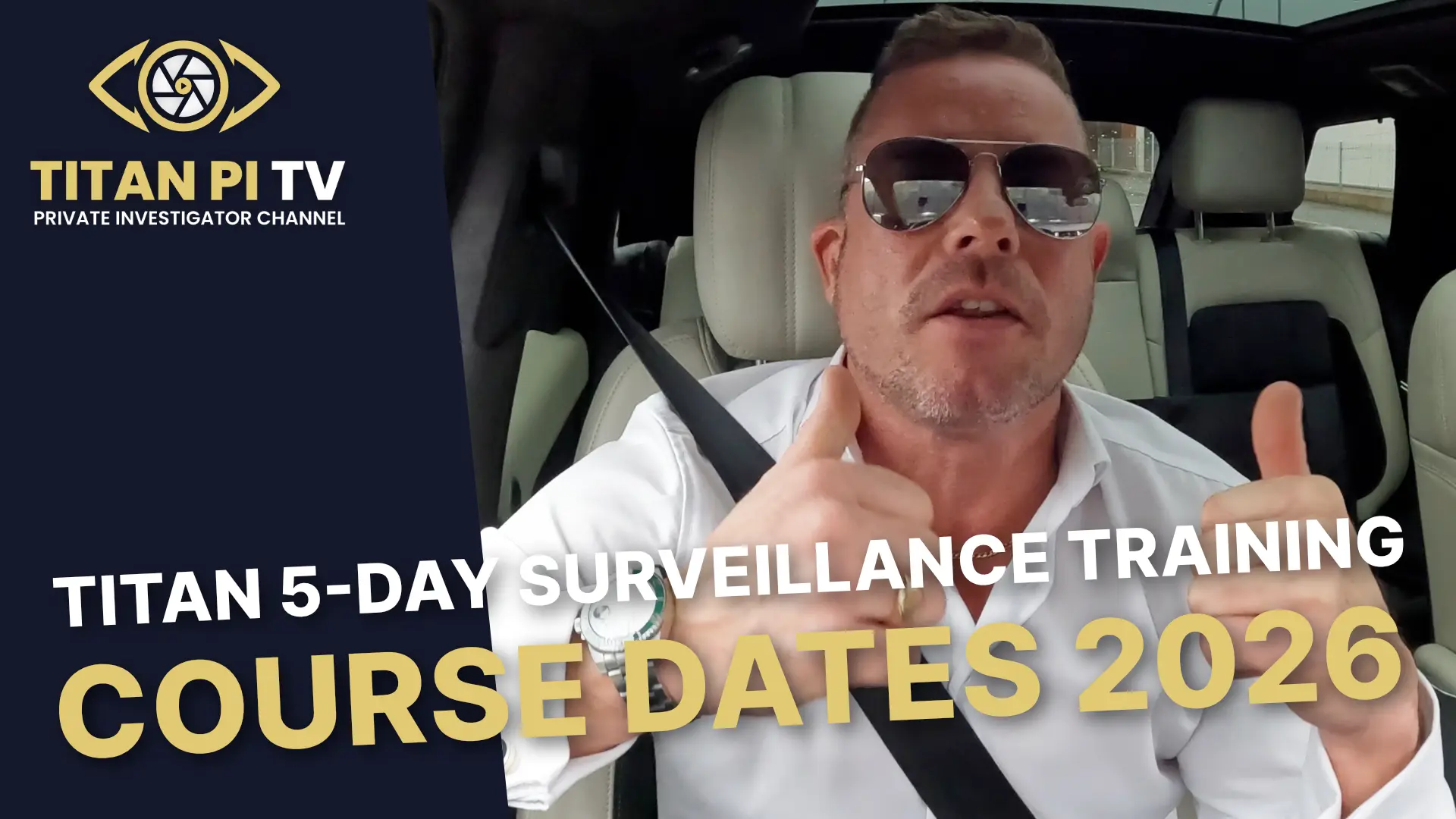
Titan 5-Day Surveillance Training Course Dates 2026
Titan PI TV Announces 2026 Dates for Flagship 5‑Day Surveillance Training Course
Titan Private Investigation has announced the 2026 dates for its highly regarded 5‑Day Surveillance Training Course, as unveiled in the latest episode of Titan PI TV with host and Managing Director, Simon Henson.
Broadcast from Titan’s Derby headquarters, the episode sets out full details of next year’s programme, pricing, qualification options and what learners can expect from a week that promises to be intensive, practical and career‑shaping.
With 10 offices across England – from Truro in the south‑west to Manchester in the north‑west – Titan is one of the UK’s most active operational investigation agencies, and its training programmes are designed first and foremost to meet genuine operational demand rather than simply to fill seats in a classroom.
2026 Course Dates Confirmed
Titan’s 5‑Day Surveillance Course runs four times a year. The months remain consistent – February, May, September and November – but the specific dates change annually. For 2026, the dates are:
- 9–13 February 2026
- 18–22 May 2026
- 14–18 September 2026
- 9–13 November 2026
All courses are delivered from Titan’s dedicated training facility on Pride Park, Derby – a central location with strong transport links and a wide choice of nearby accommodation.
Simon noted that previous attendees have travelled from across the UK and overseas, including as far afield as Hong Kong. While Titan does not arrange or fund accommodation, there are numerous hotels and Airbnbs within walking distance of the training centre, allowing delegates to self‑book and stay close to the venue for the duration of the course.
Fees, Deposits and Optional Qualification
The core 5‑Day Surveillance Course fee for 2026 is:
- £1,200 + VAT
- Total: £1,440 including VAT
To secure a place, Titan requires a 50% deposit, equivalent to £720 including VAT. This deposit confirms the learner’s position on the chosen course date. The remaining balance is typically payable closer to the start of the course.
Learners also have the option to pursue an RQF Level 4 qualification in surveillance, which sits on the national qualifications framework and is recognised across the industry. This element is entirely optional and carries an additional £420 administrative fee, payable to the Institute of Professional Investigators (IPI). The IPI then passes this to SFJ Awards (Skills for Justice), the awarding body responsible for the certification.
Crucially, Simon emphasises that opting in or out of the RQF Level 4 does not affect an individual’s post‑course work opportunities:
- Choosing the RQF Level 4 provides an industry‑recognised certificate that can be added to a CV or professional development review (PDR).
- Declining the RQF route still allows learners to complete the practical course and, upon reaching the required standard, receive a Titan certificate confirming attendance, modules covered and competencies achieved.
“It is a completely personal decision,” Simon explains. “You’ll have the same opportunities for work regardless. The question is simply whether you want that additional, formally recognised qualification on your record.”
What the Course Covers: From Fundamentals to Live‑Style Deployment
Titan’s 5‑Day Surveillance Course is designed as a steep but structured learning curve. It blends classroom‑based theory each morning with intensive practical exercises throughout the rest of the day, reinforcing skills through repetition and “muscle memory”.
Key modules include:
- Principles of surveillance – Core concepts, roles, team structures and methodology.
- Subject identification – Recognising, confirming and maintaining observation on a target.
- Radio and mobile communications – Effective, clear and unclipped signalling, including for learners who have never used radios before.
- Legends and cover stories – Constructing credible explanations for being in a given place, and deploying them if approached by a third party or even the subject.
- Static observation points – Selection, occupation and management of observation positions.
- Evidential footage – Capturing high‑quality imagery and video that can withstand scrutiny.
- Counter and anti‑surveillance awareness – Recognising when a subject may be checking for surveillance and how to respond.
- Foot surveillance – Individual and team movement, including formations and corner clearing.
- Public transport surveillance – Adapting tactics for buses, trams, trains and taxis.
- Mobile surveillance (vehicles) – Safe and covert following of subjects in vehicles.
- Stop and plot – Managing sterile areas when a subject stops, enters premises or changes behaviour.
- Lost and car park procedures – Policies and drills for when visual contact is lost or when operating in car parks.
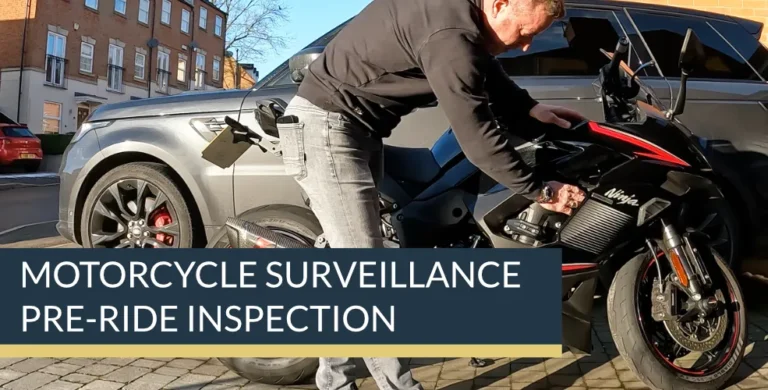
- Motorcycle surveillance (introduction) – A taster of the specialist role played by motorcycles in surveillance teams.
- Motorway surveillance – Techniques that differ from standard road environments.
- Evidential logs – Maintaining accurate records suitable for court or legal scrutiny.
- Use and deployment of GPS trackers – Practical and lawful utilisation of tracking technology.
“All of this is covered within five days,” Simon notes. “It’s intensive, but we structure the week to build you up step by step.”
Day‑by‑Day: How the Week Unfolds
Each morning begins at the Derby training facility with two to three hours of classroom theory. Once the underpinning concepts have been introduced, the group heads out into the field for the remainder of the day to put those lessons into practice.
Day 1 – Foot Surveillance Foundations
The first day is dedicated to foot surveillance around Derby city centre. Regardless of background – whether learners come from banking, courier services, nursing, the armed forces or completely unrelated sectors – the aim is that by the end of Day 1 everyone is:
- Confidently performing foot surveillance.
- Working in ABC formation.
- Safely and discreetly clearing corners.
- Competent using a radio without clipping signals.
Simon is confident in the effectiveness of this approach: “I guarantee that by the end of day one, every learner will be proficiently performing foot surveillance around Derby.”
Day 2 – Foot Surveillance on Public Transport
On Day 2, the training builds on those foundations by taking surveillance onto public transport across two counties. Although aeroplanes are not involved, the scenarios cover:
- Trains
- Trams
- Buses
- Taxis
Learners practise following a subject seamlessly across multiple modes of transport, managing ticketing, timing, positioning and communication in dynamic, real‑world environments.
Day 3 – Mobile Surveillance
Day 3 “steps up a notch”, as Simon puts it. The focus shifts to mobile surveillance, with learners following a subject driving a vehicle while operating from vehicles themselves.
Although the environment is controlled for training purposes, the team must now operate at real‑world road speeds – from 30mph up to motorway speeds of around 70mph – adding a higher level of pressure, time‑sensitivity and risk management.
Day 4 – Integrated Multi‑Modal Surveillance
On Day 4, the course consolidates learning by combining elements from the previous days:
- Foot surveillance
- Public transport surveillance
- Mobile (vehicle‑based) surveillance
Learners move between these modes as a single operation, mirroring the complexity of genuine surveillance deployments where subjects may walk, drive and use public transport in a single day.
Day 5 – Final Operational Exercise
The fifth and final day is designed to be as close as possible to a live operational deployment within a training environment.
The evening before, learners receive a formal operational order – the same kind of briefing document used in real investigations. They are expected to:
- Study the briefing.
- Conduct research around the subject, locations and potential routes.
- Plan their surveillance day as a team.
One learner is nominated as operational team leader, typically someone who has demonstrated strong performance, leadership potential or rapid development during the week. That individual is then responsible for managing the team’s surveillance operation on Day 5 under instructor oversight.
From Classroom to Casework: Titan’s Graduate Aftercare
What sets Titan apart from many training providers, Simon stresses, is what happens after the course.
Titan is primarily an operational surveillance company. Training, which began in 2017, was introduced to meet future operational demand rather than to create a stand‑alone training arm. As a result, graduates who reach the required standard are not simply sent away with a certificate – they are given a structured pathway into real work.
Every successful learner is enrolled onto Titan’s Graduate Student Aftercare Programme, a structured support and development scheme that offers:
- Ongoing mentorship and guidance.
- Practical advice on equipment and set‑up.
- Genuine paid operational opportunities.
Graduates are added to the Titan Operational Resourcing Group, a busy network that currently includes:
- Titan itself; and
- 388 other companies and sole traders across the investigative and surveillance sector.
Titan advertises all of its operational work through this group, and other members also post their own assignments, creating a constant flow of tasking opportunities. For new operatives, this represents a rare chance to gain experience, continue building skills and earn income while still developing professionally.
“We’re not a conveyor belt training provider,” Simon says. “Once you’ve acquired the standard, we then develop you through the Graduate Student Aftercare Programme and provide you with work opportunities.”
Equipment, Vehicles and Professional Set‑Up
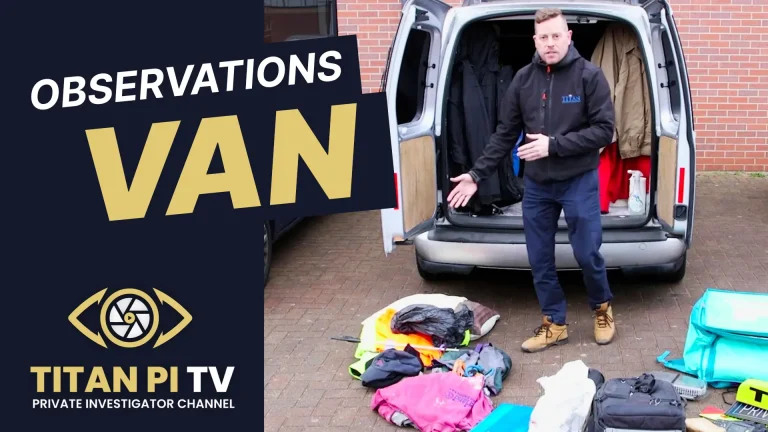
During the course itself, Titan provides all vehicles and equipment required for training. Learners are not expected to arrive with specialist kit or surveillance‑ready vehicles.
However, as part of the week, the instructors also advise on:
- What equipment is genuinely needed post‑course.
- Prioritising purchases to avoid wasted spend.
- How to equip oneself effectively for operational work.
Those who already own cameras, radios or other kit are welcome to bring it and use it during the course to become familiar with their own equipment. Titan encourages learners to speak to the team beforehand to avoid buying the wrong items.
“We don’t want you to buy the wrong kit,” Simon emphasises. “Talk to us first and we’ll guide you.”
Limited Places and How to Book
With its strong operational focus and aftercare promise, the 5‑Day Surveillance Course is consistently in demand. Titan caps each intake to maintain training quality:
- Minimum: 9 learners per course
- Maximum: 12 learners per course
“They do fill up very quickly,” Simon warns. Prospective learners who wish to secure a place on one of the 2026 dates are advised to book early with the 50% deposit (£720 including VAT).
Around one month before the course, Titan will:
- Send joining instructions and pre‑course homework.
- Provide access to the online surveillance course, which must be completed before arrival so that learners “hit the ground running”.
- Host a Microsoft Teams or Zoom meeting with the training team and fellow learners to outline the course structure and answer any questions.
The live week itself is described as challenging but highly rewarding. “The learning curve is steep,” Simon concludes, “but it’s enjoyable. We love delivering it – and you will love taking part.”
For those serious about building a career in professional surveillance – whether transitioning from another field or formalising existing experience – Titan’s 5‑Day Surveillance Course and its comprehensive aftercare programme offer a rare bridge between classroom learning and real operational deployment.
What’s Next on Titan PI TV?
Titan PI TV continues to grow steadily, with over 3,100 subscribers and counting—a testament to the appetite for straight-talking guidance in a complex field. If you found Simon Henson’s insights useful, subscribe to the channel to catch future episodes. New content drops every Friday at 3:00 pm, offering grounded advice for investigators, agency owners, and professionals who work with them.
Thank you for reading, watching, or listening to this week’s blog post on Titan PI TV. For more expert advice and behind-the-scenes insights, subscribe to Titan PI TV on YouTube or download the Titan PI TV podcast wherever you get your podcasts. If you found this information helpful, please give us a thumbs up and subscribe to our channel. Stay tuned for more insights into the world of private investigations. Until next time, stay safe and keep learning!
Titan PI TV: Uncovering the Truth, One Investigation at a Time.