What Is a Child Arrangement Order?
A Comprehensive Guide to Understanding Child Arrangement Orders
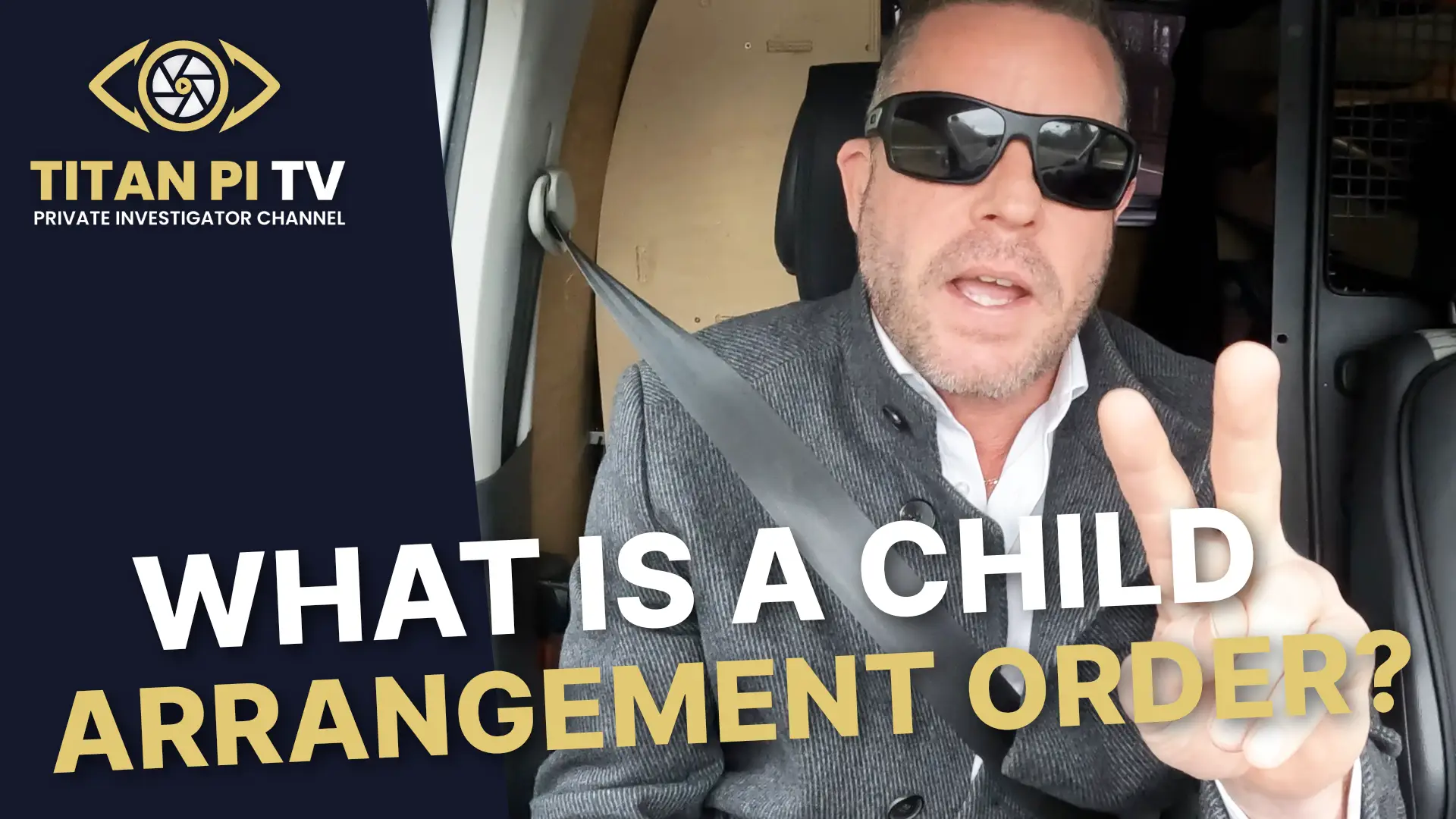
Welcome back to another episode of Titan PI TV, the series that takes you inside the world of professional private investigation. I’m Simon Henson, your host and Managing Director of Titan Private Investigation Limited — and this week, we’re tackling a topic that affects thousands of families across the UK every year: child arrangement orders.
What Is a Child Arrangement Order?
A child arrangement order is a legally binding decision made by a family court that dictates two key things: who a child lives with, and who that child has contact with. It is issued under the Children Act 1989 and carries the full weight of the law.
You may have heard these referred to by their older names — a child custody order or a child access order. These terms were used for many years and are still widely understood, but since April 2014, the correct legal terminology is a child arrangements order. The name change was introduced to move away from the adversarial language of “custody” and “access,” placing the focus instead on the practical arrangements that serve the best interests of the child.
These orders are typically put in place when parents or guardians are unable to reach an agreement between themselves about where a child should live or how much time they should spend with each parent. The court steps in to make those decisions, and once an order is in place, all parties are legally obligated to comply with its terms.
What Does a Child Arrangement Order Actually Cover?
The scope of a child arrangement order can be quite detailed. It doesn’t simply state that a child lives with one parent and visits the other — it can include specific conditions and restrictions that govern the child’s welfare during contact periods.
To illustrate this with a practical example: imagine a scenario where a child primarily lives with their mother, but spends regular time with their father. The order might include a condition stating that when the child is in the father’s care, they are not permitted to have contact with the father’s new partner — perhaps because that individual has previous criminal convictions that raise safeguarding concerns, or because there is a documented history of alcohol dependency.
Similarly, the order might specify that the child is not to have contact with certain family members, such as grandparents, during the father’s custody period. These conditions are not arbitrary — they are put in place by the court to protect the child’s welfare, and they are just as legally binding as the core living arrangements themselves.
Think of it in similar terms to bail conditions. When someone is bailed by the police or the court, they are given specific conditions — they may not be permitted to contact a witness, approach within a certain distance of a victim, or visit particular locations. A child arrangement order operates on the same principle: it sets clear parameters that must be adhered to, and breaching those conditions carries serious legal consequences.
What Happens If You Believe the Order Is Being Breached?
This is where things become critically important — and where Titan Private Investigation can help.
If you have a child arrangement order in place and you believe it is being breached, the first step is to speak to your solicitor. They will be the ones presenting any evidence to the court, so it is essential that they are involved from the outset and are satisfied with how that evidence has been gathered. You can also come directly to us for advice, but ultimately, your legal representative will need to be confident in the evidence we provide.
The good news is that everything Titan does is completely legal and fully lawful. All evidence we gather is obtained through lawful means, which means it is fully admissible in court proceedings. This is not a minor detail — it is the cornerstone of everything we do. Evidence that has been gathered unlawfully is worthless in a courtroom, and worse, it could damage your case entirely.
How Does Titan Investigate a Breach?
So, how do we actually go about gathering that evidence? Here’s exactly how a typical deployment works.
Once you instruct us, we will need to know the details of the child handover — specifically, where and when the child is being transferred from one parent to the other. From that point, we deploy a surveillance team of a minimum of two operatives. This is non-negotiable: effective surveillance simply cannot be conducted by a single operative. Two trained professionals are required to maintain covert observation without compromising the operation.
Our operatives will covertly monitor the movements and associations of the child throughout the custody period. A surveillance deployment has a minimum duration of five hours, which typically aligns with the length of a standard contact arrangement. However, if the custody period extends to a full day or longer, we will be there for the duration.
The team will witness and document the handover of the child — from mother to father, for example — and will then follow the child to wherever they are taken, typically by vehicle. Throughout the deployment, our operatives will gain video evidence of all associations and activities involving the child.
This video evidence is the crucial element. It is, in most cases, irrefutable. If the child is taken to an address associated with grandparents — when the order specifically prohibits contact with those grandparents — the footage will show exactly which address the child entered. Whilst we cannot physically prove who the child was associating with inside the property, the court will apply the balance of probability test. If it is the grandparents’ home and there is no other plausible reason for the child to be there, the court is likely to conclude that contact did take place, and a breach has therefore been evidenced.
Equally, if the child is taken to the father’s address and the father then leaves with his new partner — whose contact with the child is prohibited under the order — and the three of them go for a walk in a park, our operatives will capture video evidence of that association. That is a further, documented breach.
The Post-Deployment Report
Once the surveillance deployment is concluded, Titan will provide you with a comprehensive written report that includes still images taken directly from the surveillance footage. This report is structured to form a formal exhibit that can be presented in court proceedings.
All footage captured by our operatives is time and date stamped, and the integrity of that metadata is maintained throughout. Should the opposing party or their legal team choose to forensically examine the footage, they will find that no times, dates, or metadata have been altered. The evidence stands on its own merits — clean, lawful, and fully admissible.
This level of rigour is what separates professional private investigation from amateur attempts to gather evidence. Courts are increasingly sophisticated in how they scrutinise surveillance material, and our processes are designed to withstand that scrutiny at every level.
Getting in touch with Titan
If you suspect that a child arrangement order — previously known as a child custody order or child access order — is being breached, don’t wait. The longer a breach continues unaddressed, the more difficult it can become to resolve through the courts.
Speak to your solicitor as a first step, or contact Titan Private Investigation directly for confidential advice. We operate from our headquarters in Derby, with ten offices across England — from Truro in the south-west all the way up to Manchester in the north-west — so wherever you are, we can help.
What’s Next on Titan PI TV?
Titan PI TV continues to grow steadily, with over 3,400 subscribers and counting—a testament to the appetite for straight-talking guidance in a complex field. If you found Simon’s insights useful, subscribe to the channel to catch future episodes. New content drops every Friday at 3:00 pm, offering grounded advice for investigators, agency owners, and professionals who work with them.
Thank you for reading, watching, or listening to this week’s blog post on Titan PI TV. For more expert advice and behind-the-scenes insights, subscribe to Titan PI TV on YouTube or download the Titan PI TV podcast wherever you get your podcasts. If you found this information helpful, please give us a thumbs up and subscribe to our channel. Stay tuned for more insights into the world of private investigations. Until next time, stay safe and keep learning!
Titan PI TV: Uncovering the Truth, One Investigation at a Time.