What is the Titan Online Surveillance Training Course?
What the Online Surveillance Course Covers, Who It Serves, and Why Theory Still Matters
London, UK — In an era where investigations move at the speed of a notification and evidence can be undermined by a single procedural misstep, Titan Private Investigation Ltd has expanded its guidance on Online Surveillance Training, setting out what modern learners should expect from an online programme—and what they should not.
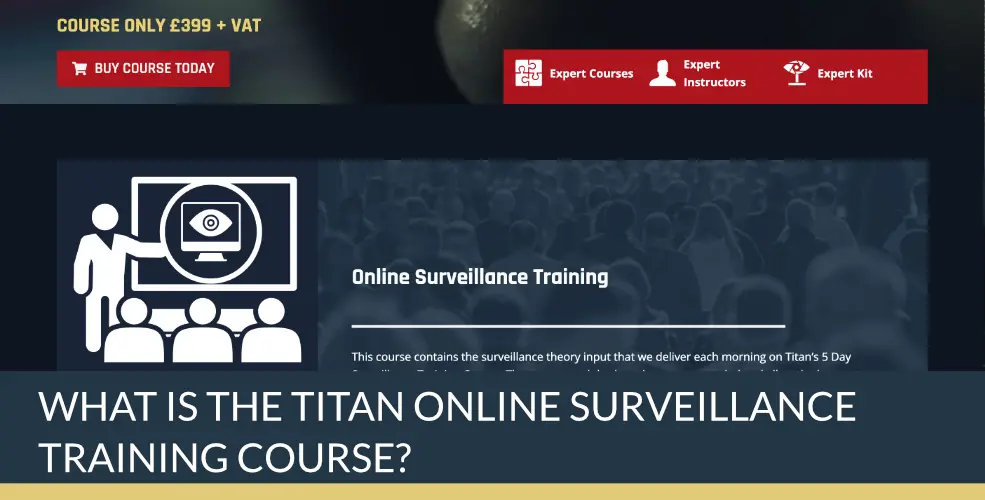
With demand rising for flexible training routes across the security, investigations and compliance sectors, Titan says the organisation’s online course is designed to provide a thorough grounding in surveillance theory, operational doctrine, evidential standards and legal boundaries. Crucially, it is positioned as a foundation: a practical springboard into supervised, in-person development rather than a substitute for fieldcraft.
A spokesperson for Titan Private Investigation Ltd explained that the objective is to make surveillance education more accessible without diluting professional expectations. “People want training that fits around work, budgets and geography,” the spokesperson said. “But they also want training that reflects reality: how decisions are made on the street, how evidence stands up in scrutiny, and how quickly things go wrong when law and procedure aren’t understood.”
The changing training landscape: why online learning has become a serious option
Private investigation work has always demanded discretion, patience and sound judgement. What has changed is the wider context in which surveillance now sits: ubiquitous CCTV, heightened privacy awareness, stricter organisational governance, and greater emphasis on demonstrable compliance. Clients—whether corporate, legal, insurance or private—are increasingly sophisticated about what constitutes “good evidence”, and courts and regulators are less tolerant of sloppy processes.
Against that backdrop, Titan argues that online programmes have matured from “emergency alternatives” into valuable entry points for structured learning. They can teach the common language of surveillance teams, the discipline of decision-making, and the legal boundaries that govern day-to-day activity. They can also standardise foundational knowledge across mixed-experience teams—useful in a sector where operatives may come from policing, military, close protection, insurance or corporate security, each bringing different habits and assumptions.
Still, Titan stresses that online delivery has natural limits. You can learn the principles of surveillance from video modules, but you cannot fully replicate the judgment that comes from instructor-led, real-time assessment in live environments—especially when pressure, fatigue and unpredictability enter the equation.
Who should consider Online Surveillance Training?
Titan’s online course is presented as suitable for several groups, particularly those who need a credible theoretical foundation before committing time and money to practical training.
1) New entrants testing the waters
For people curious about surveillance—perhaps considering a career move into investigations, corporate security, or compliance support—an online course offers a lower-commitment route. It provides a structured overview of what surveillance is (and is not), what “professional” looks like in practice, and where the real work sits: in planning, lawful decision-making and evidential recording.
2) Practitioners who cannot attend physical courses
Cost, time, location and family commitments can make a five- or ten-day practical course difficult. Titan notes that online learning also supports learners overseas who may be exploring UK-style doctrine and legal concepts as a benchmark, even where local laws differ.
3) Existing operatives seeking a refresher
Even experienced practitioners benefit from revisiting procedure, evidential standards and the legal basis for common tactics—particularly if they have been away from surveillance work, have moved into supervisory roles, or want to tighten their reporting and disclosure habits.
4) Organisations building consistent standards
For employers, the appeal is often consistency. An online course can provide a baseline for teams before practical assessment—helpful for companies that want to demonstrate training records, reduce operational risk and improve the reliability of evidence.
What the course teaches: 17 modules designed to standardise doctrine
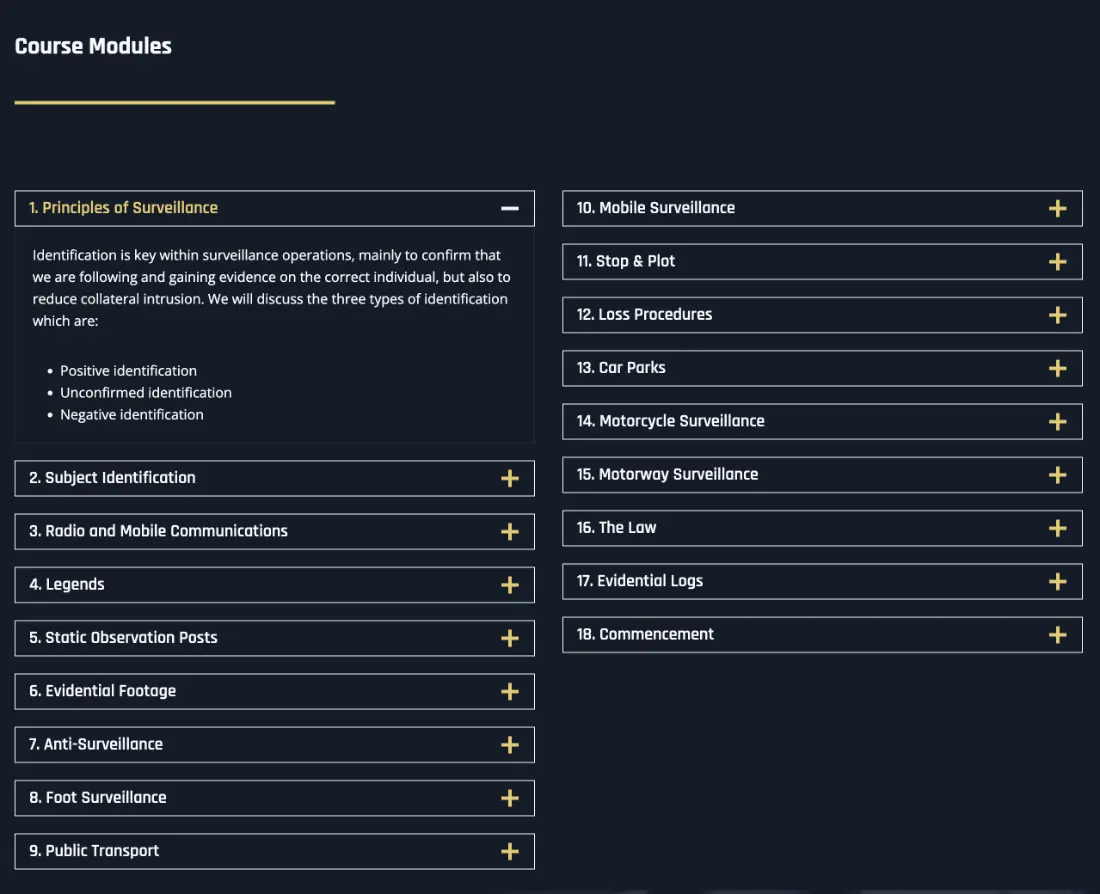
The Titan online programme is organised into 17 video modules, covering theory and operational doctrine behind effective surveillance. The emphasis, Titan says, is on principles that translate into safe, lawful and evidentially sound work—rather than “tricks” or unrealistic shortcuts.
At its core, the course aims to answer the questions that define competent surveillance:
- How do teams maintain discipline and avoid compromise?
- How do you confirm you have the right subject—lawfully and confidently—before action?
- What constitutes usable evidence, and how do you protect it from challenge?
- How do you plan for losses, mistakes and the inevitable unpredictability of movement?
- Where do legal boundaries sit, and what does compliance look like in day-to-day decisions?
Core module topics: what learners can expect in detail
Principles of surveillance
Titan describes this as the backbone of the programme: how teams change appearance, maintain discipline, and apply theory to real-world scenarios. The objective is to build an understanding of “tradecraft” that is rooted in professionalism rather than theatrics—how to avoid drawing attention, how to move naturally, and how small errors compound.
Subject identification
Misidentification is one of the fastest ways to ruin an operation and risk harm. The course teaches three approved methods to positively identify a subject before action is taken. Titan emphasises that identification is not a “nice-to-have”: it is a prerequisite for lawful and defensible surveillance activity.
Radio and mobile communications
Communication failures are operational failures. Learners are taught how to use radios, understand key components, and establish backups and fallback options—including mobile phones—when primary comms fail. The course also addresses the reality that communication discipline is as important as equipment: short, clear messages; agreed terminology; and the ability to convey risk quickly without broadcasting confusion.
Legends and cover stories
The course covers how to create lawful, believable reasons for being in a location if challenged. Titan’s framing is pragmatic: legends are not about deception for its own sake; they are about safety and de-escalation, ensuring an operative can explain their presence without escalating a situation or making admissions that compromise an operation.
Static and mobile observations
A central distinction in surveillance is monitoring an address versus following movement. Titan’s modules look at when each method is appropriate, what risks arise (including compromise and safety), and how decisions shift based on environment, resources and subject behaviour.
Evidential footage and logs
This is presented as one of the most critical areas. Learners are taught how to capture admissible imagery and write contemporaneous notes suitable for court or formal scrutiny. Titan’s position is blunt: evidence that is poorly captured, poorly logged, or poorly handled will not withstand challenge—no matter how confident an operative feels about “what happened”.
Anti-surveillance and counter-surveillance
Subjects may use detection techniques to identify whether they are being followed. The course examines common methods and, equally, how teams check whether they themselves are being followed—an aspect Titan links to operational security and duty of care.
Foot, motorcycle and motorway surveillance
Different environments demand different formations, vocabulary and triggers. Modules cover clearing corners, following on public transport, and the specialised language often used for motorway work. Titan notes that the value here is not memorising jargon, but understanding the “why”: predictable behaviour reduces risk and improves team coordination.
Stop and plot and car park procedures
When a subject stops, surveillance risk spikes: operatives must manage positioning, visibility and potential confrontation. The course addresses creating sterile areas when a subject stops and working multi-storey car parks safely—often overlooked environments where mistakes can be costly.
Loss procedures
Losses happen—even to skilled teams. Titan teaches learners to plan for inevitable losses and to recover subjects on foot or by vehicle. This is framed as risk management: good teams plan not only for success, but for the moment they lose visual contact and must act decisively and lawfully.
Law and data protection
Titan includes material on RIPER and GDPR, explaining the legal parameters operatives must work within and how those rules affect everyday decisions. The training positions legality as operational, not theoretical: the law shapes how you plan, what you record, how you retain information, and what you can responsibly share with clients or third parties.
What the online format delivers—and its limits
Titan is careful to define the strengths of online learning without overselling it.
Online Surveillance Training is described as excellent for theory, procedure and building expectations around evidence and legality. Because it was developed to keep learning going when practical courses were not possible, it is structured to be comprehensive and easy to follow, allowing learners to revisit complex topics and build notes at their own pace.
However, Titan stresses limitations that responsible providers should openly acknowledge:
- An online course cannot replace one-to-one instruction.
- It cannot replicate live assessment, where instructors spot errors a learner may not notice.
- It cannot provide the muscle memory that comes from repeated drills under supervision.
- It cannot fully teach the judgement that forms when plans collide with reality.
For these reasons, Titan says many learners use the programme as preparation for a five- or ten-day practical course, where instructors provide continuous assessment and tailored feedback. The online modules become a common baseline, allowing practical time to focus on performance, safety, and refinement rather than explaining fundamentals.
Practical details: cost, structure, and delivery
Titan’s outline includes clear logistical information:
- Format: 17 video modules covering the full syllabus described above.
- Instruction: Delivered by experienced instructors with extensive policing and surveillance backgrounds.
- Price: £399 plus VAT, available to purchase through the provider’s website.
Titan notes that learners should treat the programme like a course, not background viewing. The difference between “watching” and “learning” is whether the learner can translate the material into repeatable decisions under pressure.
How to make the most of online surveillance training
To help learners convert theory into working practice, Titan recommends a structured approach:
Work through modules methodically
Rather than skipping to “exciting” topics, learners are encouraged to move in order and take structured notes suitable for later practice sessions. Titan suggests building a personal reference file—terminology, checklists, communication formats, and evidential reminders.
Practise communication drills
Radio and communication discipline improve through repetition. Titan encourages learners to practise with colleagues or peers—short, clear transmissions; consistent vocabulary; and calm escalation protocols. Even without vehicles and field exercises, good comms drills can surface weak points quickly.
Use the online programme as foundation learning
Titan’s emphasis is that online training should be treated as preparation for supervised field training. Learners should arrive at practical courses already familiar with doctrine, terminology and expectations, so that practical time is spent on performance, not orientation.
Give special attention to evidential recording and logs
These modules are described as the difference between a case that stands and a case that falls apart. Titan’s view is straightforward: surveillance without defensible evidence is simply anecdote, and anecdote does not survive scrutiny.
Why legal and evidential modules matter more than ever
Titan’s course outline repeatedly returns to legality and evidence—not as add-ons, but as core professional competencies.
“Surveillance without admissible evidence is just anecdote,” Titan’s spokesperson said. “If you can’t demonstrate what happened, how you captured it, and that you acted lawfully, the work becomes vulnerable—operationally, reputationally, and legally.”
In practice, this means learners are taught to think beyond “getting the footage”. They must consider:
- what is necessary and proportionate,
- what can be justified if challenged,
- how data is recorded, stored and shared,
- and how contemporaneous notes and logs support reliability.
Titan argues that this mindset is what separates professional surveillance from risky improvisation. It also protects clients and operatives alike, ensuring investigations do not create new liabilities through poor compliance.
A pragmatic first step—followed by hands-on refinement
Titan Private Investigation Ltd positions Online Surveillance Training as a practical and affordable route into the discipline. It teaches the theory, rules and procedures that underpin competent surveillance, preparing learners for the hands-on refinement that comes only through supervised fieldwork.
For those seeking a solid theoretical foundation—with clear instruction on evidential standards and legal boundaries—the online course is presented as a sensible first step. For live, supervised practice and personal assessment, Titan recommends following it with a practical course where instructors can evaluate judgement, discipline and performance in real time.
In a sector where outcomes depend on what you can prove—rather than what you believe you saw—Titan’s message is simple: learn the doctrine, respect the law, and build the habits that allow evidence to withstand scrutiny. Online learning can begin that journey; professional practice completes it.
About Titan Private Investigation Ltd
Titan Private Investigation Ltd is a leading provider of corporate and private investigation services in the UK. Based in Derby, the company serves clients nationwide, offering a full range of investigative solutions including surveillance, fraud investigation, digital forensics, and more. We are a private investigation agency with a reputation for professionalism, discretion, and delivering results. Titan is the trusted partner of choice for businesses seeking to protect their interests and ensure compliance.
London Surveillance Training Courses – Call the Titan Investigations London Office 020 39046622
Birmingham Surveillance Training Courses – Call the Titan Investigations Birmingham Office 0121 7162442
Cambridge Surveillance Training Courses – Call the Titan Investigations Cambridge Office 01223 662022
Derby Surveillance Training Courses – Call the Titan Investigations Derby (Head Office) 01332 504256
Leeds Surveillance Training Courses – Call the Titan Investigations Leeds Office 0113 4574066
Leicester Surveillance Training Courses – Call the Titan Investigations Leicester Office 0116 2436520
Nottingham Surveillance Training Courses – Call the Titan Investigations Nottingham Office 0115 9646950
Manchester Surveillance Training Courses – Call the Titan Investigations Manchester Office 0161 3023008
Sheffield Surveillance Training Courses – Call the Titan Investigations Sheffield Office 0114 3499400
Truro Surveillance Training Courses – Call the Titan Investigations Truro Office 01872 888706
Alternatively, you can contact us directly using our fully confidential contact form at enquiries@titaninvestigations.co.uk or chat directly using our Live Chat facility, and one of our UK Private Investigators will get right back to you.