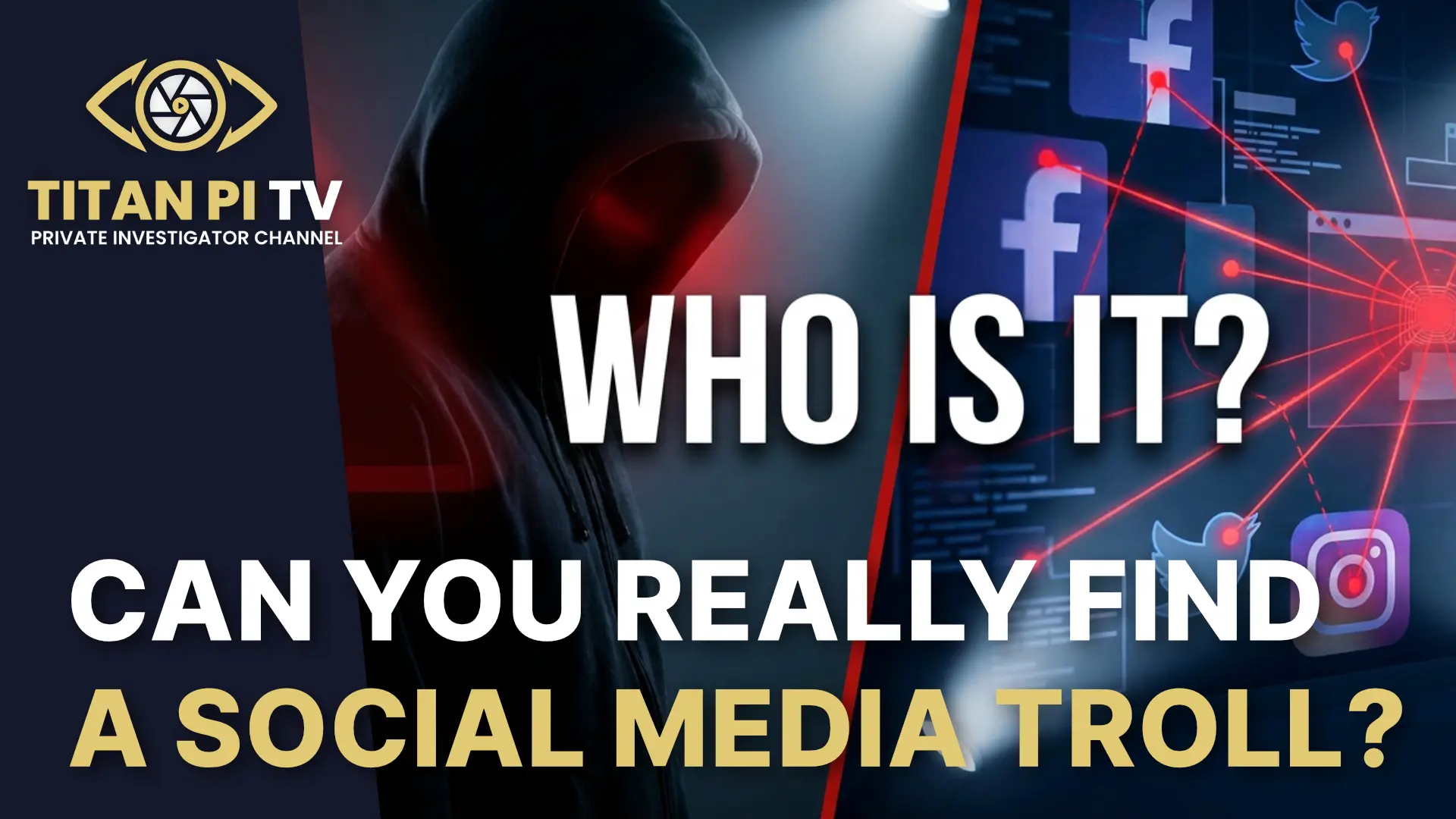
Can You Really Find a Social Media Troll?
How Titan Investigations Tracks Online Harassment
Welcome back to another edition of Titan PI TV. This week’s episode tackles a topic that is becoming increasingly relevant in our digitally connected world: Can you really find a social media troll? It’s a question that sits at the intersection of technology, law, personal safety, and the sobering limitations of what even the most experienced private investigation agency can achieve.
The Titan PI TV YouTube channel that takes viewers inside the real, day-to-day workings of a live operational investigation agency. Hosted by Simon Henson, Managing Director of Titan Private Investigation Limited, the show pulls back the curtain on the world of professional private investigation with candour, expertise, and a refreshing dose of straight-talking honesty.
The Story That Sparked the Conversation
The inspiration for this episode came directly from a recent media appearance. Simon was a guest on the Stuart George Show on BBC Radio Stoke, where the conversation turned to the troubling situation facing Councillor Maxine Clark. The councillor has been subjected to a sustained and deeply disturbing campaign of online harassment — including the circulation of AI-generated videos that falsely depict her — predominantly through Facebook and other social media platforms.
The harassment has been so severe and relentless that Councillor Clark has publicly announced she will not be standing for re-election. A dedicated public servant has been effectively driven from office not by the ballot box, but by the cowardice of anonymous online abusers hiding behind fake profiles. It is a situation that speaks volumes about the toxic underbelly of social media and the inadequacy of current safeguards.
During his radio appearance, Simon was asked the question that many victims of online harassment ask: Who are these people, and can we find them? His answer on Titan PI TV this week is both illuminating and, in some respects, deeply frustrating.
When Identification Is Possible
Let’s start with the straightforward scenario. If the individual carrying out the harassment is doing so using their real name and genuine profile, then yes — Titan Investigations can help. Simon explains that the process begins with something as simple as the HTTP address of the Facebook profile. That URL, combined with the name displayed on the profile page, gives investigators a starting point from which they can deploy their tried-and-tested tracing methodology to identify who the person is and where they currently reside in the United Kingdom.
This is the kind of work Titan does routinely — locating individuals, establishing identities, and providing clients with the evidence they need to take further action, whether that be through civil proceedings, a formal complaint, or legal counsel.
But here is the catch — and it is a significant one.
The Fake Profile Problem
Simon is candid about the reality: anyone intent on harassing someone online is almost certainly not going to use their real name. The whole point of online trolling, in most cases, is anonymity. And the uncomfortable truth is that social media platforms — Facebook in particular — make it extraordinarily easy to create a completely fictitious identity.
The process is alarmingly simple. You choose a fake name — “Joe Bloggs”, for instance — create a free email address in that same name through Gmail, Yahoo, or any number of other providers, and use that email to register your Facebook account. Facebook sends a verification email to confirm the address exists, you click the link, and that’s it. Account created. Identity entirely concealed.
There is no passport check. No driving licence required. No cross-referencing against any government database. The verification process confirms only that an email address exists — nothing more.
As Simon puts it with characteristic frankness: “You can hide behind an account and nobody — not even Meta — will know the identity of that person.”
This is not a minor loophole. It is a gaping chasm in the accountability framework of the world’s largest social media platform, and it is one that is being exploited daily by individuals who know full well they are free to cause harm without consequence.
What About IP Addresses?
A natural follow-up question is whether IP addresses — the unique numerical identifiers assigned to internet-connected devices — can be used to trace a troll. In theory, Meta does have access to IP address data, and there are circumstances in which this information could point towards a location. However, Simon is quick to temper expectations here.
In practice, if the harasser is using a mobile phone, the IP address recorded will simply be that of the nearest mobile phone mast — a location that could serve thousands of people across a wide geographical area. It is, as Simon notes plainly, “not really of any use” for identifying a specific individual.
This technological dead end means that even when law enforcement becomes involved — as in the case of Councillor Clark — the police find themselves in precisely the same position as a private investigator. Someone hiding behind a fake name and a fake email address is, for all practical purposes, invisible. The police, Simon confirms, are doing very little in Councillor Clark’s case — not through lack of will, but through lack of means.
A Call for Reform: ID Verification for Social Media
Simon doesn’t just outline the problem — he offers a solution, and it is one that many commentators and campaigners have been advocating for some time. He argues that social media platforms should require users to submit formal government-issued identification — such as a driving licence or passport — before an account can be created.
Would determined trolls find workarounds? Possibly. Fake documentation exists. But as Simon points out, “are you really going to go to the lengths of paying for a fake passport or a fake driving licence just so you can send some messages to a councillor? Probably not.” The additional friction and risk would, in all likelihood, deter the majority of casual abusers and make the most serious cases far easier to investigate and prosecute.
He draws a parallel with the UK’s SIM card registration system — or rather, the conspicuous lack of one. Having travelled extensively for work, Simon notes that the UK is virtually unique in allowing anyone to purchase a pay-as-you-go SIM card with cash, with no ID required and no registration process. Top it up with cash, and you have an entirely untraceable means of communication. In contrast, most other countries require formal identification to register a SIM. It is a regulatory gap that facilitates not just online trolling, but a range of more serious criminal activity.
What Can Victims Do Right Now?
While systemic reform may be a longer-term ambition, Simon is keen to offer practical, actionable advice for anyone currently experiencing online harassment. His guidance is clear, concise, and worth taking seriously.
1. Do not respond. Engaging with a troll — even to tell them to stop — provides the reaction they are seeking. Silence is your first line of defence.
2. Do not click on any links. Messages from unknown or suspicious accounts may contain links harbouring malware or spyware. Clicking on them could compromise your device, your personal data, and your other online accounts. The risk is real and should not be underestimated.
3. Screenshot everything. This is arguably the most important step. Messages can be deleted by the sender at any time, but a screenshot saved to your photo gallery is permanent evidence. If you ever need to report the harassment to the police or pursue legal action, this documentation is invaluable.
4. Block the harasser. Navigate to their profile, tap the three-dot menu beneath their name, and select ‘Block’. Yes, a determined abuser may simply create another fake account and start again — but blocking each account as it appears makes life incrementally more difficult for them and removes their access to you via that particular profile.
5. Review your privacy settings. If you are a private individual rather than a public figure, consider adjusting your Facebook settings so that only confirmed friends can send you messages. This simple step can significantly reduce your exposure to unsolicited and potentially harmful contact.
Simon acknowledges that for public figures like Councillor Clark — who must remain accessible to constituents — the privacy settings option is not viable. But for private individuals, it is one of the most effective tools available.
A Sobering Reality — But an Important Conversation
This episode of Titan PI TV doesn’t offer easy answers, because the honest truth is that there aren’t many. When a troll is sufficiently careful — using a pseudonym, a burner email, and a mobile phone — tracing them is, in the current regulatory environment, extremely difficult for anyone, including professional investigators and the police.
But that doesn’t mean victims are entirely without recourse. Protecting yourself, documenting the abuse, and reporting it through the appropriate channels all matter. And the broader conversation about platform accountability, ID verification, and SIM card registration is one that deserves to be had at the highest levels of government and industry.
Simon Henson and the team at Titan Private Investigation Limited are committed to keeping that conversation going — and to helping clients wherever the law and technology allow.
If you found this episode valuable, don’t forget to give Titan PI TV a thumbs up on YouTube and subscribe to the channel — it’s completely free and helps the team continue producing expert content every week. The Titan PI TV podcast is also available on all major podcast platforms. Until next Friday — stay safe.
What’s Next on Titan PI TV?
Titan PI TV continues to grow steadily, with 3,700 subscribers and counting – a testament to the appetite for straight-talking guidance in a complex field. If you found Simon’s insights useful, subscribe to the channel to catch future episodes. New content drops every Friday at 3:00 pm, offering grounded advice for investigators, agency owners, and professionals who work with them.
Thank you for reading, watching, or listening to this week’s blog post on Titan PI TV. For more expert advice and behind-the-scenes insights, subscribe to Titan PI TV on YouTube or download the Titan PI TV podcast wherever you get your podcasts. If you found this information helpful, please give us a thumbs up and subscribe to our channel. Stay tuned for more insights into the world of private investigations. Until next time, stay safe and keep learning!
Titan PI TV: Uncovering the Truth, One Investigation at a Time.