New Year, New Career as a Private Investigator
Simon Henson lifts the lid on training, tools and the realities of surveillance work
In this episode of Titan PI TV, Simon Henson, Managing Director of Titan Private Investigation Ltd, explores the practicalities of launching a career in the private investigation industry for the new year. Moving beyond the Hollywood stereotypes, Simon provides a transparent look at the high demand for professional surveillance operatives across the UK and outlines the specific training, equipment, and vehicle requirements needed to go operational. From the technicalities of foot and mobile surveillance to the importance of evidential logs and the Titan Grow Student Aftercare programme, this episode serves as a comprehensive guide for anyone looking to transition into the sector—whether as a full-time career change or a flexible way to earn additional income.
Titan PI TV, the YouTube series offering a candid look inside a working private investigation agency, has kicked off the year with a practical, recruitment-focused episode aimed at anyone contemplating a professional reset. Hosted by Simon Henson, Managing Director of Titan Private Investigation Ltd, the latest instalment is framed around a timely theme: “New Year, New Career as a Private Investigator.”
Filmed from Titan’s Derby base — the hub of an agency that operates nationally — Henson uses the episode to outline what modern private investigation work actually looks like, where demand is strongest, and what prospective entrants need to do (and buy) to become operational. It’s not a glossy, Hollywood portrayal. Instead, the episode reads as a straight-talking briefing: surveillance is the engine of the industry, training matters, and those who treat it like a serious profession can earn consistent work.
Titan, Henson explains, runs a network of 10 offices across England, with a footprint stretching “from Truro… all up to Manchester”. That geographic reach is not just a point of pride — it is central to the company’s pitch. National coverage creates national demand, and national demand creates the need for trained operatives who can deploy locally.
Surveillance: the “highest operational demand” in the PI sector
At the centre of the episode is one clear message: surveillance is where the work is.
“By far the highest operational demand is surveillance,” Henson says, adding a frank assessment for anyone entering the sector for income rather than curiosity: “If you want to make money in this industry, you need to be surveillance trained.”
That statement sets the tone for the remainder of the episode, which is structured less like a general overview of private investigation and more like a guided tour through Titan’s surveillance training pathway — from certification, to practical skills, to ongoing support and resourcing.
Certification and structure: the SFJ course and an association with the IPI
Henson encourages would-be operatives to seek training through a “certificated company”, pointing specifically to an SFJ pathway. In the episode, Titan describes delivering training in association with the Institute of Professional Investigators (IPI), referencing Skills for Justice (SFJ) as the certification framework.
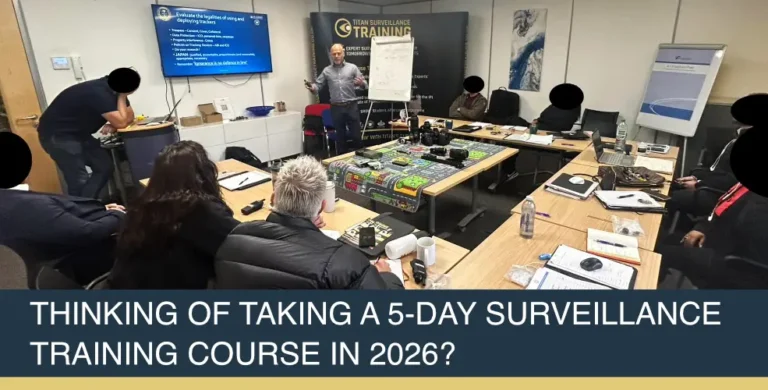
The course itself is presented as an intensive five-day programme, delivered from Titan’s Derby training facility. Importantly, the company emphasises it does not operate as a high-volume training mill. Henson describes Titan as “not a conveyor belt training provider”, noting that course sizes are deliberately capped.
The figures he shares are precise: each course runs with a minimum of six learners and a maximum of twelve, and Titan schedules four courses per year, which limits training capacity to a maximum of 48 learners annually.
For viewers weighing their options, the message is clear: the company is attempting to differentiate itself on selectivity, not scale — a model Henson positions as better aligned with operational standards and genuine post-course development.
2026 course dates and location
In a segment that is essentially a public service announcement for prospective candidates, Henson lists the upcoming dates for the year’s intakes. According to the episode, Titan’s five-day courses are scheduled for:
- 9–13 February
- 18–22 May
- 14–18 September
- 9–13 November
All are delivered from Titan’s Derby training facility, reinforcing that while the company is national operationally, its core training is centralised.
“Aftercare” and work opportunities: Titan’s Grow Student Aftercare programme
Perhaps the most distinctive feature of Titan’s pitch is what happens after training. Henson says that once learners reach the required standard, they are enrolled on the Titan Grow Student Aftercare programme — described as an ongoing support and development structure designed to bridge the gap between classroom competence and real-world deployment.
He outlines two key pillars:
- Operational support and mentoring: trainees are supported by the training team and Titan operatives — a mechanism intended to continue skills development beyond the five-day course.
- Work opportunities in the trainee’s geographic area: because Titan is a national business with nationwide demand, trainees may be offered opportunities closer to home, rather than needing to relocate.
It is, in effect, a pipeline model: train, nurture, then deploy — with the company framing it as a contrast to providers who train large numbers and leave graduates to fend for themselves.
Costs, VAT and the optional RQF Level 4 route
The episode is unusually detailed on pricing, and Henson is careful to separate the base course cost from optional certification.
He states the course fee as £1,200 plus VAT. He also references a VAT-inclusive figure (though the transcript contains a likely mis-hearing in the exact total), but his intent is clear: prospective learners should budget for VAT on top of the headline price.
For those who want an additional qualification, Henson references an optional SFJ RQF Level 4 route (described as “just above an A level”), which carries an additional £420 fee payable to the IPI. He explains this as an administrative and assessment-related cost tied to the certification process and instructor oversight.
Crucially, he stresses that this higher-level certification is a personal choice and, in Titan’s view, not essential for working potential: choosing not to complete the RQF Level 4 “will not affect your working potential”, he says, framing it as an optional credential rather than a gatekeeper.
What you need to go operational: kit and a suitable vehicle
Beyond course fees, Henson is explicit that a new entrant must be prepared for equipment costs.
At minimum, trainees will require:
- A video camera or camcorder
- A covert camera disguised as an everyday device, used to capture covert imagery and audio
- A suitable car — specifically, one that is common on UK roads and does not stand out
The vehicle advice is delivered with humour and clarity. Henson jokes that a “yellow Audi TT” is not ideal, because it draws attention. He recommends non-garish colours and suggests operatives may need tints on the rear windows to support discrete observation.
It’s an important moment in the episode because it grounds the job in practical realities: surveillance is not only about skill — it is about tools, preparation and blending into everyday environments.
Earnings and working patterns: “£30 an hour” and minimum deployments
A significant part of the appeal for career-changers is financial viability, and Henson directly addresses earning potential. He states that once trained, an operative “can then earn £30 an hour”.
He adds that every deployment is a minimum of five hours, meaning a trainee who is deployed for a day’s work is “guaranteed” £150 minimum per day for that deployment length. He also notes that increasing geographical reach can increase access to work, while emphasising that demand exists “all year round”, albeit with quieter periods such as Christmas.
Henson repeatedly returns to a resourcing theme: Titan has more surveillance demand than it can easily cover. “We are always struggling to resource work,” he says — a phrase he uses to underline that trained operatives are not being funnelled into an oversupplied market, but into one where providers are actively seeking capacity.
Inside the training: law, tradecraft and the discipline of evidence
The largest section of the episode functions as an outline of Titan’s curriculum — a blend of legal foundations, fieldcraft and evidential discipline.
Henson begins with surveillance law, focusing on what is lawful in England and Wales and what operatives can and cannot do. From there, the course moves into the principles of surveillance, including how operatives manage appearance — “how we dress up to dress down”, as he puts it — and the basics of avoiding attention.
Communication is another core component. Trainees are taught radio communications and mobile comms, including radio “glossary” and switching to mobile applications if radios fail. Henson notes that some trainees arrive having never used a radio, but are expected to be “100% proficient” by the end of the week.
Then there is the question every operative eventually faces: what happens when a member of the public, a security guard, or a suspicious subject challenges your presence? Titan trains cover stories (or “legends”) — plausible explanations for why you are somewhere — designed to reduce scrutiny and prevent escalation.
From there, the course gets more technical:
- Subject identification, including multiple methods of confirming identity properly
- Foot surveillance, with formations such as ABC (and variants), and practical skills like “clearing corners”
- Mobile surveillance, following a subject vehicle-to-vehicle, where pace and complexity increase
- Public transport surveillance, practised across multiple counties
- Anti-surveillance awareness and counter-surveillance techniques
- A foundation in motorcycle surveillance, presented as a specialism but operationally relevant for convoy work
- Stop and plot procedures on foot and in vehicles, including mnemonics used to structure sterile positioning around a subject
- Set procedures for challenging environments such as multi-storey car parks
- Evidential logs, emphasising contemporaneous note-taking that can withstand scrutiny in legal proceedings
- Loss procedures, acknowledging that losing a subject is inevitable and recoverability depends on following methodical steps
- Motorway considerations, including landmarks and standard approaches to motorway services
- Static observation points, such as watching an address and capturing images of entrants and exits
- Evidential footage, described as non-negotiable: “Without the imagery, you are nothing.”
That last line is arguably the episode’s most pointed critique of weaker training programmes. Henson argues that many courses under-emphasise imagery and evidential integrity, despite them being central to client reporting and any subsequent legal process. He highlights practicalities such as ensuring time and date stamping is “recoverable” — small technical details that can become major issues if evidence is challenged.
A “toe in the water” approach: training without quitting your current job
For viewers in steady employment who are intrigued but cautious, Henson offers a transitional model. You do not need to quit your current role, he says. Instead, you can become trained and “dip your toes into this industry” by taking work on annual leave, rest days, or evenings.
Graduates, he explains, may be added to a Titan Operational Resourcing Group, allowing them to pick up available deployments and test whether surveillance work suits them before committing fully. The pitch is pragmatic: don’t gamble your livelihood on day one — build competence and experience, then decide.
How to follow Titan PI TV and enquire
The episode closes with a familiar YouTube call-to-action — like, subscribe, and stay safe — and a clear invitation for prospective trainees to enquire by email. Henson encourages viewers to request course information and make an “educated decision” about whether to embark on Titan’s training route in association with the IPI.
With its combination of operational detail and straight-talking career guidance, the latest Titan PI TV episode functions as both an introduction to the realities of surveillance work and a recruitment gateway for those looking to turn a New Year’s resolution into a practical new profession.
What’s Next on Titan PI TV?
Titan PI TV continues to grow steadily, with over 3,200 subscribers and counting—a testament to the appetite for straight-talking guidance in a complex field. If you found Simon Simon’s insights useful, subscribe to the channel to catch future episodes. New content drops every Friday at 3:00 pm, offering grounded advice for investigators, agency owners, and professionals who work with them.
Thank you for reading, watching, or listening to this week’s blog post on Titan PI TV. For more expert advice and behind-the-scenes insights, subscribe to Titan PI TV on YouTube or download the Titan PI TV podcast wherever you get your podcasts. If you found this information helpful, please give us a thumbs up and subscribe to our channel. Stay tuned for more insights into the world of private investigations. Until next time, stay safe and keep learning!
Titan PI TV: Uncovering the Truth, One Investigation at a Time.