Surveillance Motorcyclist — How to Train for a Specialist Role
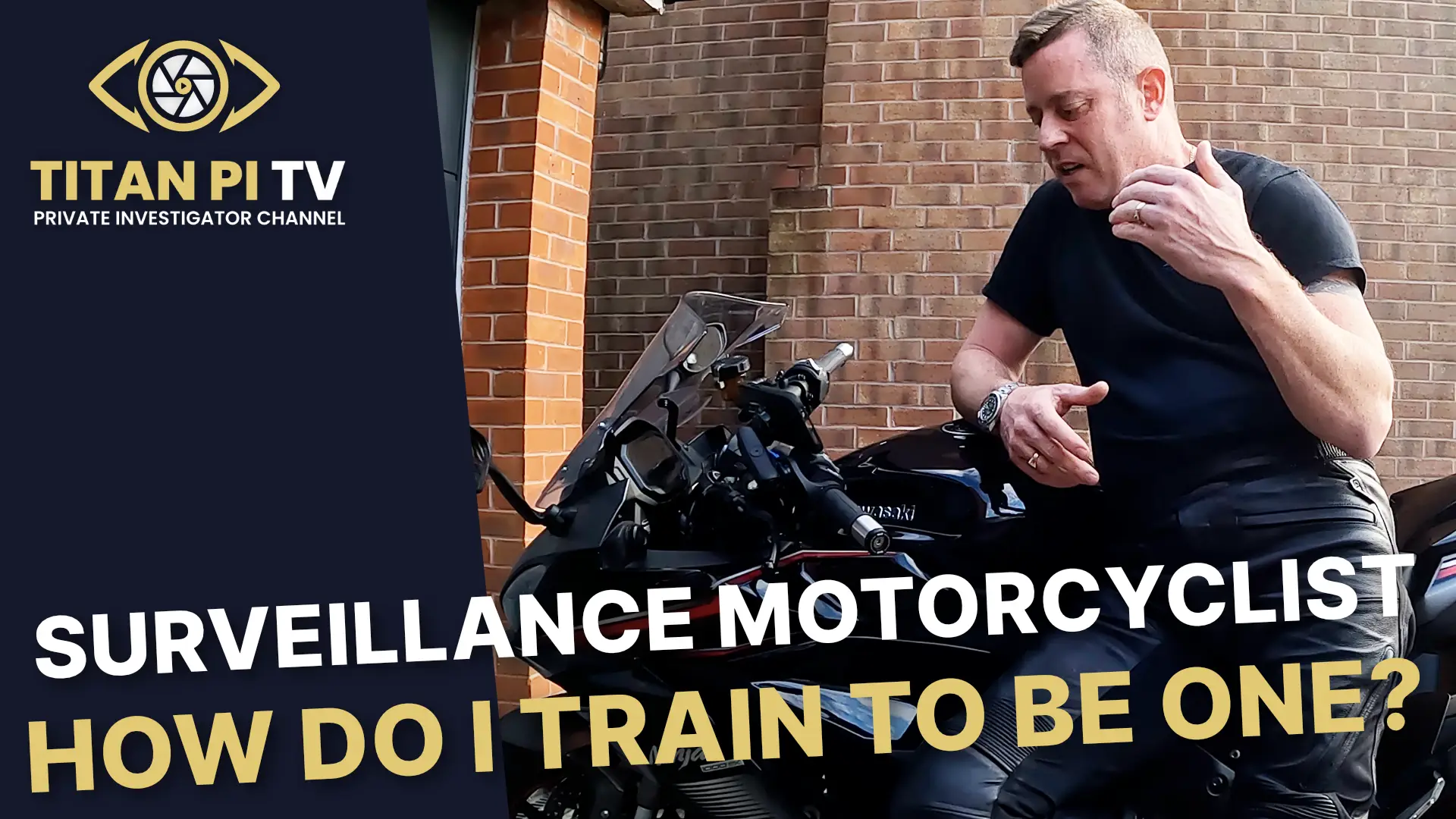
Titan’s guide on how to become a Surveillance Motorcyclist
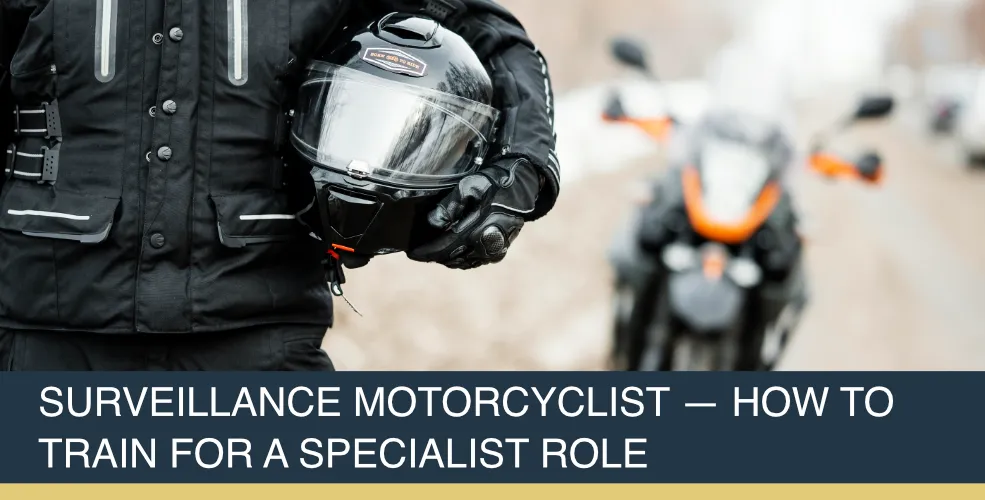
A surveillance motorcyclist is one of the most adaptable and valuable members of a covert surveillance team. When vehicles cannot gain or maintain position safely, a skilled motorcyclist can make ground quickly, move through traffic, and keep the subject under observation. The role combines advanced riding skills with a deep understanding of surveillance tactics and team commentary. In an industry where operational success often hinges on split-second decisions and seamless coordination, the surveillance motorcyclist represents a unique fusion of technical riding ability and professional intelligence tradecraft.
What a Surveillance Motorcyclist Actually Does
The primary function is straightforward: get the eyeball back on the subject when other vehicles cannot. Motorcyclists operate differently from car teams. They filter through traffic safely, use narrower lanes, and can access bus lanes legally in many cities — making them essential for urban deployments.
They don’t act alone. A motorcyclist listens continuously to team commentary and reacts to three core commands:
- Make ground — Prepare to move up behind the eyeball or backup vehicle.
- Come through — Move through the convoy and take over the eyeball position.
- Cancel — Stand down; the bike is no longer required.
Throughout an operation, the motorcyclist will “yo-yo” up and down the convoy, pre-empting traffic changes and responding to real-time instructions. Their mobility makes them the fastest option to recover a lost tail, especially on dual carriageways or congested urban streets.
What makes this role particularly demanding is the requirement to perform all of these functions whilst simultaneously maintaining a natural, unremarkable appearance. A surveillance motorcyclist must never look like they are following someone. Every lane change, every positioning decision, and every moment of acceleration or deceleration must appear entirely organic to any casual observer — including the subject themselves. This demands not only technical skill but a level of psychological composure that only comes with experience and dedicated training.
The Broader Operational Context
To fully appreciate the value of a surveillance motorcyclist, it helps to understand how a modern covert surveillance team is structured and how it operates in the field. A typical mobile surveillance team will consist of three to five vehicles, each with a designated role that rotates dynamically throughout the operation. The lead vehicle — known as the eyeball — maintains direct visual contact with the subject. Behind it, backup vehicles provide support, ready to take over the eyeball position when required.
The challenge with an all-vehicle team is that cars are inherently limited by traffic. A subject who turns onto a congested high street, enters a bus lane, or navigates a complex one-way system can quickly create a situation where the eyeball is forced to drop back or break off entirely. In these moments, the surveillance motorcyclist becomes the team’s most critical asset.
Because a motorcycle can filter legally through stationary or slow-moving traffic, access bus lanes, and navigate urban environments with far greater agility than a car, the rider can close the gap rapidly and re-establish the eyeball position before the subject is lost. In busy city centres — London, Manchester, Birmingham, and beyond — this capability is not merely useful; it is often the difference between a successful operation and a complete loss.
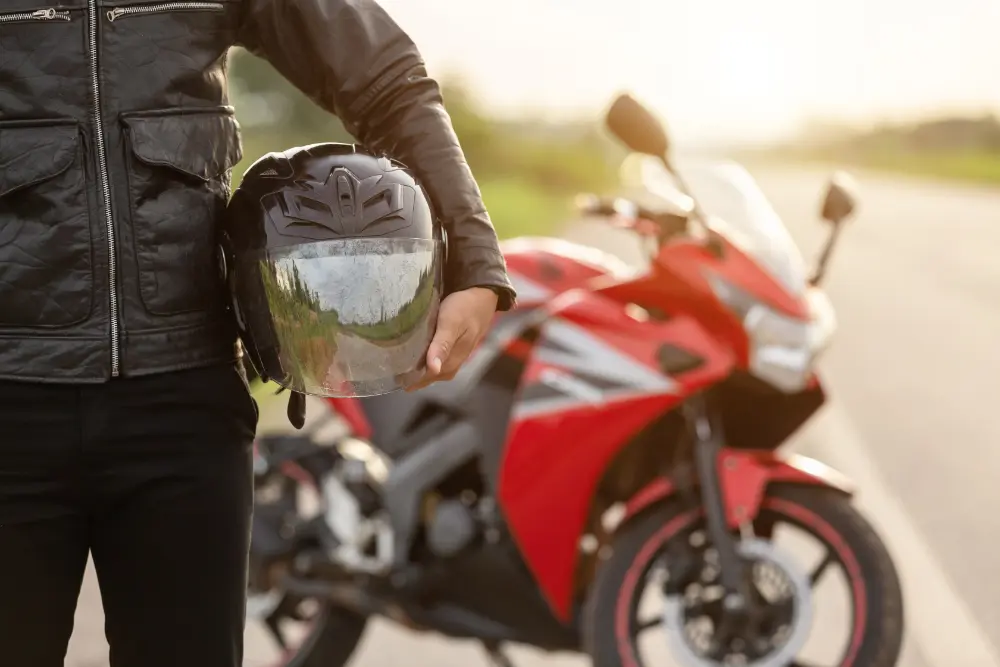
Why Motorcycles Matter — Advantages and Risks
Advantages
- Greater mobility and quicker ground-making than cars.
- Ability to use bus lanes legally in many areas, avoiding obvious traffic violations by car teams and maintaining cover.
- Rapid response during losses — motorcycles can re-establish surveillance whilst other vehicles regroup.
- Reduced footprint in tight urban environments where multiple cars may attract attention.
- Versatility across a wide range of operational environments, from city centres to rural A-roads.
Risks and Limitations
- Riders are inherently more vulnerable on two wheels; safety is a constant concern.
- The role requires highly developed riding skills and situational awareness.
- It is a specialist skill set that is becoming rarer because few providers train it.
- Weather conditions can significantly affect both rider safety and operational effectiveness.
- A motorcyclist is more visually distinctive than a car in certain environments, requiring careful management of exposure time.
Understanding these risks is not a reason to avoid the role — it is a reason to train properly. A well-trained surveillance motorcyclist manages these limitations through preparation, communication, and sound judgement. The risks are real, but they are manageable with the right foundation.
Training: What to Expect from a Specialist Motorcycle Course
Specialist training condenses operational skill and riding ability into a focused programme. The typical structure for a five-day surveillance motorcyclist course looks like this:
Day 1 — Check Ride: A thorough ride to confirm baseline riding ability. This ensures the rider can handle the bike confidently before adding surveillance tasks. Instructors will assess throttle control, positioning, observation, and general road craft. Candidates who cannot demonstrate a sufficient standard at this stage may be advised to develop their riding further before continuing.
Day 2 — Use of Cover and Positioning: How to position the bike for covert observation, use cover effectively, practise moving up and down a convoy, and perform handovers with other bikes to simulate dynamic scenarios. This day introduces the fundamental principles of covert motorcycle work and begins to bridge the gap between riding skill and surveillance tradecraft.
Days 3–4 — Integrated Team Work: Join a surveillance team of three to four vehicles and perform the specialist motorcyclist role in live exercises. This develops timing, commentary response, and coordination within a convoy. These are arguably the most demanding days of the course, as candidates must apply everything they have learned in a realistic, fast-moving environment with real consequences for errors.
Day 5 — Final Exercise: A full-scale exercise designed to mirror operational deployments as closely as possible, testing all learned skills under realistic conditions. The final exercise is assessed, and candidates receive detailed debrief feedback to identify strengths and areas for continued development.
The most effective courses run the basic five-day surveillance course in tandem with the motorcycle course. That way, riders gain hands-on experience with vehicle teams, and learners on the basic course see how to integrate a motorcycle into operations — a mutually beneficial arrangement that reflects real-world team dynamics.
The Importance of Debrief and Continuous Development
One aspect of specialist training that is often underestimated is the value of structured debrief. After each exercise, candidates should expect a thorough review of their performance — what went well, what could be improved, and why certain decisions were made. This process accelerates learning significantly and helps candidates internalise lessons that might otherwise take months of operational experience to acquire.
The best training providers do not simply put candidates through their paces and hand them a certificate. They invest in the debrief process, challenge candidates to think critically about their own performance, and provide a framework for continued self-improvement long after the course has ended. For a surveillance motorcyclist, this culture of continuous development is essential — the operational environment is never static, and neither should be the practitioner’s skill set.
Prerequisites
A specialist motorcyclist course is not an entry-level option. To get the most from five days of condensed training, candidates should already be surveillance trained and operationally competent. Recommended experience includes:
- One to two years working as a surveillance operative.
- Confident, experienced motorcycle rider — able to ride without consciously thinking about basic control.
- Familiarity with team radio communications and convoy terminology.
- A sound understanding of the legal framework governing surveillance operations in the United Kingdom.
There simply is not enough time in five days to teach both foundational surveillance techniques and specialist motorcycle work simultaneously. Candidates who arrive without the prerequisite experience will struggle to keep pace and are unlikely to reach the standard required for operational deployment.
Course Logistics, Cost, and Dates
Typical details to expect from a provider offering this specialist course:
- Duration: Five days
- Cost: £1,500 plus VAT (£1,800 total)
- Content: Check ride, use of cover, convoy integration, alternate routing, handovers, and a final operational exercise
- Booking: Visit the provider’s training pages for full course breakdowns and available dates: www.titaninvestigations.co.uk
Given the specialist nature of the course and the limited number of providers offering this level of training in the United Kingdom, places are typically limited. Prospective candidates are advised to enquire early to secure a position on their preferred course date.
Who Should Apply and the Professional Benefits
If you enjoy advanced riding and want to broaden your horizons as a surveillance operative, this role will suit you. The professional benefits are considerable:
- Higher earning potential per hour on deployments, reflecting the specialist nature of the skill set.
- More deployment opportunities thanks to the motorcycle’s versatility across a wide range of operational environments.
- Development of highly transferable skills in covert operations and team coordination.
- A challenging yet rewarding role — many former police motorcyclists and advanced riders describe surveillance motorcycle work as among the most engaging and professionally satisfying work they have undertaken.
- A competitive edge in a market where genuinely trained surveillance motorcyclists are increasingly rare.
For investigation firms and surveillance providers, having a trained motorcyclist on the team is a significant operational advantage. Clients increasingly expect surveillance teams to be capable of operating effectively in complex urban environments, and a skilled motorcyclist is central to that capability.
Safety and Legal Considerations
Riders must balance agility with caution at all times. Being able to use a bus lane legally does not justify reckless behaviour. Covert teams must avoid attracting attention by breaking traffic laws; using a motorcycle to move through restricted lanes keeps teams both covert and lawful.
Robust training emphasises risk assessment, defensive riding, and constant communication. A competent motorcyclist will always prioritise safety whilst maintaining operational objectives. This is not a compromise — it is a professional standard. An injured rider is not only a personal tragedy; it is an operational failure and a reputational risk for the entire team and the client they serve.
Candidates should also be aware of the legal framework governing surveillance in the United Kingdom, including the Regulation of Investigatory Powers Act 2000 (RIPA), the General Data Protection Regulation (GDPR), and the Human Rights Act 1998. Whilst these are not motorcycle-specific considerations, they underpin every aspect of professional surveillance work and must be understood by all operatives, regardless of their specialist role.
Final Thoughts
The surveillance motorcyclist is a specialist yet indispensable part of modern covert operations. With the right training, experience, and attitude, a motorcyclist can dramatically increase a team’s capability to maintain observation under difficult conditions. As urban environments become more congested and subjects become more surveillance-aware, the demand for skilled motorcycle operatives is only likely to grow.
If you are already surveillance trained and comfortable on a bike, specialist training will broaden your operational toolkit, increase your earning potential, and make you a far more deployable asset to any team. It is an investment in your professional development that pays dividends from the very first deployment.
For full course information and bookings, visit: www.titaninvestigations.co.uk
About Titan Private Investigation Ltd
Titan Private Investigation Ltd is a leading provider of corporate and private investigation services in the UK. Based in Derby, the company serves clients nationwide, offering a full range of investigative solutions including surveillance, fraud investigation, digital forensics, and more. We are a private investigation agency with a reputation for professionalism, discretion, and delivering results. Titan is the trusted partner of choice for businesses seeking to protect their interests and ensure compliance.
London Surveillance Motorcyclist Training – Call the Titan Investigations London Office 020 39046622
Birmingham Surveillance Motorcyclist Training – Call the Titan Investigations Birmingham Office 0121 7162442
Cambridge Surveillance Motorcyclist Training – Call the Titan Investigations Cambridge Office 01223 662022
Derby Surveillance Motorcyclist Training – Call the Titan Investigations Derby (Head Office) 01332 504256
Leeds Surveillance Motorcyclist Training – Call the Titan Investigations Leeds Office 0113 4574066
Leicester Surveillance Motorcyclist Training – Call the Titan Investigations Leicester Office 0116 2436520
Nottingham Surveillance Motorcyclist Training – Call the Titan Investigations Nottingham Office 0115 9646950
Manchester Surveillance Motorcyclist Training – Call the Titan Investigations Manchester Office 0161 3023008
Sheffield Surveillance MotorcyclistTraining – Call the Titan Investigations Sheffield Office 0114 3499400
Truro Surveillance Motorcyclist Training – Call the Titan Investigations Truro Office 01872 888706
Alternatively, you can contact us directly using our fully confidential contact form at enquiries@titaninvestigations.co.uk or chat directly using our Live Chat facility, and one of our UK Private Investigators will get right back to you.