Observation: What do you see that other people don’t?
The Art of Seeing What Others Miss: Titan PI TV’s Latest Episode on the Power of Observation
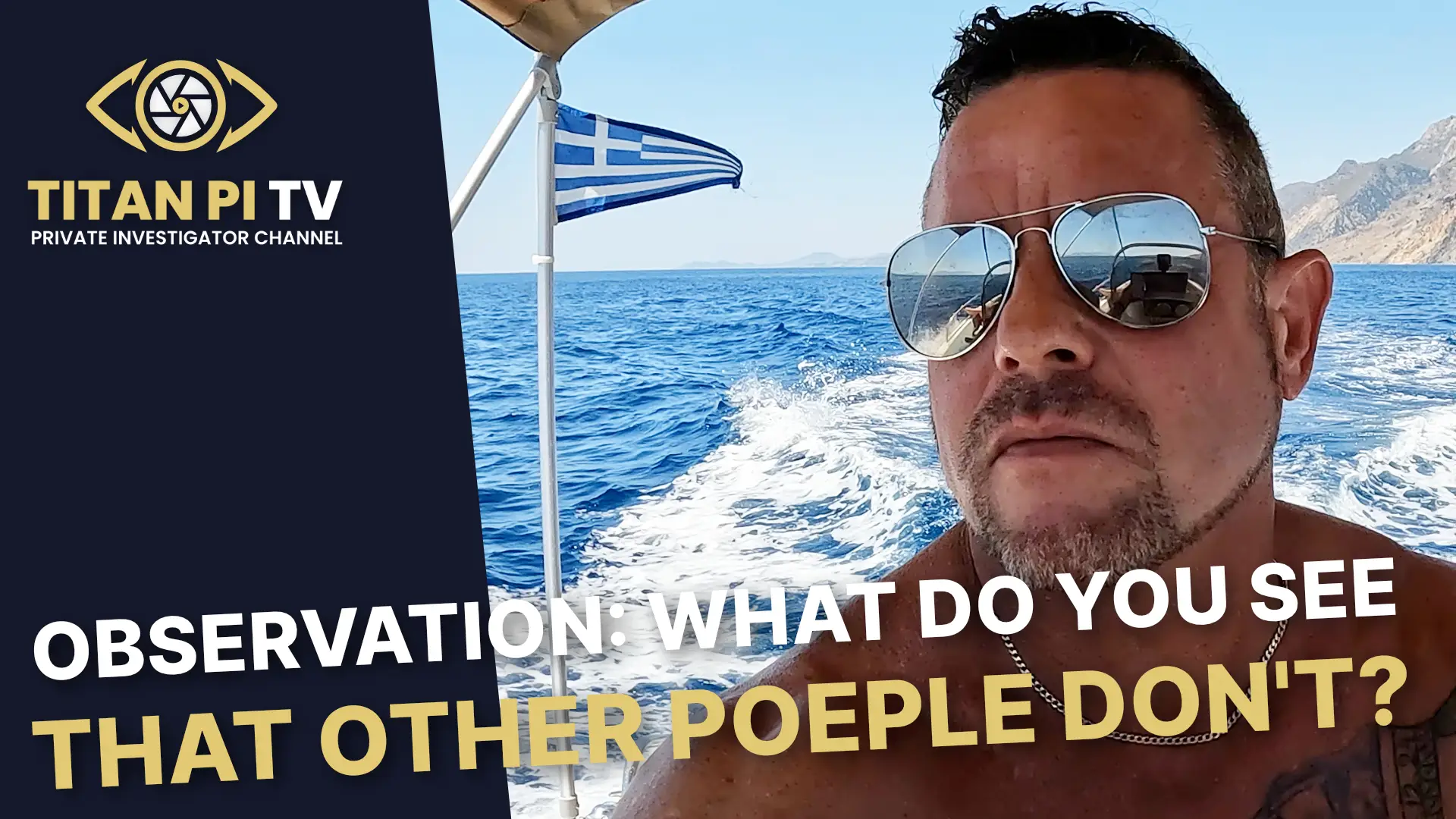
There are not many professions where a sailing holiday around a Greek island can double as a masterclass in professional development. But then again, private investigation is not like most professions. In the latest episode of Titan PI TV, Simon Henson, host, Managing Director, and the driving force behind one of England’s most established investigation agencies, makes that very point from the deck of a boat somewhere off the coast of the Greek island of Ikaria, and he makes it compellingly well.
Broadcasting from Greece rather than his usual base in Derby, Simon opens this week’s episode with characteristic warmth and a touch of self-awareness. “You might think that a Greek holiday and private investigation have very little in common,” he admits. And yet, within moments, he has drawn a thread that connects the two so naturally that viewers will find themselves looking at their own surroundings with fresh eyes by the time the episode concludes.
That thread is observation, not merely the act of looking, but the cultivated, disciplined, never-quite-switched-off habit of truly seeing.
Never Off Duty: The Investigator’s Eye
The central insight of this episode is deceptively simple: most people, when they walk through a busy harbour or a sun-filled town square, see exactly what is on the surface. They see restaurants, sunshine, and holidaymakers. They absorb the atmosphere, order a cold drink, and settle into the comfortable blur of leisure.
The investigator, Simon explains, cannot do this, or rather, chooses not to. Not because they are unable to relax, but because observation is not a switch that professional investigators flick on and off depending on context. It is a default mode, a finely tuned perceptual habit that operates continuously, whether the investigator is sitting at a desk in Derby or sailing the Aegean Sea.
“The investigator never switches off,” Simon says plainly. “They notice patterns.”
It is those patterns that he unpacks in the episode, and they are more nuanced than one might expect. It is not simply about watching people, it is about interpreting what you see against what you would expect to see. Who arrived together but left separately? Which vehicle has been parked in the same spot for three consecutive days? Which seemingly insignificant detail does not quite fit the wider picture? These are the questions that professional investigators are trained to ask instinctively, and they are the kinds of questions that most people would never think to pose.
Simon is careful to dismantle one of the most persistent myths about investigative work in this episode: the idea that cases are cracked by dramatic, Hollywood-style breakthroughs. The reality, he emphasises, is far more methodical, and arguably far more impressive.
“Good investigations are rarely solved by dramatic breakthroughs,” he says. “Most often, they’re solved by noticing the small details that everyone else overlooks, and then putting those pieces together to find the truth.”
This is a refreshing and honest perspective from someone who has spent years at the coalface of real investigative work. The glamorous image of the private investigator, all trench coats and sudden revelations, bears little resemblance to the patient, detail-oriented discipline that actually produces results. What drives success in this field is not dramatic flair; it is the willingness to stay alert, stay curious, and never dismiss a small detail as irrelevant before examining it carefully.
A Philosophy Rooted in History
What makes this episode particularly engaging is the broader intellectual context Simon brings to his discussion of observation. Broadcasting from Greece, he draws a natural and thoughtful connection to the ancient world, to the philosophers and thinkers who walked these lands thousands of years ago and laid the groundwork for the very principles that underpin modern investigative practice.
Ancient Greek mythology and philosophy placed enormous value on logic, evidence, and the art of asking the right questions. Socrates built an entire method of enquiry around the power of questioning assumptions and looking beneath the surface of things. Aristotle championed empirical observation as the foundation of knowledge. These were not abstract intellectual exercises, they were practical tools for understanding the world more clearly and truthfully.
Simon draws a compelling parallel between this ancient tradition and the work that Titan Investigations carries out today. Whether the task at hand involves tracking individuals, tracing missing persons, conducting background checks, or working with specialist techniques such as graphology, the study of handwriting as a means of understanding character and verifying authenticity, the same foundational requirement applies: a constant, rigorous commitment to observation and reassessment.
This is what separates professional investigators from curious amateurs. It is not access to special technology or secret databases (though those things have their place). It is the ability to look at the same scene as everyone else and extract information that others have missed entirely, and then to revisit that information repeatedly, reassessing it as new details emerge.
The echo of Greek philosophy in modern investigative practice is, when you think about it, rather profound. The pursuit of truth through evidence and logic is one of humanity’s oldest intellectual endeavours. Private investigation, in its most serious and professional form, is simply that pursuit applied to the real-world problems of real-world clients.
Titan Investigations: A National Presence
For viewers new to the channel, this episode also serves as a useful introduction to the scale and reach of Titan Investigations. With ten offices spread across England, from Truro in the south-west all the way up to Manchester in the north-west, the agency offers genuinely comprehensive national coverage, capable of deploying experienced investigators across a wide range of locations and case types.
This breadth of coverage is not merely a logistical convenience. It reflects a deep understanding that investigation work is inherently local as well as national. Patterns of behaviour, local knowledge, familiarity with specific areas and communities, these are all assets that a geographically distributed network of offices provides. When a case requires boots on the ground in Cornwall one day and Greater Manchester the next, Titan’s infrastructure means that capability is there.
It is a level of operational reach that distinguishes Titan from smaller, more localised agencies, and it speaks to the seriousness and ambition with which Simon and his team have built the business over the years.
Join the Conversation
One of the most appealing aspects of Titan PI TV as a channel is its genuine sense of community and dialogue. This is not a broadcast that simply talks at its audience, it actively invites viewers to reflect on their own experiences and share their thoughts.
In this episode, Simon poses a question that is surprisingly thought-provoking: what do you notice that other people don’t? Do you find yourself observing patterns and details wherever you go, or are you someone who truly manages to switch off on holiday, leaving professional habits behind at the departure gate?
It is a question worth sitting with. Many people, not just investigators, have a naturally observational disposition. Some walk into a room and immediately clock the exits. Others notice when someone’s story does not quite add up. Still others find themselves cataloguing faces, vehicles, or details without quite knowing why. Simon’s episode validates and contextualises that instinct, framing it not as a quirk but as a genuinely valuable skill, one that, when properly trained and channelled, can make an enormous difference in professional investigation work.
Where to Watch and Listen
Titan PI TV is available on YouTube and is completely free to subscribe to. If you prefer audio content, the Titan PI TV podcast can be downloaded from all major podcast platforms, simply search for Titan PI TV wherever you usually listen.
Simon and the team are actively growing the channel and genuinely appreciate the support of their audience. If you enjoy the content, a thumbs up goes a long way, and subscribing ensures you never miss a Friday episode.
This week’s instalment is a particularly strong one: thoughtful, accessible, and rich with practical insight delivered from one of the most beautiful backdrops imaginable. Whether you are considering a career in investigation, a client thinking about instructing a professional agency, or simply someone fascinated by the craft of observation and the pursuit of truth, this episode of Titan PI TV is well worth your time.
Simon signs off with his customary good cheer, promising to be back next Friday, most likely from his desk in Derby rather than a Greek sailing boat. Until then, as he puts it: keep safe, and Happy Friday.
What’s Next on Titan PI TV?
Titan PI TV continues to grow steadily, with 3,700 subscribers and counting – a testament to the appetite for straight-talking guidance in a complex field. If you found Simon’s insights useful, subscribe to the channel to catch future episodes. New content drops every Friday at 3:00 pm, offering grounded advice for investigators, agency owners, and professionals who work with them.
Thank you for reading, watching, or listening to this week’s blog post on Titan PI TV. For more expert advice and behind-the-scenes insights, subscribe to Titan PI TV on YouTube or download the Titan PI TV podcast wherever you get your podcasts. If you found this information helpful, please give us a thumbs up and subscribe to our channel. Stay tuned for more insights into the world of private investigations. Until next time, stay safe and keep learning!
Titan PI TV: Uncovering the Truth, One Investigation at a Time.