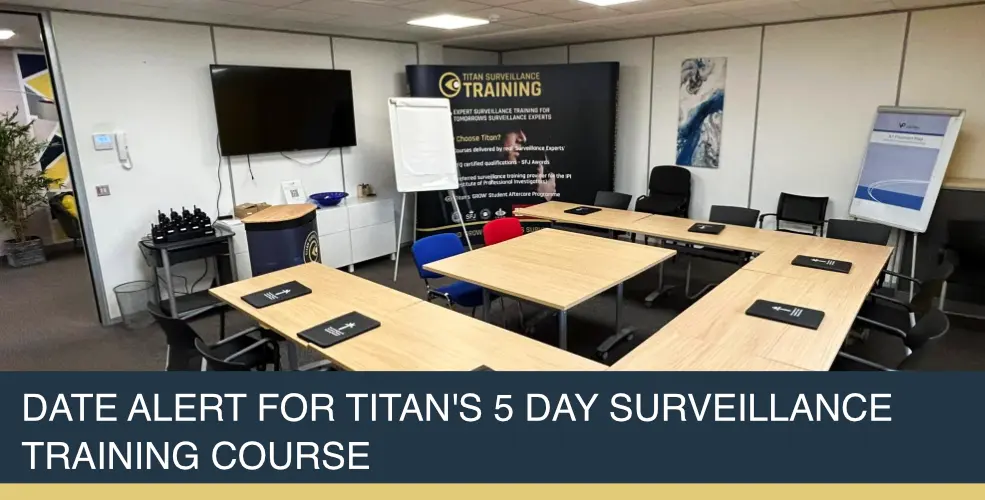
Date Alert for Titan’s 5 Day Surveillance Training Course
New weekend dates for our renowned surveillance training course
If you have been thinking about booking onto Titan’s 5 Day Surveillance Training Course but the biggest barrier has been using a full working week of annual leave, there is some good news.
Titan is trialling a new course format for selected 2026 dates so that learners in full-time employment may only need to use three days’ leave instead of five. It is a simple change, but for many people it could make professional surveillance training much more accessible.
The new trial dates move the course from the usual Monday to Friday format to Thursday through to Monday, meaning two of the five training days fall on a Saturday and Sunday.
Why Titan Is Changing the Course Dates
For a long time, one of the most common requests has been for training dates that work better around jobs, school holidays and day-to-day life. Not everyone can disappear for five weekdays without it causing problems at work, at home, or both.
That feedback has been heard.
Rather than keeping every course locked into the traditional Monday to Friday pattern, Titan is testing a new approach for the September and November 2026 courses. Both are scheduled to run from Thursday the 10th to Monday the 14th.
That means:
- Thursday: training day
- Friday: training day
- Saturday: training day
- Sunday: training day
- Monday: training day
If you work a standard full-time job, that could reduce your annual leave requirement to just three working days. If you are a shift worker, it may be even easier to fit around your rota.
This is currently being run as a trial, but it is a practical response to what prospective learners have been asking for. Titan has always prided itself on listening to the people who want to train with them, and this scheduling change is a direct result of that ongoing dialogue. It is the kind of thoughtful, learner-centred adjustment that sets a training provider apart from those who simply run the same format year after year without ever questioning whether it still serves the people it is meant to help.
The hope is that, if the trial proves successful, the Thursday to Monday format could become a permanent fixture alongside the traditional Monday to Friday dates — giving prospective learners a genuine choice about which format suits their circumstances best.
The Current Course Dates and Availability
If you do not want to wait for the new Thursday to Monday format, there is also an upcoming course running in the usual pattern:
18th to 22nd May — Monday to Friday
At the time of the announcement, there was one vacancy left on that course, with 11 learners already booked on. Given that availability, anyone interested in the May course should act quickly. With only a single place remaining, it is unlikely to stay open for long.
The new trial dates with more availability are:
- Thursday 10th to Monday 14th September 2026
- Thursday 10th to Monday 14th November 2026
If timing has been the thing stopping you from taking the next step into surveillance work, those dates are worth a serious look. September and November both sit outside the peak summer holiday period, which may make it easier for parents and carers to arrange childcare or other commitments around the course.
Course Fees and the Female Learner Discount
The standard price for Titan’s 5 Day Surveillance Course is:
- £1,200 plus VAT
- £1,440 including VAT
Titan is also continuing its push to get more women into the surveillance industry, where females remain significantly underrepresented despite being highly valuable operationally.
To support that, there is a 10% discount for all female learners.
That reduces the fee to:
- £1,296 including VAT
That is a saving of £144, or £120 plus VAT.
The message is straightforward: women are needed in the industry, and Titan is actively trying to lower the barrier to entry.
It is worth pausing on that point for a moment. The surveillance industry has historically been male-dominated, not because women are less capable — quite the opposite — but because the pathways into the profession have not always been designed with female candidates in mind. Titan’s discount is not a token gesture. It is part of a broader commitment to diversifying the talent pool and recognising that female operatives bring distinct and often irreplaceable advantages in the field. A female operative can follow a female subject into spaces that a male operative simply cannot access. She can blend into environments — shopping centres, beauty salons, leisure facilities — without attracting the kind of attention that might compromise an operation. That operational value is real, and Titan is putting its money where its mouth is by making the training more financially accessible for women who want to enter the profession.
What the 5 Day Surveillance Training Course Actually Covers
One of the strengths of Titan’s surveillance training is that it is not built around sitting in a classroom all day. The theory matters, of course, but the emphasis is on getting out and doing the job properly.
Each morning starts with classroom-based input, usually around two to three hours, depending on the pace of the group and the material being covered that day. After that, the focus shifts to practical work.
This is where the course really earns its reputation. Titan teaches the theory, then immediately builds muscle memory by putting learners into live exercises. There is no lengthy gap between learning a concept and applying it. The two happen in close succession, which is widely regarded as one of the most effective ways to develop practical skills quickly and retain them over time.
There is also a strong instructor presence throughout, with a maximum ratio of one instructor to three learners. That means constant feedback, close supervision and a much more personal learning experience than many larger training environments can offer. In a field where small errors can compromise an entire operation, that level of attention to individual development is not a luxury — it is a necessity.
How Assessment Works Throughout the Week
The course is not simply attendance-based. It is a pass or fail programme, and standards matter.
That said, this is not a setup designed to catch people out at the end. Assessment is happening all the way through the five days.
Learners are given:
- Continuous assessment during practical work
- Individual debriefs at the end of each day
- Group debriefs
- Ongoing feedback during instructor-led exercises
By the time the final exercise arrives on day five, there should be no nasty surprises. Learners generally know where they stand because they have been coached and assessed continuously from the start. This approach reflects a mature understanding of how adults learn best. Rather than building towards a single high-stakes moment, the continuous assessment model allows instructors to identify weaknesses early, address them in real time, and give learners the opportunity to improve before it counts most.
Day 1: Building Solid Foot Surveillance Skills
The first day is full on.
Training starts at 8:00 in the morning and usually runs through until around 6:00 or 7:00 in the evening. The opening day is longer partly because there is some course admin to complete before operational training begins.
That includes:
- Registration
- A short English test
- Signing operational paperwork such as the “rules of the road” for mobile surveillance work
The English test is not something to be worried about. It is there simply to make sure learners understand instructions and operational communication clearly, and it is described as straightforward even for those whose first language is not English.
Once the admin is done, the real work begins.
Day one is all about foot surveillance. By the end of the day, the aim is for everyone to be carrying it out proficiently. According to Titan, that happens on every course.
Typical day one practical work includes:
- Walking substantial distances, often seven to eight kilometres
- Working in an ABC formation
- Using radios properly
- Carrying out handovers between team members
- Learning how to clear corners instead of simply following a subject blindly around them
It is common for people to doubt themselves early on, especially if they have never done surveillance before. The idea of following someone through a busy town centre without being noticed can feel daunting in theory. But once the practical phase starts, confidence tends to grow very quickly. Surveillance is one of those disciplines where application matters enormously. It becomes much easier once the theory is tested in real conditions, and the structured environment of the course means that mistakes are learning opportunities rather than operational failures.
Day 2: Public Transport Surveillance Across Multiple Counties
On the second day, the pressure increases.
Foot surveillance remains part of the picture, but the operational challenge expands to following a subject across multiple areas using public transport.
This is a critical skill. Real-life surveillance rarely stays tidy or predictable, and teams need to be comfortable adapting when a subject uses different forms of travel.
Training on day two includes following subjects using:
- Taxis
- Buses
- Trains
- Trams
That combination helps learners understand how surveillance changes when pace, distance, boarding decisions and communication all become more dynamic. The challenge of public transport surveillance is not simply logistical — it is psychological. Learners must make rapid decisions about whether to board a vehicle, how to maintain visual contact without drawing attention, and how to communicate effectively with the rest of the team when they may be separated by carriages, platforms or ticket barriers.
It is one thing to follow someone on foot through a town centre. It is another thing entirely when they jump into a taxi, switch to rail travel, or cross county lines on public transport. Day two is designed to build that adaptability, and it does so in a way that mirrors the unpredictability of genuine operational work.
Day 3: Moving Into Mobile Surveillance
Day three is where the course properly steps up.
This is the start of the mobile surveillance phase: following a subject in a vehicle from another vehicle.
The pace increases significantly here. On foot, instructors can control tempo more easily and help learners build up gradually. In vehicles, things move at the speed of the road. If the road is 30 mph, the exercise is happening at 30 mph. There are traffic lights, junctions, separation risks and opportunities for things to go wrong quickly.
That is exactly why this stage matters.
Learners are introduced to one of the most important and unfamiliar skills in surveillance driving: commentary.
This means clearly communicating what the subject vehicle is doing while also maintaining awareness of:
- Your own driving
- The number of cover vehicles in play
- Vehicle positioning
- Handover timing
- Backup declarations
- Potential loss procedures
To make that manageable, Titan does not throw learners straight into the deep end. The process is staged.
How the Mobile Phase Is Taught
Before learners are asked to do commentary while driving, they begin in the passenger seat.
That allows them to get comfortable with the communication side of mobile surveillance without having to split attention between surveillance and vehicle control. Once they are ready — and once instructors are satisfied they are ready — they move into the driver’s seat.
Only then do they take on the full task: driving while delivering commentary and managing a moving surveillance operation.
It can feel intense. It can feel hot and flustered. But that is also why it is taught in a controlled training environment where scenarios can be shaped, repeated and debriefed properly. The staged approach is not about making things easier — it is about making the learning stick. By the time a learner is behind the wheel managing a live mobile exercise, they have already built the mental framework for what they are doing. The driving is the final layer, not the first.
Day 4: Bringing All Surveillance Disciplines Together
By day four, the goal is not to let any skill fade.
Rather than focusing on one area alone, the course revisits the key operational disciplines together:
- Foot surveillance
- Public transport surveillance
- Mobile surveillance
This is an important day because real surveillance work does not happen in neat compartments. A subject may begin on foot, transfer onto public transport, and then end up in a vehicle — all within the same operation. Teams need to stay competent across all of it, and the transitions between disciplines are often where things go wrong for inexperienced operatives.
Day four is about reinforcing those transitions and keeping learners operationally sharp before the final exercise. It is also an opportunity for instructors to identify any remaining gaps and address them before the assessment that matters most.
Day 5: The Final Exercise
The final day is where everything comes together.
Titan aims to make this exercise as close as possible to a genuine live operation within a training environment. The evening before, learners receive their operational order — effectively the briefing sheet for the job — through a WhatsApp group. That reflects how information is commonly passed in real operational settings, and it means learners arrive on day five already in the right mindset.
From that point, learners are expected to treat the task as a real deployment. There is no hand-holding. The skills, the communication, the decision-making — all of it needs to come from the learner.
What Titan finds, time and again, is that people often rise to the occasion. The final exercise tends to bring a noticeable lift in performance and confidence, with learners pulling together everything they have developed across the week. The combination of pressure and preparation tends to produce results that surprise even the learners themselves.
What Happens if Someone Does Not Pass First Time?
Titan is very clear on standards, but equally clear on support.
The course is not “attendance only”. A certificate is not handed out simply for showing up. If the required standard is not met, that matters.
However, the approach is constructive rather than punitive.
If a learner is struggling in a particular area — whether that is foot surveillance, mobile surveillance, or another practical element — Titan may invite them back to retake the relevant part of the course.
In most cases, there is no charge for this. The main cost to the learner would usually be accommodation. The only time extra cost may arise is if the return creates additional operational expense, such as needing to bring in another instructor or hire another vehicle because the course is already full. In that case, the cost would be shared.
The wider point is reassuring: if someone needs a bit more time behind the wheel, a bit more time on foot, or simply a little more confidence-building, there is a route to get them there. No one is written off after a single attempt. The ethos is one of development, not elimination.
That reflects the training philosophy at its core. The aim is not to fail people. The aim is to produce competent surveillance operatives who are genuinely ready to work — and who will represent the profession well once they are out in the field.
Success Rates and What Comes Next After the Course
Titan has been running this surveillance training course since 2017, and over that time only a small number of learners have needed to come back and reattempt parts of it.
The overwhelming majority get through the course, enjoy it and discover that there is a real career path available to them. That track record speaks for itself. Nearly a decade of delivering practical surveillance training, with consistently high pass rates and a growing alumni of working operatives, is not something that happens by accident. It is the result of a well-designed programme, experienced instructors and a genuine commitment to learner outcomes.
For those who do pass and want to continue, Titan offers progression through its graduate student aftercare programme. The purpose is to develop and nurture new operatives by giving them work and helping them grow in the industry.
That is an important distinction. This is not training in isolation. It is training connected to live operational opportunities. Completing the course does not simply earn you a certificate — it opens a door into a professional network and a pipeline of real work.
Some people want a complete career change. Others prefer to dip their toes into the industry and take on as much or as little work as suits them. The structure appears designed to support both, which makes it a genuinely flexible entry point into the profession regardless of where you are starting from.
What Makes Titan Different From Other Surveillance Training Providers?
It is a fair question to ask. There are other surveillance training courses available in the UK, and anyone considering spending £1,440 on professional development deserves to understand what they are getting for their money.
A few things stand out about Titan’s approach.
The instructor-to-learner ratio is exceptional. A maximum of one instructor to every three learners is not the industry norm. Many training providers operate with far larger groups, which inevitably means less individual attention, less personalised feedback and a more generic learning experience. Titan’s ratio means that no learner gets lost in the crowd.
The training is genuinely practical. Some surveillance courses lean heavily on classroom theory and deliver relatively little time in the field. Titan’s model flips that balance. The classroom sessions are purposeful and focused, but the bulk of the learning happens on the ground, in real environments, with real operational challenges.
The aftercare programme is a genuine differentiator. Most training providers hand you a certificate and wish you well. Titan’s graduate programme actively works to get new operatives into paid work. For someone making a career change, that kind of support can be the difference between a qualification that sits on a shelf and one that genuinely transforms their professional life.
The feedback loop is built into the design. The Thursday to Monday trial dates exist because Titan listened to what prospective learners were saying. That responsiveness is not something every training provider demonstrates, and it suggests an organisation that is genuinely invested in making its courses work for the people who attend them.
Who This Course Is Really For
This course is likely to appeal to:
- People looking for a new career in private investigation or surveillance
- Those already working in security, law enforcement or related fields who want to formalise and expand their skill set
- Those already interested in investigative work who want practical, structured training
- Full-time workers who need a more flexible course format
- Shift workers who may benefit from the new Thursday to Monday schedule
- Women considering entering an underrepresented but operationally important part of the industry
- Former military or police personnel transitioning into civilian investigative roles
- Self-employed individuals looking to add surveillance capability to an existing service offering
If you want hands-on surveillance training rather than vague theory, and if you want a route into genuine operational work, this course is clearly built with that in mind.
How to Book a Place
If you want to secure one of the remaining places or enquire about the September and November trial dates, you can contact Titan through:
- Website: www.titaninvestigations.co.uk
- Email: inquiries@titaninvestigations.co.uk
With the May course almost full and the alternative 2026 dates now introduced for greater flexibility, the practical advice is simple: if one of these courses suits you, do not leave it too long. Courses at this level of quality and with this level of instructor attention do not stay open indefinitely, and the September and November dates will attract interest from the moment they are publicised.
Titan Surveillance Training Course
Sometimes a small scheduling change makes a big difference.
By moving selected 5 Day Surveillance Training Course dates to a Thursday through Monday format, Titan is making it easier for people with jobs, family commitments and limited annual leave to take part. Add in the continued discount for female learners, the close instructor-to-learner ratio, the practical training model, the continuous assessment approach and the potential pathway into paid operational work through the graduate aftercare programme, and this becomes more than just a course date update.
It is a reminder that the door into the surveillance industry may be more open than you think — and that Titan is actively working to make it more accessible to more people.
The surveillance industry needs skilled, professional operatives. It needs people who can think on their feet, adapt to changing circumstances, communicate clearly under pressure and conduct themselves with discretion and integrity. Those are not qualities that can be taught in a single afternoon. They are developed through structured, practical, professionally delivered training — exactly the kind that Titan has been providing since 2017.
If you have been waiting for the right time, this might be it.
About Titan Private Investigation Ltd
Titan Private Investigation Ltd is a leading provider of corporate and private investigation services in the UK. Based in Derby, the company serves clients nationwide, offering a full range of investigative solutions including surveillance, fraud investigation, digital forensics, and more. We are a private investigation agency with a reputation for professionalism, discretion, and delivering results. Titan is the trusted partner of choice for businesses seeking to protect their interests and ensure compliance.
London Surveillance Operative Training – Call the Titan Investigations London Office 020 39046622
Birmingham Surveillance Operative Training – Call the Titan Investigations Birmingham Office 0121 7162442
Cambridge Surveillance Operative Training – Call the Titan Investigations Cambridge Office 01223 662022
Derby Surveillance Operative Training – Call the Titan Investigations Derby (Head Office) 01332 504256
Leeds Surveillance Operative Training – Call the Titan Investigations Leeds Office 0113 4574066
Leicester Surveillance Operative Training– Call the Titan Investigations Leicester Office 0116 2436520
Nottingham Surveillance Operative Training – Call the Titan Investigations Nottingham Office 0115 9646950
Manchester Surveillance Operative Training – Call the Titan Investigations Manchester Office 0161 3023008
Sheffield Surveillance Operative Training – Call the Titan Investigations Sheffield Office 0114 3499400
Truro Surveillance Operative Training – Call the Titan Investigations Truro Office 01872 888706
Alternatively, you can contact us directly using our fully confidential contact form at enquiries@titaninvestigations.co.uk or chat directly using our Live Chat facility, and one of our UK Private Investigators will get right back to you.