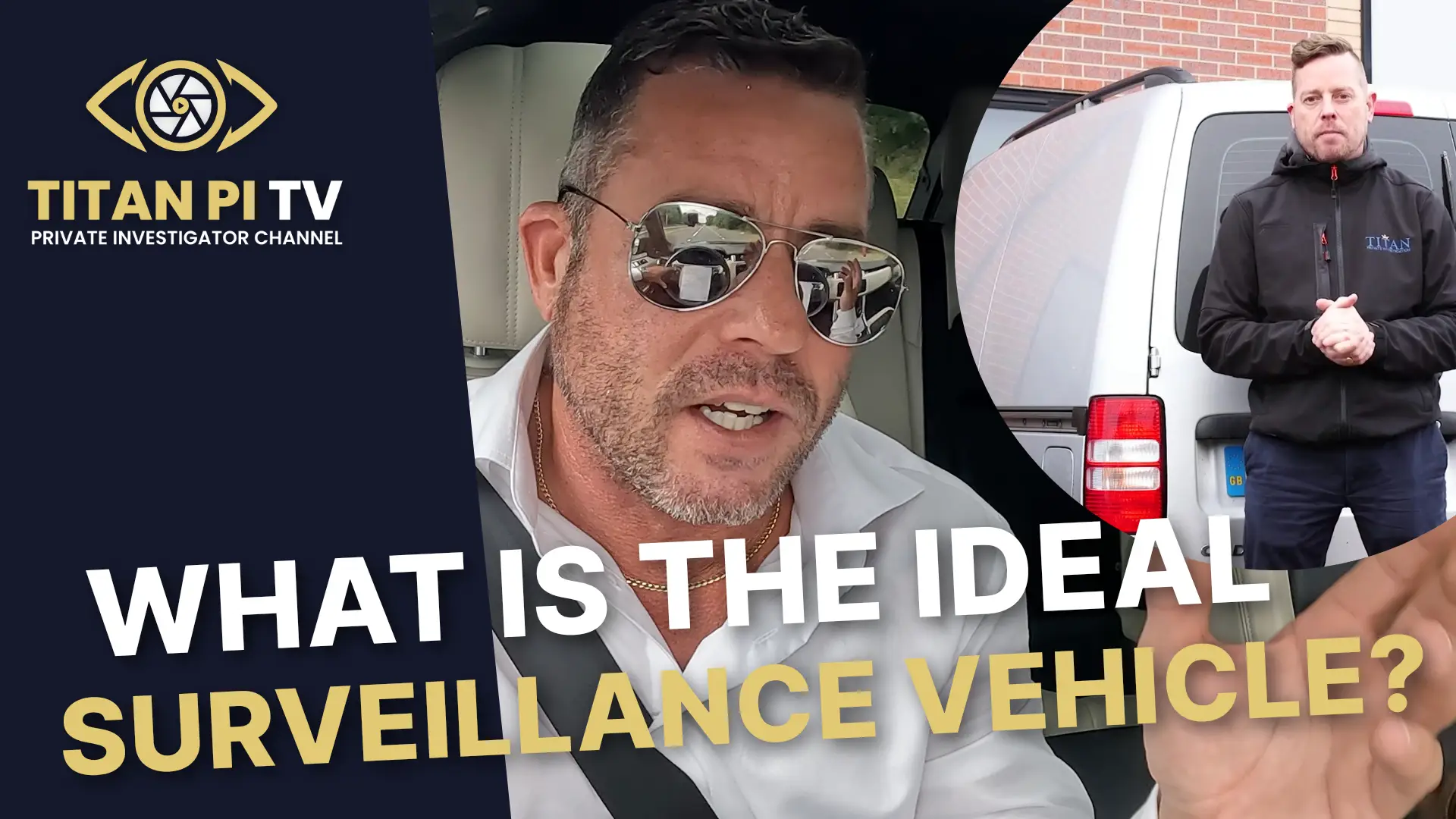
What is the ideal surveillance vehicle?
Simon Henson shares his expert advice on vehicles used for surveillance.
Choosing the right surveillance vehicle can make the difference between a successful operation and one that quickly becomes compromised. In the latest episode of Titan PI TV, host and Titan Private Investigation Limited Managing Director, Simon Henson, takes viewers behind the scenes of professional surveillance work to explain what investigators should consider before selecting a vehicle for operational deployments.
Drawing on decades of investigative experience, Simon explores one of the questions he is asked most frequently by aspiring and experienced surveillance operatives alike: “What is the ideal surveillance vehicle?”
While many people might assume the answer involves specialist equipment or expensive vehicles, Simon explains that the reality is quite the opposite. Successful surveillance relies on remaining unnoticed, blending into everyday environments and choosing practicality over prestige.
An Inside Look at Professional Surveillance
Broadcast from Titan Private Investigation Limited’s headquarters in Derby, Titan PI TV continues to provide viewers with an insight into the day-to-day realities of running a modern investigation agency.
With ten offices stretching from Truro in the South West to Manchester in the North West, Titan has built a national reputation for delivering professional private investigation services across the UK. Through the weekly series, Simon shares practical advice, real operational experience and guidance designed for both industry professionals and anyone interested in the world of investigations.
This week’s episode focuses on one of the most important assets available to a surveillance operative—the vehicle.
Why Choosing the Right Vehicle Matters
According to Simon, there are several reasons why investigators regularly ask for advice on surveillance vehicles.
For newcomers entering the industry, purchasing a vehicle represents a significant financial investment. Making the wrong decision can prove costly, particularly when the vehicle becomes an integral part of daily operational work.
Others may already be working within surveillance and simply be looking to replace an ageing vehicle with something better suited to modern operations.
There are also experienced investigators returning to surveillance after spending time away from the industry. Vehicle trends change over time, and what may once have been considered ideal may no longer be the best option today.
Whatever the reason, Simon stresses that selecting the correct vehicle should never be an afterthought.
Car or Van? The First Major Decision
One of the first questions surveillance operatives must answer is whether a car or van is better suited to their work.
Simon explains that there is no universally correct answer, as both have distinct advantages depending on the nature of the operation and the investigator’s personal preferences.
A standard passenger car offers excellent all-round visibility, making it easier to observe activity from multiple directions. With appropriate legally compliant window tinting on the rear windows, an operative can work discreetly from the back of the vehicle while maintaining a wide field of view.
Additional screening inside the vehicle, such as privacy curtains positioned behind the front seats, can further reduce the risk of silhouettes being seen from outside during prolonged observations.
Vans, meanwhile, provide different operational benefits.
Their additional interior height often makes long surveillance deployments more comfortable, and the absence of side windows can help conceal the investigator from anyone approaching the vehicle.
However, Simon points out that vans also have limitations. Without side windows, observation angles become more restricted, particularly when compared with a conventional estate car or hatchback. At night, heavily tinted rear windows can further reduce visibility, meaning operatives may rely primarily on the windscreen for observation.
Some investigators overcome these limitations by fitting discreet camera systems that feed live images to internal monitors, allowing observations to continue without drawing attention.
Ultimately, Simon believes the decision comes down to personal preference and operational requirements rather than there being a single perfect solution.
The Five Essential Characteristics of a Surveillance Vehicle
Regardless of whether investigators choose a car or van, Simon outlines five essential qualities every surveillance vehicle should possess.
1. Choose an Everyday Vehicle
Perhaps Simon’s most important piece of advice is remarkably simple.
The ideal surveillance vehicle should be completely ordinary.
Rather than driving something luxurious, sporty or unusual, investigators should select a model that blends effortlessly into everyday traffic.
Vehicles such as the Ford Focus and similar mainstream family cars are excellent examples because they are so common that they become almost invisible.
The goal is simple: if a subject notices the vehicle, it should not stand out enough to be remembered.
Exotic sports cars, prestige SUVs or rare models naturally attract attention and therefore increase the likelihood of compromising an operation.
Professional surveillance is about becoming part of the background.
2. Stick to Neutral Colours
Colour plays a surprisingly important role in surveillance.
Simon recommends selecting understated shades such as grey, silver or black rather than brighter colours.
A vivid yellow, bright red or similarly eye-catching vehicle naturally attracts attention and becomes easier for people to remember.
Using a light-hearted personal example, Simon jokes about his daughter’s habit of shouting “Yellow car!” whenever she spots one on the road. While humorous, the story perfectly illustrates an important surveillance principle.
Anything memorable increases risk.
Investigators should aim for vehicles that disappear into traffic rather than stand apart from it.
3. Comfort Matters During Long Operations
Surveillance work often involves patience.
Investigators may spend many hours conducting static observations while waiting for a subject to leave a property or arrive at a particular location.
During these lengthy deployments, comfort becomes far more important than many newcomers realise.
Simon explains that operatives require enough interior space to move comfortably, stretch periodically and manage the practical realities of remaining inside a vehicle for extended periods.
An estate car or compact van often provides significantly more usable space than a smaller hatchback.
Simon recalls using a Ford Focus Estate early in his surveillance career, praising its generous interior space and overall practicality during long observations.
4. Storage Space Is Essential
A surveillance vehicle is far more than simply transport.
It also functions as a mobile operational base carrying everything an investigator might require throughout the day.
Professional surveillance operatives often transport multiple cameras, lenses, covert recording equipment, spare clothing, footwear, bags and a wide variety of props used to adapt their appearance during changing circumstances.
Some may even carry specialist equipment such as drones where appropriate and lawful to use.
Because of this, Simon emphasises that a generous luggage compartment is vital.
Small vehicles with limited boot space can quickly become impractical.
He specifically highlights smaller cars such as the Mini Cooper as presenting operational challenges due to their restricted storage capacity and limited access to equipment.
Organisation also plays an important role.
Keeping equipment stored in labelled containers allows operatives to retrieve items quickly without unnecessary delays when circumstances change unexpectedly.
5. Avoid Personalised Registration Plates
One of Simon’s strongest recommendations concerns personalised number plates.
While they may appeal to vehicle owners, they are generally unsuitable for surveillance work.
Personalised registrations naturally attract curiosity.
People often find themselves attempting to decipher what the plate spells or represents, making the vehicle more memorable than one displaying a standard registration.
Simon uses his own vehicle as an example, explaining that its registration references Titan, making it completely unsuitable for operational surveillance because anyone noticing it is likely to remember it.
Even seemingly harmless personalised registrations based on initials can unintentionally attract attention.
The objective is always to reduce the number of features that make a vehicle memorable.
Understanding Personal Triggers
An interesting point raised during the episode concerns what Simon describes as “triggers”.
Certain combinations of letters, numbers or visual details can catch an individual’s attention because they have personal meaning.
He recalls an example involving the letters “ORG” on a registration plate.
While meaningless to most people, the sequence had significance to one surveillance operative due to previous professional experience, making it something they noticed repeatedly.
Although investigators cannot predict every personal trigger someone might have, they can eliminate obvious ones by selecting plain vehicles with standard registrations and neutral appearances.
Blending In Is the Ultimate Goal
Throughout the episode, Simon repeatedly returns to one fundamental principle.
The best surveillance vehicle is not necessarily the fastest, newest or most expensive.
Instead, it is the one nobody notices.
Professional surveillance depends upon remaining inconspicuous.
Every design choice—from vehicle model and colour through to registration plates and storage layout—should contribute towards blending naturally into the surrounding environment.
Rather than impressing others, the ideal surveillance vehicle quietly becomes part of the everyday landscape.
Titan PI TV Continues to Educate the Industry
As Titan PI TV continues its long-running series, Simon Henson remains committed to sharing practical knowledge gained from years of operational experience.
The programme has become a valuable resource for aspiring investigators, experienced surveillance professionals and members of the public with an interest in private investigations.
At the end of the episode, Simon encourages viewers to suggest future discussion topics in the comments, helping shape upcoming episodes and ensuring the content continues to answer the questions that matter most to the investigative community.
For anyone considering a career in surveillance—or simply curious about how professional investigators work behind the scenes—this latest instalment offers an informative and refreshingly honest look at one of the profession’s most important tools.
Sometimes, as Simon demonstrates, success isn’t about standing out at all. It’s about becoming completely forgettable.
Watch the latest episode of Titan PI TV on YouTube to hear Simon Henson’s full insights into choosing the ideal surveillance vehicle, and subscribe to the channel for more expert advice, operational stories and behind-the-scenes perspectives from one of the UK’s leading private investigation agencies.
What’s Next on Titan PI TV?
Titan PI TV continues to grow steadily, with 3,700 subscribers and counting – a testament to the appetite for straight-talking guidance in a complex field. If you found Simon’s insights useful, subscribe to the channel to catch future episodes. New content drops every Friday at 3:00 pm, offering grounded advice for investigators, agency owners, and professionals who work with them.
Thank you for reading, watching, or listening to this week’s blog post on Titan PI TV. For more expert advice and behind-the-scenes insights, subscribe to Titan PI TV on YouTube or download the Titan PI TV podcast wherever you get your podcasts. If you found this information helpful, please give us a thumbs up and subscribe to our channel. Stay tuned for more insights into the world of private investigations. Until next time, stay safe and keep learning!
Titan PI TV: Uncovering the Truth, One Investigation at a Time.