The Ideal Surveillance Vehicle: What Every Professional Investigator Needs to Know
Titan Investigations guide to what make the ideal surveillance vehicle
When it comes to covert investigation work, few decisions carry more operational weight than the choice of surveillance vehicle. It is not merely a matter of preference or budget — it is a strategic decision that can determine whether an operation succeeds or fails before the subject has even left their front door. For the experienced professionals at Titan Private Investigation Ltd, selecting and equipping the right vehicle is considered as fundamental as the training of the operative behind the wheel.
Private investigators across the United Kingdom face a unique set of challenges. Urban environments demand vehicles that can disappear into busy streets, whilst rural settings require something capable of blending into quieter roads without attracting curious glances. The surveillance vehicle, in every sense, is the operative’s office, observation post, and mobile kit room — all rolled into one. Getting that choice right is not a luxury; it is a professional necessity.
Car or Van? Understanding the Core Trade-Off
The first and most consequential decision any surveillance professional faces is whether to deploy a car or a van. Both vehicle types have genuine, well-established advantages in covert work, and neither automatically outperforms the other. The correct choice depends on the nature of the operation, the environment, the equipment being carried, and the working style of the operative.
The case for a car rests largely on visibility. A well-positioned car offers a remarkable 360-degree field of observation through its windows — front, rear, nearside, and offside. This all-round awareness is invaluable during static surveillance, where an operative may need to monitor movement from multiple directions simultaneously.
Rear window tinting further enhances a car’s suitability for covert work. Under current UK regulations, the rear side windows and rear windscreen may be tinted to a very dark level, provided the front windscreen and front side windows retain the legally required light-transmission levels. Operatives should always verify current UK legislation on tinted windows before making modifications. With appropriately dark rear tinting and a simple internal curtain or divider to prevent light bleed, an operative can sit in the back of a vehicle and remain virtually invisible to passers-by — even those who deliberately approach the vehicle for a closer look.
The case for a van, by contrast, is built on space, height, and the ability to create a more controlled working environment. Long-duration static operations — sometimes stretching across an entire shift or more — demand a degree of physical comfort and organisational space that a car simply cannot always provide. A van’s enclosed load area allows operatives to move slightly, manage equipment, take necessary breaks, and maintain focus without compromising their position.
The trade-off, however, is visibility. Standard panel vans lack side windows, which restricts lateral observation. At night, even tinted rear glass can make filming through the back problematic, leaving the front windscreen as the primary workable angle. That said, a well-configured van can overcome many of these limitations — roof-mounted cameras feeding a discreet internal monitor, for example, can extend observation capability without requiring open windows or obvious positioning.
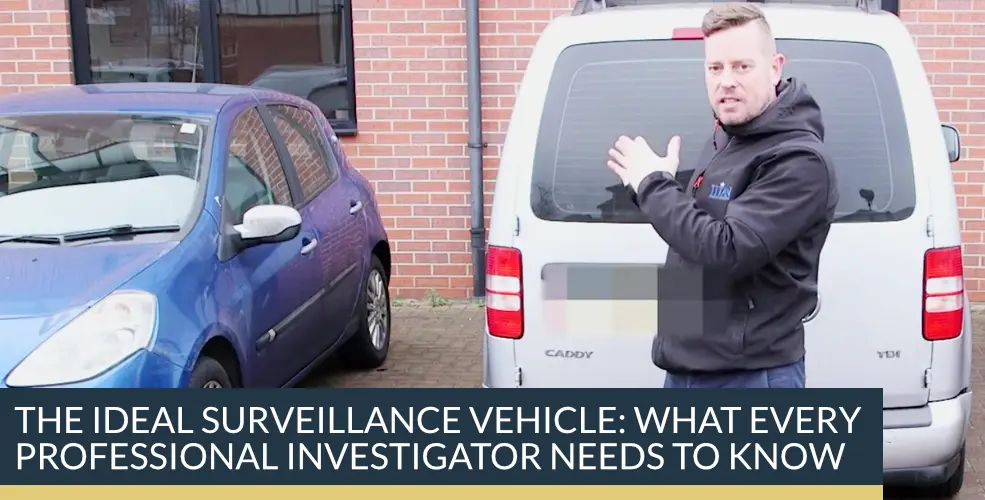
A practical middle ground often favoured by experienced investigators is the car-derived van — models such as the Volkswagen Caddy or the Peugeot Partner. These vehicles combine the familiarity and road presence of a regular car with the additional internal space of a light commercial vehicle. They attract little scrutiny, are common on UK roads, and offer enough room to organise equipment effectively.
Ultimately, the car-versus-van debate is as subjective as any professional tool preference. What matters is that the chosen vehicle serves the operation — not the operative’s personal taste.
The Five Pillars of an Effective Surveillance Vehicle
Beyond the fundamental car-or-van decision, five practical principles should guide every surveillance vehicle selection. These are not guidelines — they are operational standards that seasoned investigators apply consistently.
1. Choose a Vehicle That Blends Into the Background
The single most important quality of any surveillance vehicle is its invisibility — not literal invisibility, but the capacity to be seen without being noticed. The vehicle should be a model that appears on every road, in every car park, and outside every building across the country without prompting a second glance.
A Ford Focus estate is a textbook example. It is ubiquitous, practical, and carries no associations with wealth, prestige, or unusual purpose. Other widely seen family cars, hatchbacks, and estate models can serve equally well. The defining criterion is volume: if the model is everywhere, it will be overlooked everywhere.
Conversely, a prestige vehicle — however appealing — is entirely counterproductive. A luxury saloon or sports car is memorable by design. People notice it, remark upon it, and remember it. In surveillance, being remembered by anyone connected to the subject — or by the subject themselves — can destroy an operation that has taken considerable time and resource to establish.
2. Colour: Choose Dull, Stay Dull
Colour is a trigger. Human perception is naturally drawn to bright, saturated hues, and that instinct works directly against covert operations. Surveillance vehicles should always be finished in subdued, forgettable shades — grey, silver, dark blue, or black are consistently recommended.
A bright yellow car, a vivid red estate, or a distinctive two-tone finish will be noticed and retained in memory far more readily than a silver hatchback. Colour is the first thing a casual observer registers about a vehicle; making it dull ensures the vehicle registers as background rather than foreground. For those operating across multiple assignments in different areas, a neutral colour also reduces the risk of a subject or their associates recognising the same vehicle across different locations over time.
3. Comfort Enables Effectiveness
Surveillance is physically demanding in ways that are not immediately obvious to those outside the profession. An operative may spend eight, ten, or twelve hours in a single position, managing equipment, monitoring movement, recording activity, and maintaining concentration — often without being able to leave the vehicle.
The working environment must support this. There must be sufficient room to sit without becoming cramped, to manage food and hydration, to access kit without contortion, and to remain alert throughout. Discomfort degrades attention and increases the likelihood of errors or missed activity at critical moments.
A van naturally offers more space, but a well-chosen estate car can also provide a comfortable and effective platform. The key is ensuring that the vehicle’s interior dimensions genuinely accommodate the demands of the work — not just for a short drive, but for an extended operational deployment.
4. Boot Space Is an Operational Requirement
The equipment carried by a professional investigator is far more extensive than most people assume. A fully equipped operative may carry multiple changes of clothing, alternative footwear, caps and accessories, DSLR still cameras, covert video equipment, organised prop kits, and in some cases an unmanned aerial vehicle where regulations and circumstances permit.
Each element serves a purpose. Alternative clothing and footwear allow an operative to alter their appearance if they need to leave the vehicle and conduct a brief mobile follow. Prop items — litter-picking equipment, Royal Mail-style clothing, or other contextually appropriate accessories — provide cover stories for being in a particular location. These items must be stored securely, organised for rapid access, and protected from damage.
A small boot is, therefore, not merely an inconvenience — it is a genuine operational liability. A vehicle that cannot carry the tools required for the job is not the right vehicle for the job, regardless of its other qualities.
5. Avoid Private Registration Plates Without Exception
Private registration plates are one of the most common, and most avoidable, mistakes in surveillance work. The problem is psychological as much as practical: people read number plates. Even when a plate is not immediately obvious, the human instinct to decode patterns, names, and words means that a distinctive registration will be noticed, read, and retained.
A plate containing a company name, a recognisable word, initials, or any meaningful combination is entirely unsuitable for covert use. A registration including the name “Titan,” for example, would create an immediate association and give any observer a clear reason to remember the vehicle — and potentially link it to the organisation conducting the surveillance. Even seemingly innocuous combinations can be memorable to specific individuals. A standard-format registration, by contrast, gives nobody cause to look twice. It is forgettable, which is precisely what is required.
Preparing Your Vehicle for Deployment: A Professional Checklist
Before any surveillance vehicle is committed to an operation, a thorough pre-deployment review should confirm the following:
- Is it common? The model should appear regularly on UK roads without distinction.
- Is it forgettable? Distinctive styling, unusual body types, and prestige marques should be avoided.
- Is the colour neutral? Grey, silver, black, or dark blue offer the lowest visual profile.
- Can an operative work in it for hours? Static observation demands genuine comfort and adequate room.
- Can it carry all necessary equipment? Boot space and internal organisation should support full kit deployment.
- Does it offer suitable observation angles? Consider window tinting, side visibility, and any additional camera provision.
- Does it carry a standard registration plate? Any memorable, distinctive, or decoded plate must be removed from operational use.
The Titan Approach to Professional Surveillance
At Titan Private Investigation Ltd, every operation begins with the right tools, the right training, and the right vehicle. Our experienced investigators operate across the United Kingdom, conducting surveillance assignments with the discretion, precision, and professionalism that clients in both the private and corporate sectors depend upon.
Whether you require evidence for legal proceedings, suspect fraudulent activity, need to locate a missing person, or require discreet background enquiries, our team brings the expertise, equipment, and judgement to deliver results — safely, legally, and without compromise.
Contact Titan Private Investigation Ltd today to discuss your requirements in confidence. Our team is available to provide guidance, outline our services, and advise on the most appropriate approach for your situation. Visit our website or call us directly — because when discretion matters, experience makes all the difference.
Titan Private Investigation Ltd operates in full compliance with UK law and professional standards. All surveillance activity is conducted lawfully and ethically.
About Titan Private Investigation Ltd
Titan Private Investigation Ltd is a leading provider of corporate and private investigation services in the UK. Based in Derby, the company serves clients nationwide, offering a full range of investigative solutions including surveillance, fraud investigation, digital forensics, and more. We are a private investigation agency with a reputation for professionalism, discretion, and delivering results. Titan is the trusted partner of choice for businesses seeking to protect their interests and ensure compliance.
London Private Investigators – Call the Titan Investigations London Office 020 39046622
Birmingham Private Investigators – Call the Titan Investigations Birmingham Office 0121 7162442
Cambridge Private Investigators – Call the Titan Investigations Cambridge Office 01223 662022
Derby Private Investigators – Call the Titan Investigations Derby (Head Office) 01332 504256
Leeds Private Investigators – Call the Titan Investigations Leeds Office 0113 4574066
Leicester Private Investigators – Call the Titan Investigations Leicester Office 0116 2436520
Nottingham Private Investigators – Call the Titan Investigations Nottingham Office 0115 9646950
Manchester Private Investigators – Call the Titan Investigations Manchester Office 0161 3023008
Sheffield Private Investigators – Call the Titan Investigations Sheffield Office 0114 3499400
Truro Private Investigators – Call the Titan Investigations Truro Office 01872 888706
Alternatively, you can contact us directly using our fully confidential contact form at enquiries@titaninvestigations.co.uk or chat directly using our Live Chat facility, and one of our UK Private Investigators will get right back to you.