Advanced Lie Detection or Truth Validation using EyeDetect
Titan Private Investigation Ltd advanced EyeDetect lie detection service
Titan Private Investigation Ltd has expanded its suite of specialist investigative services with the introduction of EyeDetect – a cutting‑edge lie detection, or “truth validation”, system that uses eye‑tracking technology rather than the traditional polygraph. Already widely adopted in parts of the United States and mainland Europe, EyeDetect is now emerging in the UK as a modern, less intrusive and faster way to help establish the truth in both private and corporate investigations.
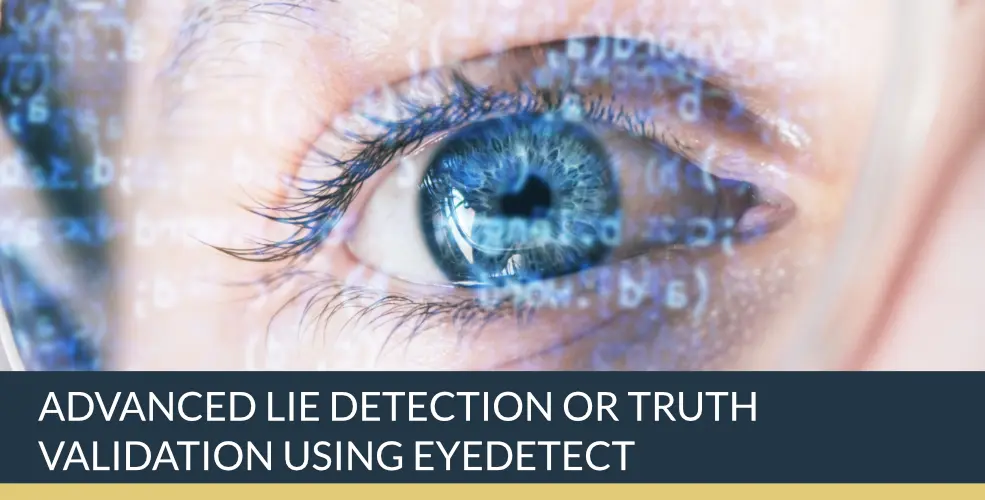
At its core, EyeDetect measures tiny, involuntary changes in the eye and pupil to help determine whether a person is being truthful. These physiological responses are virtually impossible to consciously control and can be analysed rapidly by specialised software. When the test has been properly prepared, professionally administered and interpreted in context, EyeDetect can be a highly effective component in an evidence‑gathering strategy.
Titan Private Investigation is among the first UK investigation firms to make this technology available to both individual and business clients as part of a structured, professional investigative process.

A modern alternative to the polygraph
For many years, the polygraph – commonly known as the “lie detector test” – has been the most recognised tool for credibility assessment. Polygraph examinations monitor several physiological indicators, such as blood pressure, breathing rate and galvanic skin response, while a trained examiner asks a series of questions. While still useful in some contexts, polygraph testing can be lengthy, physically uncomfortable for some individuals, and, in some people’s eyes, somewhat intimidating.
EyeDetect offers a more modern alternative. Instead of attaching sensors to the body, the system relies on high‑resolution cameras embedded in a computer monitor. As the subject reads and responds to statements displayed on screen, EyeDetect records a variety of eye‑related indicators that research has associated with cognitive load and deception. These can include:
- Pupil dilation and constriction
- Blink rate and blink duration
- Subtle changes in gaze direction
- Reading and response time patterns
Because it is non‑invasive and largely automated, EyeDetect can feel less confrontational than the traditional polygraph. Subjects simply sit in front of a screen, wear headphones, and respond to clear, pre‑agreed written statements by clicking true or false.
When EyeDetect is most useful
In Titan’s experience, EyeDetect is particularly well‑suited to focused, single‑issue enquiries where clear, tightly defined statements can be written in advance. Two broad categories dominate current demand.
Matrimonial and infidelity investigations
In the private sphere, EyeDetect is often commissioned in the context of relationship difficulties or suspected infidelity. Clients may want clarity on a specific set of issues such as:
- Whether a partner has engaged in sexual contact with another person since the relationship began
- Whether there has been full sexual intercourse outside the relationship
- Whether online, financial or social contact with a particular individual has occurred in the way alleged
The questions in these cases are generally straightforward and factual. For example, an EyeDetect statement in a matrimonial case may read:
“Since you began this relationship, you have not had sexual intercourse with anyone else.”
The subject then responds with either “true” or “false”. Because EyeDetect is optimised for narrow, clearly defined issues, it can be particularly helpful where a couple wishes to move forward but needs a structured, professional process to address specific allegations.
Corporate and workplace investigations
In corporate settings, EyeDetect can assist with internal investigations where a defined group of individuals may have had the opportunity to commit a particular act. Typical scenarios include:
- Internal theft, such as stock or cash shortages
- Unauthorised disclosure of confidential information or trade secrets
- Data breaches where access logs indicate a small pool of possible sources
- Misuse of company assets or systems by a limited group of employees
When a business is dealing with potential misconduct, it is often essential to resolve matters quickly, discreetly and fairly. EyeDetect allows a small cohort of people to be screened in a relatively short period of time, helping management and HR teams to identify where further in‑depth investigation may be necessary.
In both matrimonial and corporate domains, EyeDetect should be viewed as one tool among several – a way to add structure and objective measurement to situations often dominated by emotion, suspicion and incomplete information.

How EyeDetect works in practice
Despite the sophisticated science behind the software, the EyeDetect test procedure itself is straightforward.
- The subject is seated at an EyeDetect terminal
The test is conducted on a dedicated computer with a specialised monitor housing sensitive cameras. The subject sits comfortably in front of the screen in a quiet environment. Headphones are provided to ensure privacy and to standardise how questions are heard. - Statements are presented one at a time
Instead of being asked open questions, the subject is presented with statements. These are read out through the headphones and shown simultaneously on the screen. The subject cannot advance until the statement has been read in full. This control over timing is deliberate, ensuring that responses are captured under consistent conditions. - The subject responds “true” or “false”
Once the statement has been fully presented, the subject uses a mouse or similar input device to indicate whether they believe the statement is true or false. There is no opportunity to explain, qualify or argue at this stage; the system is designed to capture clean, binary responses. - Control items and target statements
Each test contains two types of item:- Control items, which are used by the software to learn how the subject’s eyes behave when they are answering truthfully or deceptively.
- Target statements, which are the core statements the client wants to have assessed. These usually number between one and three per test.
- Continuous monitoring of micro‑changes
Throughout the test, the cameras track the subject’s pupils and eye movements. The software analyses these measurements in real time, using established algorithms to detect patterns associated with cognitive effort and possible deception. - Automated scoring and reporting
At the end of the session, the EyeDetect system generates a score indicating the likelihood that the subject’s responses were truthful. In the hands of an experienced examiner, this result is then considered alongside case background and any other available evidence.
Practical requirements and limitations
To ensure the integrity and fairness of an EyeDetect session, certain conditions must be met.
Number of questions
Each EyeDetect test can contain a maximum of three key statements for validation. Clients may choose to test a single statement, two statements or all three. If additional issues need to be covered, a separate test must be commissioned. This limitation is not arbitrary; it is central to maintaining focus and statistical reliability. Attempting to cover too many matters in one sitting dilutes the clarity and usefulness of the result.
Age and literacy
Subjects must be:
- At least 16 years of age, and
- Sufficiently literate to read and understand the statements presented on the screen.
Because the system relies on both reading and listening to fairly precise wording, it is not suitable for very young subjects or for those who are unable to comprehend written English to a reasonable standard.
Voluntary participation
EyeDetect cannot and should not be forced upon anyone. The individual being tested must agree to participate of their own free will. This is essential both ethically and practically; a reluctant or highly resistant subject is unlikely to engage with the process in a way that produces meaningful data.
No pauses once started
Once the EyeDetect test begins, it runs continuously until completion. There is no facility to pause and resume later. However, the protocol does include brief, programmed breaks – for example, a rest period of around 15 minutes during the session – to minimise fatigue and maintain concentration.
Understanding EyeDetect accuracy
As with any scientific tool, it is important to interpret EyeDetect results with an informed and realistic understanding of accuracy.
Independent evaluations and manufacturer data typically place EyeDetect’s accuracy figures in the mid‑to‑high eighties when used in isolation. In practice, this is often quoted in the region of 86–88% accuracy. When EyeDetect is used in conjunction with a professionally conducted polygraph examination, combined accuracy figures are often cited in the 98–99% range.
One experienced examiner remarked:
“For me, it’s 100% – I’ve tried to beat it and I can’t.”
This kind of professional testimony reflects the high degree of confidence experienced practitioners may develop in the system. However, Titan Private Investigation is careful to emphasise that no investigative tool is infallible. Even very high accuracy rates imply a small margin for error.
For that reason:
- EyeDetect results should never be treated as a sole determinant of guilt or innocence.
- Outcomes should always be weighed alongside other evidence, witness accounts and broader context.
- Professional judgement remains paramount; EyeDetect is a powerful aid, not a replacement for experienced investigators and decision‑makers.
Time, cost and logistics
One of EyeDetect’s main advantages is its speed and relative simplicity compared with the polygraph.
- Test duration: An EyeDetect session usually lasts around 30 minutes, significantly shorter than a typical polygraph appointment, which can run to 1 hour 45 minutes or more, once pre‑test interview and post‑test discussion are included.
- Cost: Titan Private Investigation currently charges £480 including VAT for an EyeDetect examination (commonly itemised as £400 plus VAT). This reflects not only the test itself but also specialist test design, licensing costs and professional interpretation of the results.
- Location: Examinations are most often conducted from a central office – for example, Titan’s Derby facility – where the EyeDetect terminal is securely installed. This controlled environment helps ensure consistency and confidentiality. In some circumstances, and subject to assessment, Titan can arrange for an examiner to travel to a suitable alternative location, provided it meets the necessary technical and privacy requirements.
- Travel charges: Where travel is required, clients should expect a mileage cost to be applied – typically around 45p per mile for the round trip – in addition to the standard test fee.
- Payment terms: Payment is required at the point the test is commissioned. This is because licences for each test, along with the work of drafting and uploading bespoke statements, must be purchased and completed in advance. This approach also secures the booking and ensures that time and resources are specifically reserved for the client’s case.
Preparing and writing an effective EyeDetect test
The reliability of an EyeDetect examination depends heavily on how well the core statements – the issues to be tested – are defined and written. Titan follows a structured workflow to protect the client’s interests and ensure clarity:
- Initial consultation with the client
An experienced investigator or examiner meets with the client to understand the background, objectives and any relevant evidence. The purpose here is to identify precisely what needs to be proved or disproved. In matrimonial matters, this might be limited to a single incident or timeframe; in corporate cases, it could focus on a specific leak or theft. - Drafting the target statements
Once the crucial points have been identified, these are converted into clear, factual statements that the subject can answer with “true” or “false”. Precision is critical. Dates, locations, names and definitions (for example, what constitutes “sexual contact”) may need to be carefully specified to avoid ambiguity. - Professional review and test construction
A qualified EyeDetect examiner or test writer reviews the draft statements to ensure they are:- Grammatically clear and unambiguous
- Focused on a single issue per statement
- Free from emotional language or assumptions
- Suitable for the EyeDetect format
- Subject briefing and consent
Before testing, the subject is briefed about the process, has the opportunity to ask questions, and is asked for their informed consent. It is important that they understand what is being tested and what is not. - Test session and result interpretation
The subject completes the test as described above. Afterwards, the examiner reviews the automated report, considers it in light of the case circumstances, and provides a clear, plain‑English explanation to the commissioning client.
Rushing or glossing over the question‑design phase is one of the most common reasons for dissatisfaction with any form of lie detection. Vague or poorly worded statements can lead to results that are difficult to interpret or fail to address the client’s real concerns. Titan therefore encourages clients to invest sufficient time at the outset to define exactly what they want to establish.
Ethical and practical considerations
Titan Private Investigation takes seriously the ethical responsibilities that accompany any form of truth‑validation technology. Used sensitively, EyeDetect can help reduce uncertainty, support fair decision‑making and even restore trust. Used recklessly, it could risk compounding conflict or being seen as coercive.
To guard against this, Titan:
- Emphasise voluntary participation and informed consent.
- Encourages clients to view EyeDetect as supporting evidence, not the sole arbiter of truth.
- Advises on appropriate communication of results, particularly in sensitive matrimonial cases where emotions may run high.
- Works to maintain confidentiality at every stage, from booking through to reporting.
In corporate settings, EyeDetect is generally integrated into a wider HR or investigative process, with clear documentation of how and why individuals were selected for testing. In the private sphere, clients are briefed carefully on the implications of positive or negative indications and on how to use the information responsibly in discussions with partners, legal advisers or therapists.
EyeDetect as part of a broader investigative strategy
While EyeDetect is an impressive technological development, Titan stresses that successful investigations almost always rely on a combination of methods. Depending on the case, EyeDetect may be used alongside:
- Traditional investigative work, such as surveillance or background enquiries
- Digital forensics and data analysis
- Witness interviews and statement comparison
- Polygraph examinations, where appropriate
By integrating EyeDetect into this broader toolkit, Titan can offer clients a more rounded, evidence‑based perspective rather than relying on any single test or technique.
Next steps: arranging an EyeDetect test with Titan
For individuals or organisations considering EyeDetect, the first step is usually an informal discussion to establish whether the technology is appropriate to the situation.
Clients who wish to explore EyeDetect further can visit www.titaninvestigations.co.uk and navigate to the Services section, looking under Lie Detector or EyeDetect. There, prospective clients can find further information and contact details to arrange a confidential consultation.
During that initial conversation, Titan’s investigators will:
- Clarify what you are hoping to establish.
- Explain whether EyeDetect is suitable for your specific circumstances.
- Outline the likely costs, logistics and timescales.
- Discuss how best to frame the key statements for testing.
With careful planning and professional administration, EyeDetect offers a fast, minimally invasive and scientifically grounded option for truth validation – whether the context is a deeply personal question of fidelity or a complex internal corporate investigation. Used responsibly, it can provide valuable clarity and help move difficult situations towards resolution.
About Titan Private Investigation Ltd
Titan Private Investigation Ltd is a leading provider of corporate and private investigation services in the UK. Based in Derby, the company serves clients nationwide, offering a full range of investigative solutions including surveillance, fraud investigation, digital forensics, and more. We are a private investigation agency with a reputation for professionalism, discretion, and delivering results. Titan is the trusted partner of choice for businesses seeking to protect their interests and ensure compliance.
London Lie Detector Tests – Call the Titan Investigations London Office 020 39046622
Birmingham Lie Detector Tests – Call the Titan Investigations Birmingham Office 0121 7162442
Cambridge Lie Detector Tests – Call the Titan Investigations Cambridge Office 01223 662022
Derby Lie Detector Tests – Call the Titan Investigations Derby (Head Office) 01332 504256
Leeds Lie Detector Tests – Call the Titan Investigations Leeds Office 0113 4574066
Leicester Lie Detector Tests – Call the Titan Investigations Leicester Office 0116 2436520
Nottingham Lie Detector Tests – Call the Titan Investigations Nottingham Office 0115 9646950
Manchester Lie Detector Tests – Call the Titan Investigations Manchester Office 0161 3023008
Sheffield Lie Detector Tests – Call the Titan Investigations Sheffield Office 0114 3499400
Truro Lie Detector Tests – Call the Titan Investigations Truro Office 01872 888706
Alternatively, you can contact us directly using our fully confidential contact form at enquiries@titaninvestigations.co.uk or chat directly using our Live Chat facility, and one of our UK Private Investigators will get right back to you.