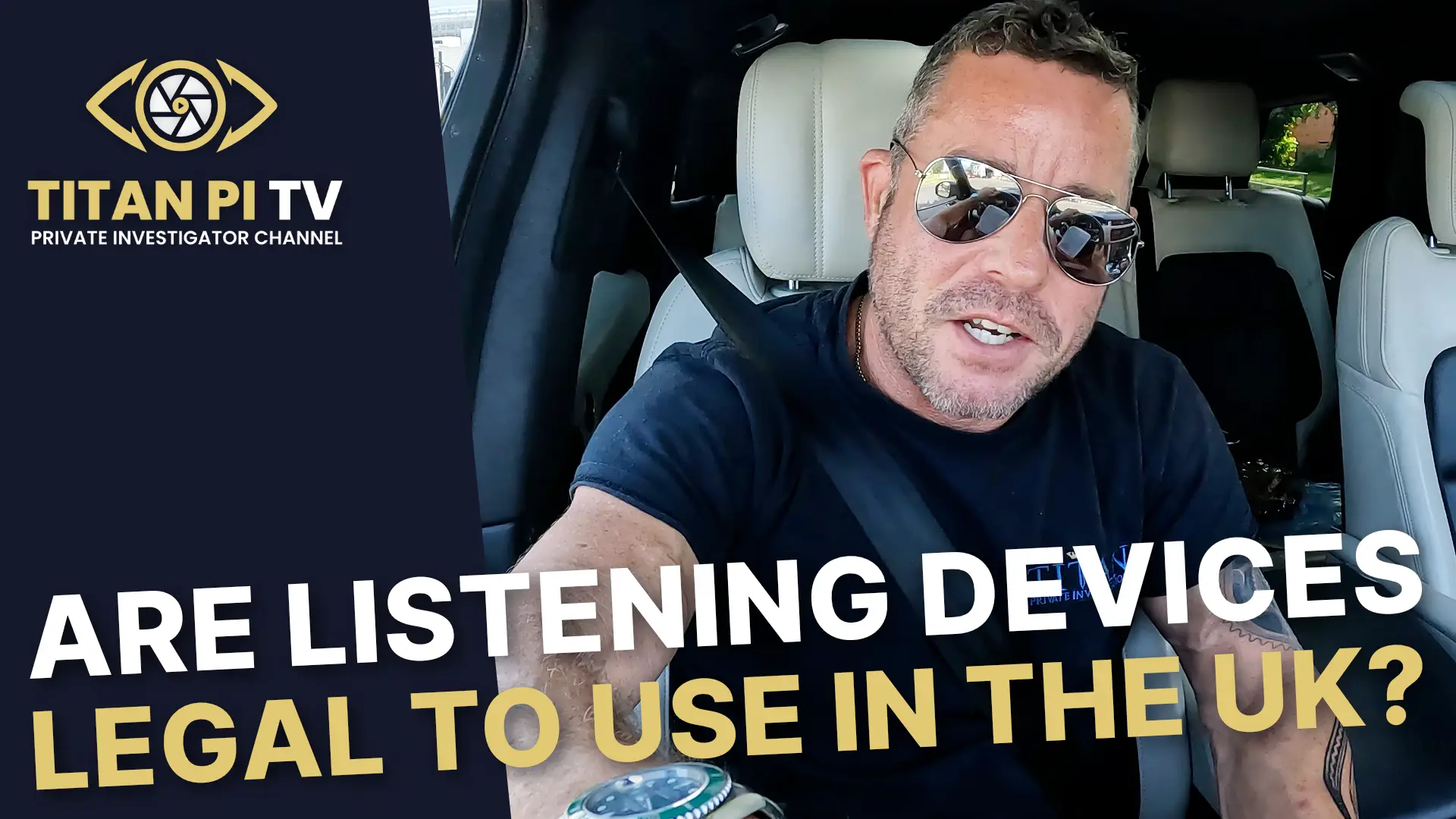
Are Listening Devices Legal to use in the UK?
Simon Henson explains the law and common misconceptions around listening devices.
In the latest episode of Titan PI TV, Titan Private Investigation Ltd Managing Director and host Simon Henson tackles one of the most frequently asked questions received by the agency: are listening devices legal to use in the UK?
Although the title you provided refers to “What is the difference between Counter and Anti-Surveillance?”, the transcript itself covers the legality of listening devices in the UK. The article below has therefore been based on the transcript provided.
With myths, misinformation and legal misunderstandings surrounding covert surveillance becoming increasingly common online, Simon breaks down what private investigators can and cannot legally do, the laws that genuinely apply, and the situations where the use of listening devices may be lawful.
Drawing on real-world examples from Titan Investigations’ day-to-day casework, the episode provides valuable insight into the complex legal and ethical considerations surrounding covert audio surveillance.
The Simple Answer Is… It Depends
One of the biggest misconceptions surrounding listening devices is that they are either completely legal or completely illegal.
According to Simon, neither assumption is correct.
Instead, the legality depends entirely upon the circumstances, ownership, privacy expectations and the purpose for which the device is being used.
Before examining practical examples, Simon addresses two pieces of legislation that people frequently quote incorrectly.
Two Laws That Are Often Misunderstood
One of the most common mistakes made by members of the public is assuming that the Regulation of Investigatory Powers Act 2000 (RIPA) governs private investigations.
Simon explains that this is simply not the case.
RIPA was created to regulate investigatory powers exercised by public authorities such as government departments, local authorities and other public bodies. It does not generally regulate the activities of private individuals instructing a private investigation company.
As Simon points out, if someone hires Titan Investigations to undertake lawful investigative work, RIPA is generally not the legislation that determines whether a listening device can be deployed.
He then turns to another frequently misunderstood piece of legislation: the Data Protection Act 2018.
Again, Simon explains that many people wrongly believe the Act automatically applies to every situation involving recordings or surveillance.
In reality, the legislation primarily concerns organisations, businesses and those processing personal data in a professional capacity. For many private domestic situations involving individuals, the Act may not apply in the way people often assume.
However, where investigations involve businesses or organisations, data protection considerations become significantly more important.
Why Do People Request Listening Devices?
Simon explains that Titan receives enquiries involving listening devices for a wide variety of reasons.
Some of the most common include:
- Suspected relationship infidelity.
- Concerns that an employee is sharing confidential information with competitors.
- Family disputes.
- Attempts to establish whether someone is lying.
Each scenario raises different legal considerations, meaning there is no universal answer.
Instead, every request must be assessed individually.
Relationship Investigations
One of the most common enquiries involves people who suspect their partner is having an affair.
Clients often believe their partner is speaking to another person over the telephone and ask whether a listening device can be installed inside the vehicle to capture those conversations.
Simon explains that ownership becomes a crucial factor.
Where the vehicle is jointly owned, perhaps through marriage or joint finance, there may be circumstances where installation could be legally considered.
However, that alone is not enough.
Every investigation undertaken by Titan Investigations is subject to what Simon refers to as a Legitimate Interest Assessment (LIA).
This assessment considers several important legal principles, including:
- Whether the proposed investigation is lawful.
- Whether it is genuinely necessary.
- Whether it is proportionate.
- Whether there is a less intrusive method of obtaining the required evidence.
Only after considering all of these factors would Titan determine whether a particular investigative tactic is appropriate.
What About Inside the Home?
The conversation then moves to residential properties.
Again, the answer depends on where any device is placed.
Simon explains that communal areas within a jointly occupied property are treated very differently from areas where privacy is naturally expected.
For example, living rooms, kitchens and shared spaces may present different legal considerations from private areas such as bedrooms or bathrooms.
Bedrooms and bathrooms are places where individuals have a clear expectation of privacy.
Installing covert recording devices in these locations risks far more serious legal consequences and may raise issues extending beyond simple surveillance, including allegations relating to privacy violations.
Simon makes it clear that these locations are completely unsuitable for covert audio recording.
Importantly, he notes that the same principles extend beyond listening devices to covert video recording equipment as well.
Corporate Investigations
The episode then turns to business investigations.
Suppose an employer suspects an employee is sharing commercially sensitive information with a competitor while driving a company vehicle or working within company premises.
Can listening devices simply be installed?
According to Simon, the answer is generally no unless appropriate workplace policies already exist.
Businesses wishing to monitor company vehicles or workplaces must have clear written policies explaining that monitoring may take place.
Employees should have been informed of those policies and acknowledged them.
Without those safeguards, evidence obtained through covert listening devices may be extremely difficult, if not impossible, to rely upon in employment tribunals, civil litigation or criminal proceedings.
In other words, even if valuable information is obtained, the method used to obtain it could undermine its usefulness.
Family Disputes
Family disagreements are another area where Titan receives enquiries.
Simon describes situations where clients wish to understand conversations taking place within their own homes during ongoing family disputes.
Again, ownership and occupation of the property become important considerations.
Where someone owns or rents the property and recording takes place within appropriate communal areas, there may be lawful circumstances in which such monitoring can occur.
However, each case requires careful assessment before any action is taken.
Catching Someone Out
Some clients simply want proof that another individual is lying.
While emotions often run high in these situations, Simon emphasises that Titan cannot ignore legal boundaries simply because a client believes they have been deceived.
If the proposed investigation involves entering property without lawful authority or placing equipment inside assets belonging solely to another individual, the answer will always be no.
Where Titan Draws the Line
Simon provides several examples of situations Titan Investigations refuses to undertake.
If an estranged partner owns a vehicle outright, Titan will not enter that vehicle to install a listening device.
Even if a former partner still possesses spare keys, investigators cannot lawfully use them to gain access.
Similarly, investigators will not enter a property where they have no legal authority to be.
Doing so could amount to trespass or potentially even burglary.
Simon stresses that Titan will never break the law on behalf of a client.
That principle remains central to the company’s investigative standards.
Considering Less Intrusive Alternatives
One of the recurring themes throughout the episode is proportionality.
Just because a client wants a particular investigative tactic does not mean it represents the most appropriate solution.
The Legitimate Interest Assessment specifically considers whether less intrusive alternatives could achieve the same objective.
In many cases, Simon explains, there are better options available.
Could a Lie Detector Test Be the Better Option?
One alternative discussed is the use of polygraph examinations.
Titan Investigations regularly conducts lie detector tests, particularly in relationship disputes where allegations of infidelity have arisen.
Unlike covert surveillance, however, polygraph examinations require the voluntary participation of the person being tested.
No one can be forced to undergo a lie detector examination.
Simon explains that a standard examination typically lasts around 30 minutes and focuses on three agreed questions.
Where all parties are willing, this can often provide a quicker, less intrusive and potentially more cost-effective solution than deploying covert investigative techniques.
The same principle can also apply in workplace investigations and certain family disputes.
The Importance of Professional Advice
Perhaps the biggest takeaway from this week’s episode is that surveillance law is rarely straightforward.
Many assumptions made by members of the public are based on inaccurate information found online or misunderstandings of legislation that does not actually apply to private investigations.
Ownership, consent, legitimate interest, privacy expectations and proportionality all play an important role when determining whether a listening device may be lawfully used.
Professional investigators must balance a client’s objectives against the law at every stage of an investigation.
Final Thoughts: Listening Devices
Simon concludes by reminding viewers that listening devices are neither automatically legal nor automatically prohibited.
Each case must be assessed on its individual facts, with careful consideration given to property ownership, legal authority, privacy expectations and whether less intrusive methods could achieve the same objective.
For anyone considering covert surveillance, the message is clear: obtaining professional legal and investigative advice before taking action is essential.
As always, Simon encourages viewers to like the episode, subscribe to Titan PI TV and return next week for another behind-the-scenes look at the fascinating world of private investigations.
What’s Next on Titan PI TV?
Titan PI TV continues to grow steadily, with 3,700 subscribers and counting – a testament to the appetite for straight-talking guidance in a complex field. If you found Simon’s insights useful, subscribe to the channel to catch future episodes. New content drops every Friday at 3:00 pm, offering grounded advice for investigators, agency owners, and professionals who work with them.
Thank you for reading, watching, or listening to this week’s blog post on Titan PI TV. For more expert advice and behind-the-scenes insights, subscribe to Titan PI TV on YouTube or download the Titan PI TV podcast wherever you get your podcasts. If you found this information helpful, please give us a thumbs up and subscribe to our channel. Stay tuned for more insights into the world of private investigations. Until next time, stay safe and keep learning!
Titan PI TV: Uncovering the Truth, One Investigation at a Time.