Want a new career as a Private Investigator?
Titan Private Investigation Ltd Opens Doors to a New Generation of Surveillance Operatives
As the new year begins, many people across the UK find themselves reassessing what they want from work. For some, it’s about greater independence. For others, it’s the need for practical skills, better earning potential, or a role that feels genuinely purposeful. In that mix of ambition and uncertainty, private investigation has emerged as a realistic and increasingly popular career change—particularly for those drawn to surveillance work.
Titan Private Investigation Ltd, a national investigation company with ten offices across England, says it is seeing sustained demand for trained surveillance operatives. In response, the company is continuing to run its Titan SFJ five-day surveillance course in Derby, offering a structured route into operational work for people who want a hands-on role that combines discipline, observation, discretion and sound judgement.
Unlike many career pivots that require years of retraining or the risk of starting from scratch, surveillance work offers something rare: a direct pathway from training to paid operational deployments—provided candidates take preparation seriously and learn the job properly.

Why surveillance has become one of the most in-demand investigation specialisms
Private investigation covers a broad landscape—everything from tracing and background enquiries to corporate investigations and fraud support. Yet operational surveillance remains one of the most consistently requested services.
There are practical reasons for this. Surveillance provides contemporaneous, objective evidence that can help clients make decisions, resolve disputes, or progress legal matters. It is also highly situational, which means clients typically need trained people on the ground rather than purely desk-based support. When a subject is mobile, when timings change unexpectedly, or when evidence must be captured lawfully and accurately, experience and competence matter.
A Titan spokesperson said surveillance is “the operational engine room” of modern investigation work: “When clients instruct surveillance, they’re paying for results that stand up to scrutiny. That means operatives who understand not only what to do, but what not to do—legally, ethically and practically.”
This emphasis on standards is one reason surveillance training is essential. The public perception of investigation work can be shaped by fiction and social media, but the reality is technical. Surveillance is methodical. It requires clear procedures, strong communication discipline, and the ability to make fast decisions without drawing attention to yourself or placing anyone at risk.
A practical, hands-on career change—without forcing an all-or-nothing leap
One of the most appealing elements of surveillance as a career path is flexibility. Not everyone can—or should—leave a current job overnight. Titan’s approach is designed to support gradual entry into the profession.
With the right training and ongoing support, operatives can build part-time income around an existing role, taking deployments on evenings, rest days or annual leave. Over time, some choose to transition fully, while others maintain surveillance work as a second income stream.
This flexibility is not just convenient; it is operationally realistic. Surveillance work can be unpredictable. Some assignments are long-term and regular. Others are shorter, time-sensitive deployments. Being able to accept work as it fits your life—especially in the early stages—can be an advantage for both operative and company.
Why surveillance training is essential if you want to earn in this industry
Titan is clear on one point: if you want to make money in private investigation, you need to be surveillance trained.
Surveillance is frequently the highest operational demand in the sector. Proper training makes you operationally effective, legally compliant and marketable to clients. It also reduces risk—both for you and for the client instructing the work.
Titan states that with the right skillset, operatives can expect to earn around £30 per hour, and that every deployment carries a five-hour minimum, meaning a guaranteed £150 per deployment. For people looking to supplement their income without committing to a full-time salaried role, that is a straightforward, transparent proposition—provided you can deliver the standard required on live operations.
But pay rates tell only part of the story. In surveillance, credibility is currency. Clients and instructing professionals want reliable evidence captured in a lawful manner. That means operatives who can produce court-ready logs, follow instruction, remain discreet, and handle the practical realities of long hours, changing environments and shifting subject behaviour.
The Titan SFJ five-day course: structure, availability and cost
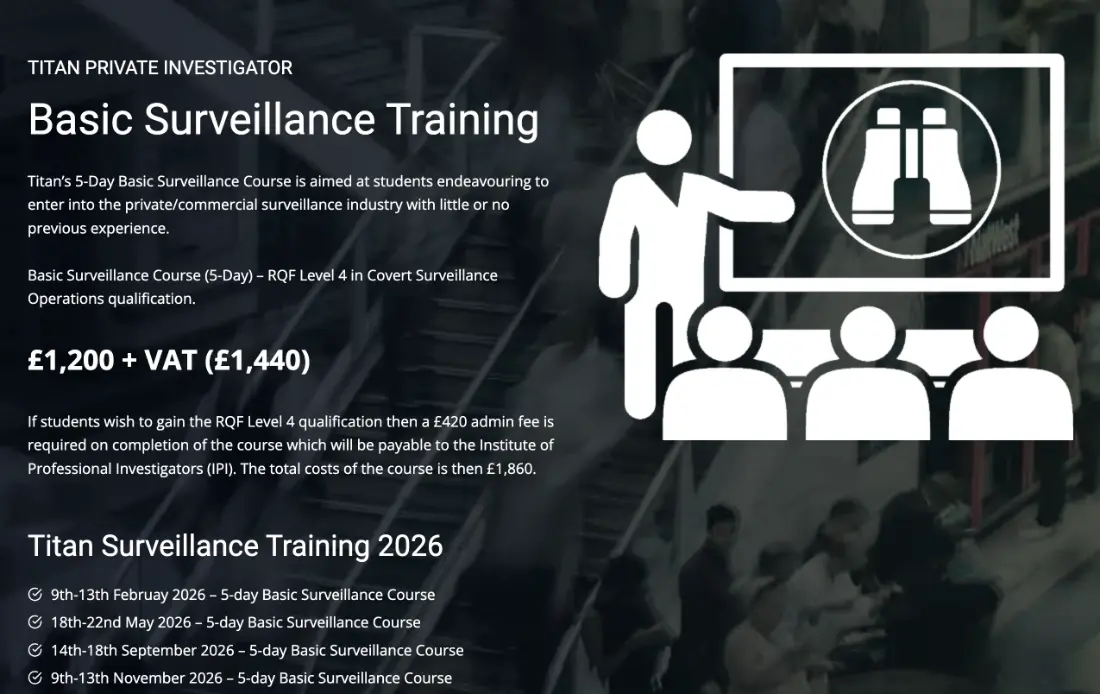
Titan’s SFJ five-day surveillance course is delivered in Derby and runs four times a year. The course is deliberately limited in size, reflecting the practical nature of the training and the need for close instruction.
Each course has a minimum of six learners and a maximum of 12, meaning no more than 48 new operatives are trained annually. For learners, that has a direct benefit: more attention, more feedback, and more realistic practical exercises rather than purely classroom-based theory.
Scheduled course dates
- 9–13 February
- 18–22 May
- 14–18 September
- 9–13 November
Price
- £1,200 + VAT = £1,440
For learners who want an additional formal recognition, an optional qualification is available:
- Optional SFJ RQF Level 4 (via the Institute of Professional Investigators): extra £420 payable to the IPI
Titan notes that the RQF Level 4 sits above an A level in standing and can add weight to a CV, but stresses that it is not essential to start working. In surveillance, operational competence is the differentiator: can you perform under pressure, follow procedure, stay within the law, and produce accurate evidence?
What the course covers: legal, practical and evidential competence
The course is built around the reality of live surveillance deployments. Rather than focusing on abstract scenarios, it combines legal context with hands-on practice and evidential discipline so learners leave with a clear understanding of what professional surveillance looks like.
Key modules include:
- Surveillance law
Understanding what is lawful and what is not under English and Welsh law. This is a foundation module, because poor legal understanding can compromise evidence and expose operatives and clients to risk. - Surveillance principles
How to dress appropriately, change appearance where appropriate, and conduct yourself discreetly. In practice, “blending in” is less about gimmicks and more about behaving naturally for the environment you’re in. - Radio and mobile communications
Radio use, fallback to mobile apps, and communication discipline. Clear, concise comms reduce errors, keep teams coordinated, and prevent avoidable losses. - Cover stories (legends)
Plausible reasons for being in a location to avoid attracting suspicion. The goal is not theatre; it’s credibility and calmness if approached. - Subject identification
The three recognised methods of positively identifying a subject. Getting identification wrong is one of the quickest ways to undermine an operation, so learners are trained to confirm rather than assume. - Foot surveillance
ABC formation (sometimes ABCD), corner clearing and paced observation techniques. Foot work is where discipline shows: spacing, timing, positioning and patience. - Mobile surveillance
Vehicle tracking, convoy methods and higher-speed control techniques. This is a core skillset for modern surveillance, where subjects may travel quickly and unpredictably. - Public transport operations
Practical exercises across two counties to simulate real-world movement. This reflects the reality that subjects do not operate within tidy boundaries—and neither can surveillance teams. - Anti-surveillance and counter-surveillance
How to spot hostile surveillance and mitigate it. Understanding counter-surveillance behaviours helps operatives maintain discretion and avoid escalating risk. - Motorcycle awareness
Understanding a motorcyclist’s role within a convoy system. This module supports team coordination and safety. - Stop and plot procedures
Sterile cocoons around a subject using pneumonics like veno (visual, enter, nearside, offside) and posted for vehicle stops. These procedures are designed to control risk and reduce mistakes when a subject stops unexpectedly. - Multi-storey car parks
Procedures and safety when subjects use complex parking environments. These settings can be high-risk for losses if teams lack a plan. - Evidential logs
Writing contemporaneous logs, making corrections properly, debriefing and sign-off procedures so evidence is court ready. Many newcomers underestimate the importance of logs; in reality, a strong log can be as important as footage. - Loss procedures
How to react when a subject is lost, using the HELP mnemonic (honest early call location procedure) to recover them. Losses happen; what matters is how you respond, communicate and recover. - Motorways and service areas
Landmark-based techniques and responsibilities when approaching services. These environments change quickly, and errors compound fast without procedure. - Static observation points
Setting up observation, capturing entry/exit images and ensuring legal evidential footage with recoverable time-date stamps.
Together, these modules aim to produce operatives who can contribute to a professional team, rather than simply “knowing the basics”. In operational work, the basics—done correctly and consistently—are what keep you effective.
Essential equipment and vehicle guidance: practical, economical and effective
Titan’s equipment advice is notably grounded. New operatives sometimes assume they need expensive, exotic kit to look the part. In reality, the priorities are reliability, evidential integrity and discretion.
Essentials include:
- A covert camera or camcorder that produces recoverable evidential footage with reliable time-date stamping. The key is that footage must be dependable and usable, not merely “good enough for social media”.
- A suitable vehicle
Titan advises avoiding garish colours and choosing something with plenty of on-road presence, ideally with rear window tints. Crucially, you do not need an exotic car. A normal, non-attention-grabbing vehicle is often the best option because it blends into everyday traffic and neighbourhoods.
The message is simple: modest kit, paired with real training and discipline, is enough to become operational.
The Titan Grow Student Aftercare programme: where training becomes work-readiness
For many people, the biggest worry about retraining is what happens after the course ends. Titan addresses this through its Titan Grow Student Aftercare programme, designed to nurture trainees, assess readiness and—importantly—offer real work opportunities.
Aftercare provides a supportive environment where instructors and experienced operatives help embed skillsets and guide new operatives through live deployments. This matters because surveillance is a performance skill: you improve fastest when you apply techniques under real-world pressure with proper feedback.
On completion, learners are added to an operational resourcing group and can pick jobs in their geographical area. That structure supports gradual entry into the profession and allows people to build experience without feeling pushed into an immediate full-time leap.
Titan emphasises that this is not about throwing new operatives into the deep end. It’s about measured progression—learning to operate as part of a team, communicating effectively, producing accurate logs, and delivering evidence that meets professional expectations.
Practical earnings, flexibility and demand across England
With ten offices across England, Titan says there is a steady flow of work year-round. Like most industries, surveillance has natural peaks and quieter periods. Titan notes that demand can soften around Christmas, while long-term assignments can provide more stable earning patterns.
The operational proposition is clear:
- Rate: £30 per hour
- Minimum deployment: 5 hours (£150)
- Increase your geographical reach and you increase the volume of available work.
For prospective operatives, that last point is particularly important. Being willing to travel—within reason—often increases the number of deployments you can accept. As skills and confidence grow, many operatives find that their availability becomes a key factor in how quickly they can build momentum.
Who should consider this career change?
Surveillance work is not for everyone, and Titan is candid about the qualities that matter most.
If you are calm under pressure, comfortable working independently (and sometimes quietly for long periods), and willing to follow procedure, surveillance can be a strong fit. A professional manner is essential, as is the ability to communicate clearly and to write accurate evidential logs.
It also suits people who value practical competence over titles. In surveillance, results are built on small decisions: when to move, when to hold, what to record, what to say on comms, and how to remain unobtrusive. Done well, it is a craft.
For those coming from security, the armed forces, the emergency services, driving-based roles, or any job requiring discipline and situational awareness, the transition can feel natural—though training remains essential regardless of background.
How to apply
Titan encourages prospective learners to request full information and booking details by email:
- Email:
inquiries@titaninvestigations.co.uk
The training is delivered in association with the Institute of Professional Investigators and is focused on real-world skills learners will use from day one.
For people looking for a practical, well-supported route into surveillance work, Titan’s message is straightforward: take training seriously, learn the legal and evidential foundations properly, and use aftercare to build real operational confidence. Private investigation is varied, intellectually demanding and highly rewarding for those who commit to doing it professionally—and for many, this new year could be the start of an entirely new career.
About Titan Private Investigation Ltd
Titan Private Investigation Ltd is a leading provider of corporate and private investigation services in the UK. Based in Derby, the company serves clients nationwide, offering a full range of investigative solutions including surveillance, fraud investigation, digital forensics, and more. We are a private investigation agency with a reputation for professionalism, discretion, and delivering results. Titan is the trusted partner of choice for businesses seeking to protect their interests and ensure compliance.
London Private Investigator Training – Call the Titan Investigations London Office 020 39046622
Birmingham Private Investigator Training – Call the Titan Investigations Birmingham Office 0121 7162442
Cambridge Private Investigator Training – Call the Titan Investigations Cambridge Office 01223 662022
Derby Private Investigator Training – Call the Titan Investigations Derby (Head Office) 01332 504256
Leeds Private Investigator Training – Call the Titan Investigations Leeds Office 0113 4574066
Leicester Private Investigator Training – Call the Titan Investigations Leicester Office 0116 2436520
Nottingham Private Investigator Training – Call the Titan Investigations Nottingham Office 0115 9646950
Manchester Private Investigator Training – Call the Titan Investigations Manchester Office 0161 3023008
Sheffield Private Investigator Training – Call the Titan Investigations Sheffield Office 0114 3499400
Truro Private Investigator Training – Call the Titan Investigations Truro Office 01872 888706
Alternatively, you can contact us directly using our fully confidential contact form at enquiries@titaninvestigations.co.uk or chat directly using our Live Chat facility, and one of our UK Private Investigators will get right back to you.