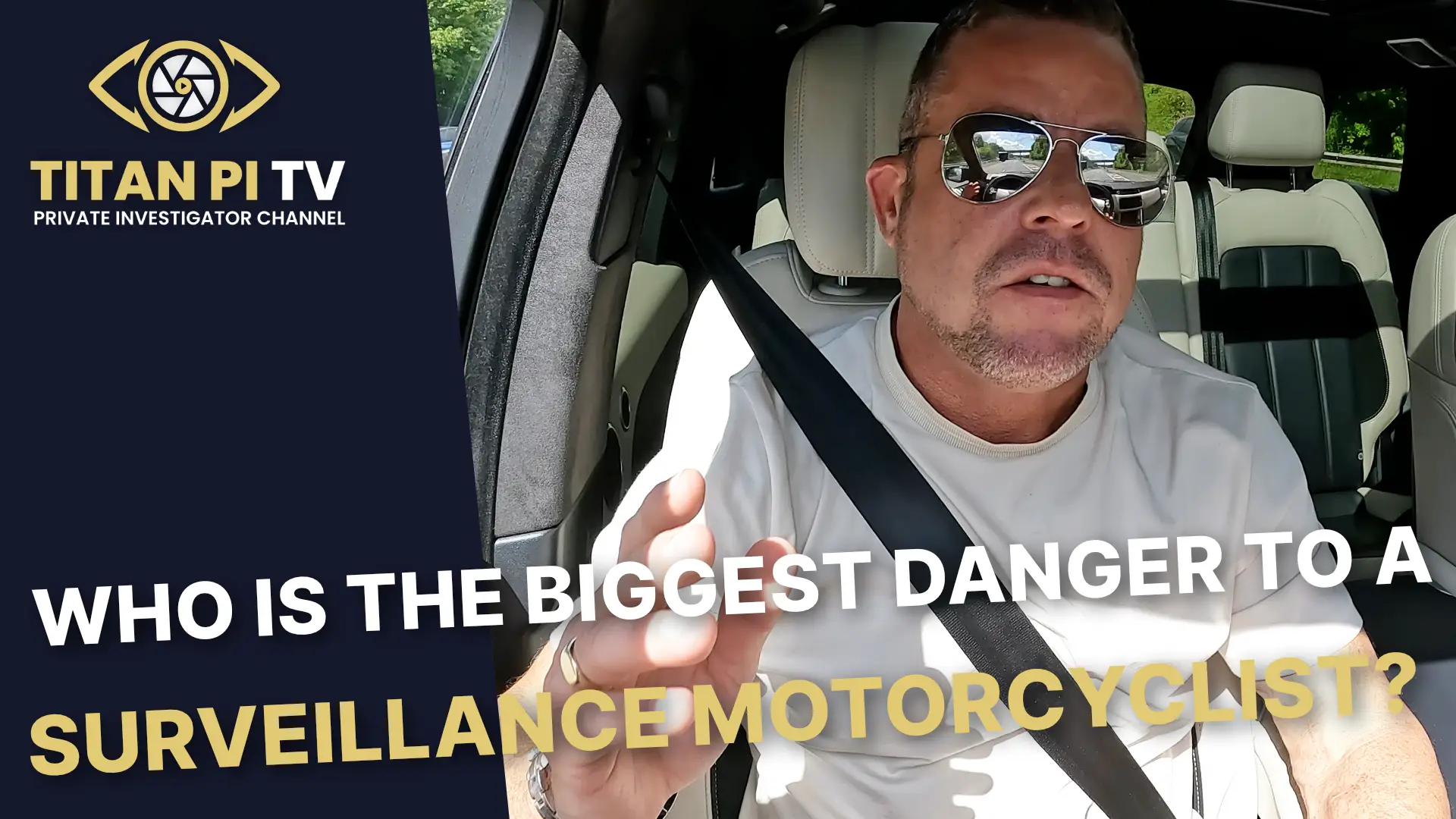
Who Is the Biggest Danger to a Surveillance Motorcyclist?
Two Wheels, One Mission: A Day in the Life of a Surveillance Motorcyclist
In the latest episode of Titan PI TV, host Simon Henson tackles a question that may surprise those outside the surveillance world: who poses the greatest danger to a surveillance motorcyclist? The obvious answer might be the subject under observation, unpredictable members of the public, or even the hazards of the road itself. Yet, as Henson explains, the reality is rather more uncomfortable. In many operational situations, the greatest risk to the surveillance biker can come from their own team.
It is a sharp, practical and highly relevant episode that shines a light on one of the most specialist roles in mobile surveillance. Drawing on operational experience, Henson explains how a surveillance motorcyclist works within a convoy, the split-second decisions required on the road, and the communication that allows the bike to support the wider team. At the same time, he underlines the dangers that arise when colleagues in cars fail to remain aware of the biker’s constant movement around them.
For those involved in surveillance, investigations or protective operations, the episode is a valuable reminder that the motorcyclist is both an asset and a vulnerability. For those new to the field, it offers an accessible insight into why the role demands such precision, awareness and teamwork.
The “yo-yo” role in a surveillance convoy
One of the most vivid images from the episode is Henson’s description of the bike working “like a yo-yo” up and down the convoy. That phrase neatly captures the fluid nature of the role. Unlike a vehicle that may remain in a relatively stable position, the surveillance motorcyclist is constantly adjusting distance, pace and placement in response to unfolding conditions.
According to Henson, a skilled biker listens closely to the live commentary coming over communications and uses that information to decide where they need to be. If the road conditions ahead suggest the convoy is likely to continue without disruption, the motorcyclist may sit further back, preserving distance and reducing unnecessary exposure. If, however, there are signs that the lead vehicle could lose the subject or face an obstruction, the biker may begin to move up the convoy in anticipation of being needed.
This constant repositioning is not random. It is informed by a trained reading of both the road and the team’s commentary. A motorcyclist who understands the flow of an operation will be listening for clues, assessing traffic conditions and planning ahead, often before any formal instruction is given.
That anticipatory mindset is what separates a competent rider from a truly effective surveillance motorcyclist.
Reading the road: late reds and stale greens
A key part of Henson’s explanation centres on traffic lights and what they reveal to a trained operator. He refers to two familiar but critical indicators: late reds and stale greens.
A late red suggests that lights have been on red for some time and may soon turn green. In that scenario, the bike will often remain behind the vehicle in the convoy, because there is a good chance the team will continue moving and the biker will not need to break cover or intervene.
A stale green, by contrast, signals potential trouble. If traffic lights have been green for a while, they may soon change to red. That creates the risk that the lead vehicle, described in the episode as the “eyeball” or IBOR vehicle, might get through while supporting vehicles do not. In that moment, separation becomes a real possibility.
This is where the biker becomes crucial. If they are “worth their salt”, as Henson puts it, they will already be moving up the convoy, getting into a stronger position in case they are required to take over the eyeball. In practical terms, that means being close enough to continue the surveillance if the rest of the convoy is cut off by traffic.
It is a highly dynamic function, and one that shows why the motorcyclist must be proactive rather than reactive. By the time the lights change, the decision window may already have passed.
The motorcyclist as the last resort
Another important point made in the episode is that the surveillance biker is often the last resort. They are not there to dominate the operation or constantly sit at the front. Their value lies in being able to step in when conventional mobile surveillance is at risk of failure.
If the entire convoy clears the junction without difficulty, the biker will typically move back out of view. That withdrawal is deliberate. It reduces exposure, helps maintain covert discipline and keeps the motorcyclist available for the next pinch point.
This economy of movement is central to good surveillance tradecraft. A biker who is overused, overexposed or poorly positioned risks compromising both themselves and the operation. The role therefore requires restraint as much as speed.
Yet while the biker is preserving cover, they are also navigating one of the most dangerous elements of the job: moving rapidly through their own convoy.
The real danger: your own surveillance team
The central message of the episode lands with striking clarity. Henson states that, by far, the surveillance team is the biggest risk to the motorcyclist.
It is a powerful observation because it runs against common assumptions. Most people would imagine the danger comes from external factors: aggressive drivers, sudden manoeuvres by the subject vehicle, poor weather, road layout or exposure to hostile attention. Those risks are real, of course. But Henson’s point is that the surveillance motorcyclist is especially vulnerable when fellow operatives in nearby vehicles forget that the bike may be filtering, overtaking, closing gaps or changing position at speed.
When the bike is moving up and down the convoy, particularly at points where the team may lose visual contact or encounter obstructions, the potential for collision rises sharply. A vehicle operative who changes lane, turns, brakes or manoeuvres without checking mirrors and blind spots may inadvertently put the biker on the floor.
It is a sobering reminder that operational awareness must extend beyond the subject and the environment. Team members must remain alive to the movements of their own assets. In surveillance, internal discipline can be just as important as external observation.
The three commands every biker is listening for
Henson also outlines the three core commands the surveillance biker is listening to over comms: make ground, come through and cancel.
The first, make ground, is effectively an early warning. It tells the biker that they may soon be needed. At that point, the rider judges where they are in relation to the convoy and begins moving into a more useful position. This may mean closing distance and preparing for a handover.
The second, come through, is the decisive instruction. This is when the team is handing the eyeball to the motorcycle. Henson describes the biker as coming through “at a rate of knots”, which captures both the speed and urgency involved. It is the moment when the rider must transition from support role to primary observation platform, often under pressure and in difficult traffic conditions.
The third, cancel, is equally important. It is the instruction that the bike is no longer required for that particular manoeuvre. For example, the biker may have been told to make ground because stale green lights suggested the convoy might split, only for the eyeball and back-up vehicles to get through cleanly after all. In that case, the biker is stood down and can reposition safely.
These commands may sound simple, but their execution demands high levels of concentration, roadcraft and mutual trust. Every instruction affects movement, spacing and risk. That is why communication quality and situational awareness are so vital.
A message for surveillance operatives: check, then move
Henson’s practical advice to surveillance teams is direct and easy to remember: always do a shoulder check and check your mirrors before manoeuvring.
That advice may sound basic, but in a live surveillance setting it is easy for operatives to become fixated on the subject, the route ahead or the commentary coming through the radio. When attention narrows, awareness of colleagues can slip.
Henson warns that points of loss, obstacles and obstructions are exactly where the bike is most likely to be coming through and changing position. In other words, the moments when a vehicle operator may be most stressed or distracted are also the moments when the surveillance motorcyclist may be closest and most vulnerable.
For any team using a bike asset, the message is clear: be ultra-aware. Good surveillance is not only about keeping eyes on the target. It is also about preserving the safety of every operative involved.
Training the role properly
The episode also serves as a strong introduction to Titan’s surveillance motorcyclist training pathway. Henson explains that Titan runs a five-day surveillance motorcyclist course in parallel with its basic surveillance course, allowing the biker and vehicle-based team to train together.
That integrated approach reflects the reality of the job. A motorcyclist does not operate in isolation; they function within a team environment, and their effectiveness depends on how well everyone understands the role.
On day one, the motorcycle course begins with a check ride to assess the rider’s ability. This ensures that standards are understood from the outset and gives instructors a clear picture of the rider’s starting point.
On day two, the focus turns to operational skills such as use of cover, making ground and taking parallel routes. These are the building blocks of effective mobile surveillance on two wheels.
By day three, riders join the basic surveillance course while the vehicle team is undertaking mobile surveillance exercises. From there, the training expands into real-world environments and scenarios, including public transport settings, motorways, A and B roads, motorway services and multi-storey car parks.
This practical emphasis is significant. Surveillance riding is not simply about handling a motorcycle well. It is about applying that riding ability within a covert operational framework, while communicating effectively and integrating with the wider team.
An additional skill and a commercial advantage
Henson also points to the professional benefits of adding surveillance motorcycling to an operative’s skillset. Titan’s course is priced at £1,500 plus VAT, with candidates bringing their own bike while Titan provides the communications equipment needed for the role.
Beyond the technical training, Henson frames the qualification as an extra string to your bow and a genuine USP. In a competitive investigations and surveillance market, being able to work as both a surveillance operative and a trained motorcyclist can open up more opportunities and, in many cases, command a higher rate of pay.
That commercial point will not be lost on professionals looking to broaden their capabilities. Specialist, deployable skills remain highly valuable across the sector, and surveillance motorcycling is clearly one of them.
Final takeaway
The latest Titan PI TV episode is a concise but revealing examination of a role that is often misunderstood. Simon Henson does more than explain what the surveillance motorcyclist does; he highlights the discipline, judgement and risk involved in doing it well.
Most striking of all is the episode’s central warning: the greatest danger to a surveillance biker may not be the subject, the public or the road ahead, but the very team they are supporting. That truth places responsibility on everyone in the convoy to communicate properly, manoeuvre carefully and never lose sight of where the bike may be.
For surveillance professionals, it is a timely operational lesson. For aspiring operatives, it is a compelling look at one of the most demanding roles in the field. And for Titan PI TV viewers, it is another insightful instalment from Simon Henson that blends practical advice with real-world experience.
If this episode is any indication, Titan PI TV continues to deliver the kind of focused, no-nonsense content that professionals can immediately take back into the field.
What’s Next on Titan PI TV?
Titan PI TV continues to grow steadily, with over 3,600 subscribers and counting—a testament to the appetite for straight-talking guidance in a complex field. If you found Simon’s insights useful, subscribe to the channel to catch future episodes. New content drops every Friday at 3:00 pm, offering grounded advice for investigators, agency owners, and professionals who work with them.
Thank you for reading, watching, or listening to this week’s blog post on Titan PI TV. For more expert advice and behind-the-scenes insights, subscribe to Titan PI TV on YouTube or download the Titan PI TV podcast wherever you get your podcasts. If you found this information helpful, please give us a thumbs up and subscribe to our channel. Stay tuned for more insights into the world of private investigations. Until next time, stay safe and keep learning!
Titan PI TV: Uncovering the Truth, One Investigation at a Time.